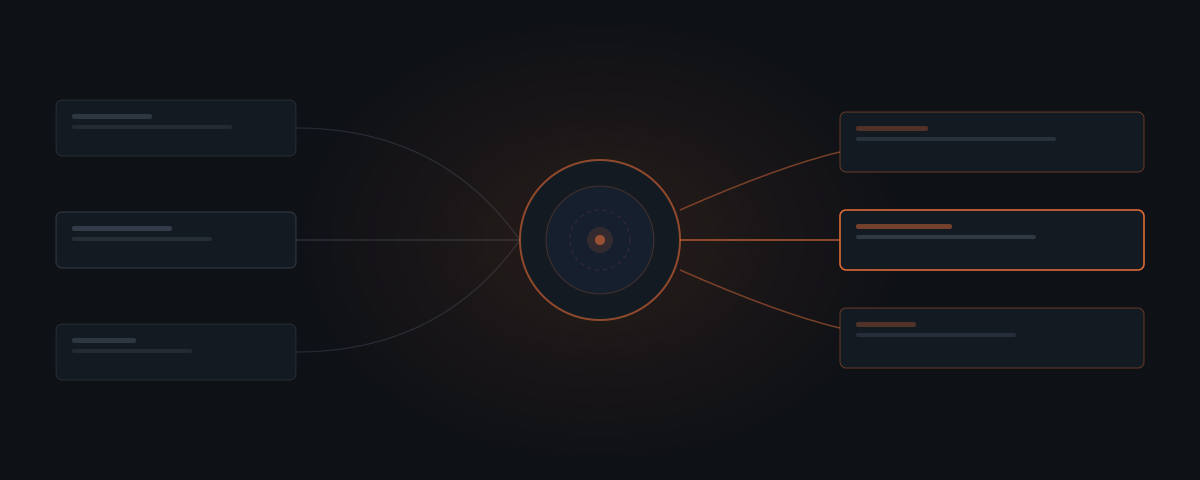
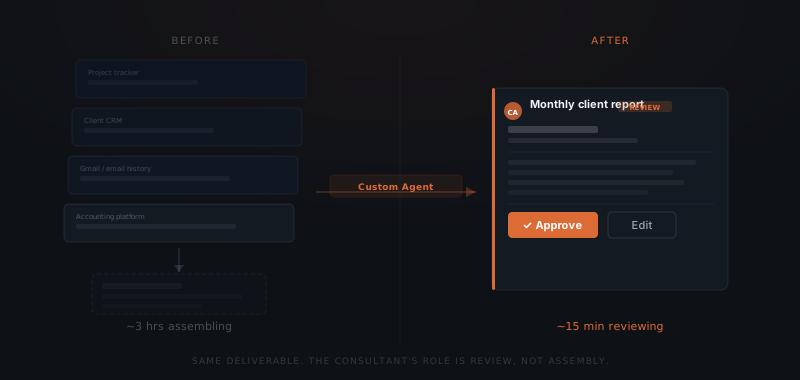
A fractional CFO spends three hours every Friday preparing for Monday client reviews: pulling data from three accounting platforms, assembling it into her standard report format, updating the client tracker. None of it requires her financial judgement. A custom agent handles that assembly layer — pulling the data, populating the report structure, and surfacing the draft for review. The analysis, the recommendations, and the client conversations stay with the CFO.
Professional services firms lose margin to prep work, not client work
Professional services firms sell expertise. The billable work is the analysis, the recommendation, the strategic advice. But every client engagement has a prep layer: pulling data from connected systems, formatting it into the right structure, drafting the communication that carries the analysis to the client.
That prep layer is not billable in most practices. Professional services firms using custom agents for research and report assembly report recovering 6–10 hours per consultant per week on non-billable prep work. That recovery directly increases the ratio of billable to total hours — which is the metric that determines firm margin.
The custom agent handles the prep. The consultant handles the expertise.
The table below shows where those non-billable hours go and what the agent recovers:
| Task | Weekly time without agent | Weekly time with agent | Hours recovered |
|---|---|---|---|
| Financial or data dashboard compilation | 2–3 hrs | 20 min review | 1.5–2.5 hrs |
| Monthly report formatting | 1.5–2 hrs | 15 min review | 1.25–1.75 hrs |
| Post-meeting action summaries | 1–1.5 hrs | 10 min review | 0.75–1.25 hrs |
| Deliverable follow-up sequences | 1–1.5 hrs | 15 min review | 0.75–1.25 hrs |
| Total per consultant | 5.5–8 hrs | ~60 min | 4.5–7 hrs |
For a fractional CFO with 8 retainer clients, recovering 6 hours per week is 24 hours per month of additional capacity — enough to take on one additional retainer at the same working hours.
What a custom agent handles in professional services delivery
A custom agent for a professional services firm handles three workflows that collectively account for most pre-engagement preparation time.
Research and data assembly — Before a client review, the agent pulls data from connected platforms — accounting tools, CRM, project trackers, or whatever the firm uses as its source of record — and assembles it into the structured format the consultant uses for that client type. The consultant reviews the assembled data, not the raw inputs from five separate systems.
Report drafting — The agent takes the assembled data and populates the firm's report template. For a fractional CFO practice using a standard monthly reporting format, the agent fills in the data fields, writes the structured commentary against each section, and flags any numbers that fall outside expected ranges. The consultant reviews and revises the draft rather than writing from a blank template.
Follow-up and communication — After a client engagement, the agent drafts the follow-up email: summarising decisions made, listing action items by owner, and setting the next check-in. The consultant approves before anything sends.
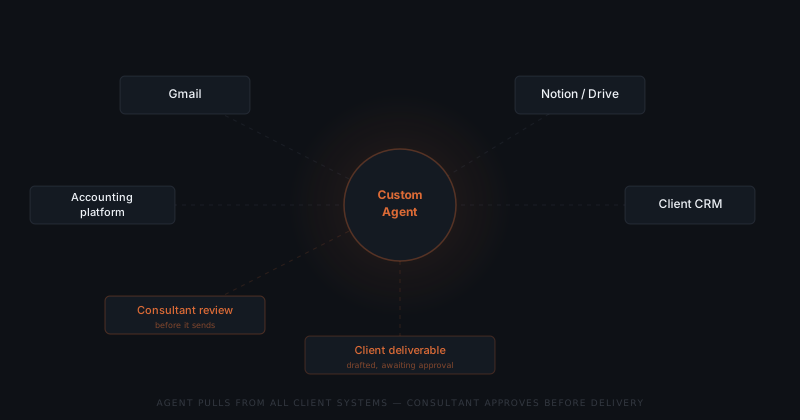
A custom agent for a professional services firm does not write the advice — it removes the data assembly work that precedes the advice. The consultant still evaluates, recommends, and decides. The agent removes the prep hours that do not require a consultant.
Why professional services workflows require custom integration
Off-the-shelf agents are built around generic business tool integrations — Gmail, Slack, Notion. Professional services workflows are built around the specific combination of tools each firm uses with each client.
A fractional CFO practice may connect to Xero for one client, QuickBooks for another, and a custom spreadsheet system for a third. An HR consultancy may have each client on a different HRIS. A compliance firm may pull data from regulatory databases alongside internal trackers. Each of these is a different integration requirement — one that off-the-shelf agents, built for common patterns, are not designed to handle.
A custom agent is built with integrations specific to the firm's tool stack and client configuration. The data mapping reflects how the firm actually stores and uses client data — not a generic assumption about what professional services firms do. That specificity is what allows the agent to produce a draft that a consultant can approve rather than rebuild.
The practical difference is visible in the first week. A generic agent configured for "financial reporting" produces a draft that uses standard accounting terminology and a generic report format. A custom agent configured for a specific fractional CFO practice produces a draft in that practice's specific template, with the client's own KPI labels, and commentary written against the specific metrics the client has been tracking for the past 12 months. The first draft requires a different kind of review — checking for accuracy, not rebuilding the structure.
The billable work is the judgement. The agent handles everything it takes to prepare the judgement.
What the consultant still controls
A custom agent does not replace what makes a professional services firm valuable. The financial analysis stays with the CFO. The strategic recommendation stays with the consultant. The advice that reflects understanding of the client's specific situation, history, and constraints stays with the person who built that understanding.
Client relationships stay with the consultant. The agent drafts the follow-up email; the consultant decides whether it accurately represents the engagement and what the client actually needs to hear. No client communication goes out without an explicit approval step.
The judgement calls — whether a number is a problem or a one-time variance, whether a client's plan needs a course correction, what the right recommendation is given everything the consultant knows — stay with the consultant. The agent handles the work that precedes the judgement, and the approval step ensures that no output reaches a client without that judgement applied.
What building a custom agent for your practice involves
A professional services custom build typically covers two to three workflows: data assembly and report drafting for the primary deliverable type, plus follow-up communication. The core integrations are the firm's primary data sources (accounting platform, HRIS, or project tracker), the document or report destination (Notion, Google Drive, or a client portal), and Gmail or Outlook for communication.
The build maps the firm's actual data structure and report format, connects to the specific tools used, encodes the report logic and follow-up templates in prompts, and configures the approval layer. A single-practice build for two workflows typically takes four to eight weeks.
For cost, see what a custom agent actually costs. For teams working out whether a workflow is ready to hand off, see how to know if a business process is ready to hand to an agent.
What the first month looks like for a professional services agent
Week one is close review. Every draft — financial summary, status update, follow-up email — is reviewed by the consultant before anything sends. The correction rate is typically 30–40% in week one: the agent produces structurally correct drafts, but the tone, depth, and client-specific framing need adjustment. Each correction updates the brief.
By week three, the correction rate on the most common task types drops below 15%. The financial summary for the firm's most active client type — the one the brief was written to match — reaches send-ready quality with minor edits. Newer client types and edge cases take longer.
By month three, the consultant's review time per deliverable has dropped from 30–45 minutes of correction to 5–10 minutes of final check. The brief has been updated two or three times based on real patterns from the first month of operation. The agent's output reflects the firm's actual client base, not the test cases it was configured against.
The metrics to track in the first month: correction rate per deliverable type (target: declining week over week), consultant review time per draft (target: under 10 minutes by week four), and escalation rate to manual handling (target: under 10% by week four). If any of these do not improve by week three, the brief requires revision before the second month of operation.
What professional services firms get wrong when implementing a custom agent
Insufficient data source mapping. A financial summary that pulls from Xero but misses a supplementary Google Sheet the CFO uses as a source of truth produces an incomplete draft the consultant has to supplement manually. Mapping all data sources before the build starts is a prerequisite — not something to discover in week one.
One brief for multiple client tiers. A practice with enterprise and SMB clients on different reporting cadences and detail levels needs separate briefs. A single brief calibrated for the enterprise client produces drafts that are over-detailed for SMB clients and vice versa.
Waiting too long to update the brief. The brief is accurate at the point when it is written. Three months later, one client has changed their KPI set, another has added a new entity structure, and a third has requested a different report format. Without a named brief owner and a defined update process, these changes accumulate and the agent's draft quality degrades without a clear cause.
The right maintenance cadence for a professional services agent is a brief review triggered by any client-facing process change — not a fixed quarterly schedule. When a client changes their reporting requirements, the brief is updated that week. When the firm adopts a new report template for a client tier, the brief is updated before the next report cycle. Keeping the brief current is the single most cost-effective maintenance practice for a professional services deployment.
Frequently asked questions
What does a custom agent do for a professional services firm? A custom agent handles the research-to-draft pipeline: pulling client data from connected platforms, assembling it into the firm's report structure, and surfacing the draft for consultant review. The agent removes data assembly time before billable engagement work — not the judgement, advice, or client relationship.
Which professional services firms benefit most from a custom agent? Firms with a repeatable delivery format — a standard monthly report, a consistent follow-up structure, a defined research process — benefit most. The agent is built around that format. Firms with highly bespoke deliverables for every engagement have a narrower automation target, though follow-up and communication sequences typically remain consistent and automatable.
How much time does a professional services custom agent save? Professional services firms using custom agents for research assembly and report drafting typically recover 6–10 hours per consultant per week on non-billable prep work. The recovery varies by how data-intensive the primary deliverable is — firms pulling from multiple client systems before every engagement see the highest returns.
What does the build involve for a professional services firm? The build maps the firm's data sources, report structure, and communication format, then connects to the specific tools used. A two-workflow build covering data assembly and follow-up communication typically takes four to eight weeks. See what a custom agent actually costs for cost ranges.
What is the approval model for a professional services agent? All client-facing output routes through the consultant for approval before anything sends. The agent produces the draft; the consultant decides whether to send it as written, edit it, or dismiss it. This is not an optional step — it is the control design that makes the agent appropriate for professional services use. An agent that sends financial summaries or strategic recommendations to clients without consultant review is not a professional services tool. The value of the agent is in reducing the time the consultant spends on each review, not in removing the review.
Can a custom agent handle confidential client data? This depends on the deployment configuration. A custom agent built on infrastructure the firm controls — or with data handling agreements appropriate for the sensitivity of the client data — can handle confidential information. The data handling question is a deployment decision, not an agent capability question. Professional services firms handling regulated data (financial, healthcare, legal) should confirm their builder's data handling practices before beginning a build.
How does the agent handle a client who requests a different report format? The brief is updated to include the new format for that client, and the agent's output for that client changes accordingly. This is a maintenance event — typically 30–60 minutes of brief revision and prompt testing. It is one of the routine categories covered under ongoing maintenance cost. The agent does not need to be rebuilt; the brief that governs its output for that client is updated.
What types of data sources does a professional services agent typically connect to? The most common connections for professional services firms are: accounting platforms (Xero, QuickBooks, Sage) for financial data; HRIS platforms (BambooHR, Personio, Rippling) for HR consulting workflows; project management tools (Notion, Asana, ClickUp) for status and milestone tracking; Google Drive or SharePoint for document storage and report delivery; and Gmail or Outlook for client communication. The specific combination depends on how the firm tracks client data and delivers its work.
Notes
- Anthropic, Building effective agents, 2024. Integration complexity and implementation benchmarks. https://www.anthropic.com/research/building-effective-agents
- YardWork implementation benchmarks, 2025–2026. Time-savings estimates based on professional services workflow audits.
For a full breakdown of what a custom build costs including integration work and ongoing maintenance, see what a custom agent actually costs. For how to build a custom agent from brief to go-live, see how to build a custom agent.