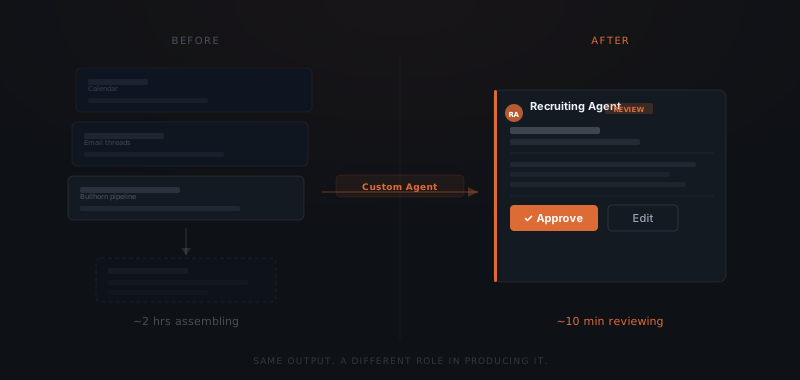
Every Tuesday, a recruiter at an eight-person placement agency assembles the weekly client update. Two hours of pulling pipeline data from Bullhorn, cross-referencing email threads, and drafting status reports — none of which requires candidate judgement. A custom recruiting agent handles that layer: assembling the data, drafting the updates, and surfacing them for approval. The sourcing, the calls, and the placements stay with the recruiter.
Recruiting firms lose time to the administrative layer, not the placement work
The placement cycle has two distinct parts. The first is expertise-intensive: sourcing candidates, running discovery calls, managing client relationships, negotiating offers. The second is administrative: updating pipeline records, drafting status emails, assembling client reports, following up on next steps.
Recruiting agencies typically lose 5–8 hours per recruiter per week to the administrative part. That time is not optional — clients need status updates, candidates need follow-ups, and records need to stay current. But the administrative layer does not require a recruiter's experience or judgement. Every hour spent on pipeline updates is an hour not spent on placements.
The administrative layer is what a custom recruiting agent is built to handle.
The table below breaks down where those 5–8 hours go and what the agent recovers:
| Workflow | Weekly time without agent | Weekly time with agent | Hours recovered |
|---|---|---|---|
| Pipeline updates | 2–3 hrs | 30 min review | 1.5–2.5 hrs |
| Client status reports | 2–3 hrs | 20 min review | 1.5–2.5 hrs |
| Candidate follow-up sequences | 1–2 hrs | 15 min review | 0.75–1.75 hrs |
| Total per recruiter | 5–8 hrs | ~65 min | 4–6.75 hrs |
For an 8-person agency with 6 recruiters, recovering 5 hours per recruiter per week is 30 hours per week of placement capacity returned to the team — without adding headcount.
What a custom recruiting agent actually handles
A custom recruiting agent handles three workflows that collectively account for most of the administrative time in a placement cycle.
Pipeline updates — The agent pulls the latest placement data from the ATS on a set schedule, checks linked email threads and communication logs, and compiles a structured summary of each open role: candidates in process, recent status changes, next scheduled steps. The recruiter reviews the summary, not the raw data from four separate sources.
Client status reports — Weekly client updates require pulling data from multiple sources — the ATS, email, calendar, and sometimes a spreadsheet — and assembling it into a per-client format. The agent handles the data assembly. The recruiter reviews the draft before sending.
Follow-up sequences — When a candidate goes quiet after a screening call, or a client hasn't responded to a shortlist, the agent drafts the follow-up at the right interval and surfaces it for approval. The recruiter decides whether to send as drafted, edit, or skip.
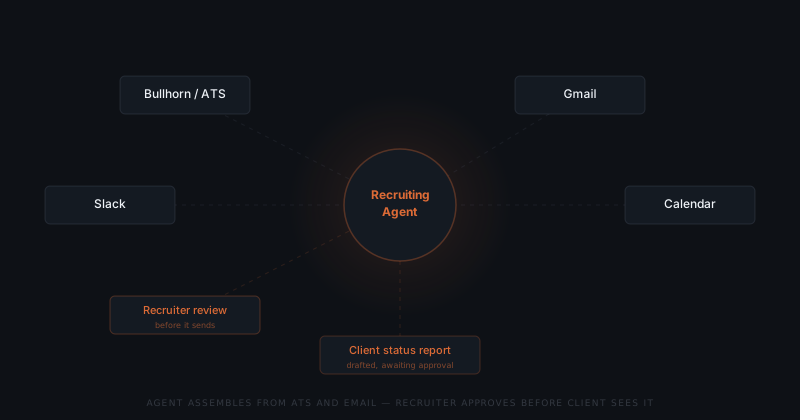
A custom recruiting agent does not replace recruiter judgement — it removes the data assembly work that sits between the recruiter and the client. Sourcing decisions, offer negotiations, and candidate assessments stay with the recruiter.
How recruiting-specific integrations make the difference
Off-the-shelf AI agents are built around generic CRM and email integrations. Recruiting workflows are structured around ATS platforms — Bullhorn, Greenhouse, Lever — which have their own data models, field names, and API structures.
A custom recruiting agent is built with a direct integration to the specific ATS the firm uses. That integration maps the firm's actual field names, stage labels, and record structures — not generic CRM assumptions. Pipeline data pulls correctly without reformatting. Status changes log to the right fields. The agent knows what "active," "submitted," and "offer stage" mean in that firm's specific Bullhorn or Greenhouse configuration.
The agent doesn't find candidates. It removes everything that slows you down after you do.
The same principle applies to client communication. Each client relationship has a history in email threads, a contact structure in the CRM, and often a preferred report format built up over months. A custom agent integrates with those systems at the level of how the firm actually uses them — not a generic email integration that assumes a standard contact record shape.
This is the distinction between a recruiting agent that works in the first week and one that requires months of correction before it is useful. An agent that understands "submitted" in the firm's specific Bullhorn configuration — not "submitted" in the abstract sense — produces status report drafts that match what the client expects to see. An agent built on generic CRM assumptions produces drafts that the recruiter has to rewrite because the field labels and stage names are wrong.
What the recruiter still controls
A custom recruiting agent does not automate the work that makes a recruiting firm valuable. Sourcing decisions — which candidates to surface, how to evaluate fit against a brief, which candidates to advance — stay with the recruiter.
Client relationships stay with the recruiter. The agent drafts the status report; the recruiter decides whether it accurately represents the situation and what the client actually needs to hear. No external communication goes out without an explicit approval step. The agent is a preparation layer, not a replacement for the recruiter's role in the client conversation.
Offer negotiations, candidate assessments, and the judgement calls that determine whether a placement succeeds stay with the recruiter. The agent handles the data-assembly work between sourcing and client communication.
The approval step is not a sign that the agent cannot be trusted — it is the design choice that allows the agent to be trusted. Every communication that reaches a client or candidate has been reviewed by a recruiter. The agent's job is to make that review fast and accurate, not to bypass it.
What agencies get wrong when implementing a custom recruiting agent
Three implementation mistakes account for most of the cases where custom recruiting agents do not deliver the expected time savings.
Starting with the wrong ATS integration depth. An integration that reads top-level pipeline stage labels but does not pull communication history will produce status reports that describe where candidates are in the pipeline but miss context from recent email threads. The recruiter ends up correcting the report with information that should have been in the brief. The fix is building the integration to the depth the workflow actually requires — which means auditing the current status report preparation process before specifying the integration requirements.
Inconsistent brief quality across client types. A recruiting firm with 20 clients may have 5 or 6 distinct report formats — different levels of detail, different terminology, different delivery cadences. An agent built against one client's format and applied to all 20 produces correct drafts for one client and incorrect drafts for the others. The solution is separate context definitions per client type, or at minimum per report format, before go-live.
No owner for the brief after launch. An agent that produces excellent drafts in month one may start producing incorrect drafts in month three when the firm changes its stage labels, updates a client's contact structure, or adds a new reporting section. Without a named person responsible for keeping the brief current, these changes accumulate unnoticed until the recruiter's correction rate climbs back to where it was before the agent was deployed. Assigning one owner for the recruiting agent brief is the same governance principle as assigning one owner for any other critical ops process.
| Common mistake | What it produces | How to prevent it |
|---|---|---|
| Shallow ATS integration | Status reports missing communication context | Audit current report preparation before specifying integration depth |
| Single brief for all client types | Correct drafts for one client, incorrect for others | Separate context definition per client report format |
| No brief owner after launch | Correct drafts at launch, degrading drafts over time | Assign one named owner before go-live |
| Too broad an initial scope | High correction rate across all workflows | Start with one workflow type; expand after 4 weeks of stable operation |
What a custom recruiting agent build involves
A recruiting agency build typically covers three workflows: pipeline updates, client status reports, and follow-up sequences. The core integrations are the ATS (Bullhorn, Greenhouse, or Lever), Gmail or Outlook for communication, and Slack for internal notifications and approvals.
The build maps the firm's actual ATS field structure and stage labels, connects to the ATS and communication tools, encodes the report format and follow-up logic in prompts, and configures the approval layer in Slack. A single-firm build for these three workflows typically takes four to six weeks.
For cost context, see what a custom agent actually costs. For teams evaluating whether a workflow is ready for automation, see how to know if a business process is ready to hand to an agent.
What the first month of operation looks like for a recruiting agent
The agent goes live in review-only mode. Every draft — pipeline update, client report, follow-up email — surfaces for recruiter sign-off before anything reaches a client or candidate. The recruiter approves, edits, or dismisses.
In the first two weeks, the correction rate is highest. Drafts that miss the client's preferred report format, use the wrong stage terminology, or reference outdated process steps are corrected by the recruiter. Each correction is a prompt update that improves the next draft.
By weeks three and four, the most common task types — the weekly status report for an established client, the pipeline update for an active role — require minimal editing. By the end of month one, the recruiter's review time per draft has dropped from 15–20 minutes of correction to 2–3 minutes of final check.
The correction-to-approval ratio also signals whether the brief was accurate. A correction rate above 40% in week two typically means one of two things: the ATS field mapping is wrong, or the client's report format was not captured accurately in the brief. Both are identifiable and fixable before the agent has been running long enough for the wrong pattern to compound.
| Week | Review mode | Typical correction rate | Recruiter time per draft |
|---|---|---|---|
| 1–2 | 100% review | 30–50% | 15–20 min |
| 3–4 | 100% review | 10–25% | 5–10 min |
| Month 2+ | 100% review | Under 10% | 2–3 min |
The approval cadence stays at 100% — all drafts reviewed — for the first two months. This is not a limitation of the agent; it is the control design. An agent that sends recruiting firm communications without review is one incident away from a client relationship problem. The review step stays in place; the time it takes decreases.
Frequently asked questions
What does a custom recruiting agent actually do? A custom recruiting agent handles the administrative layer of the placement cycle: pulling pipeline data from the ATS, assembling client status reports, and drafting follow-up emails for recruiter approval. Sourcing decisions, candidate assessments, and client relationships stay with the recruiter.
Which ATS platforms does a custom recruiting agent integrate with? Custom recruiting agents are built with direct integrations to the ATS the firm uses — Bullhorn, Greenhouse, and Lever are the most common. The integration maps the firm's specific field names, stage labels, and record structures rather than generic CRM assumptions.
How much time does a custom recruiting agent save? Recruiting agencies using custom agents for pipeline tracking and client reporting typically recover 5–8 hours per recruiter per week on administrative work. The savings come from eliminating the manual data-assembly step — pulling from ATS, email, and calendar before drafting client communications.
Can the agent handle different clients with different report formats? Yes, but each client type requires its own context definition. A single context block covering multiple client report formats produces drafts that are partially correct for most clients and fully correct for none. Setting up separate context per client type or per report format takes additional setup time upfront but produces significantly better draft quality from the first week of operation.
What happens when the ATS is updated and field names change? A field name change in the ATS breaks the integration mapping — the agent either stops pulling data correctly or starts pulling the wrong field. Monitoring ATS release notes is part of the ongoing maintenance work for a recruiting agent. Most ATS providers announce API changes in advance; a well-maintained integration gets updated before the change breaks the data pull rather than after. This is one of the three main items covered under ongoing maintenance cost.
Does the recruiting agent work for contingency and retained search firms equally? Yes, with different brief configurations. Contingency models typically emphasize candidate volume tracking and response time metrics. Retained models typically emphasize fewer, higher-detail client updates and more narrative status content. Both are automatable; the brief for each reflects the specific reporting and communication conventions of that model.
What does a custom recruiting agent build cost? A three-workflow build (pipeline updates, client reports, follow-up sequences) with two to three integrations typically runs $12,000–$30,000. Ongoing maintenance — prompt updates when the firm's process changes, integration maintenance when the ATS updates its API — runs 15–30% of build cost per year. See what a custom agent actually costs for a full breakdown.
Notes
- Anthropic, Building effective agents, 2024. Integration complexity and maintenance cost benchmarks. https://www.anthropic.com/research/building-effective-agents
- YardWork implementation benchmarks, 2025–2026. Time-savings estimates based on recruiting agency workflow audits.