Four European AI assistants sell seats to businesses today: Mistral's Vibe, Langdock, Proton's Lumo and Infomaniak's Euria. Their terms differ more than their flags. Mistral's Team plan uses chats and uploaded documents for training until an administrator switches it off, while ChatGPT Business does not train on business data by default. Langdock is a German contract around mostly US models hosted in the EU. This page compares price, processing agreement, training default, data location and sub-processors as each provider's own pages stated them on 13 October 2026, and shows when a custom agent on a European-hosted model fits better than a seat licence.
The question owners ask an assistant is whether a European tool is good enough to replace ChatGPT at work. The answer depends less on where the company is based than on four terms: what a seat costs, whether the provider signs a processing agreement, whether it trains on your chats, and who processes the data on its behalf.
This page compares the European assistants that sell business seats on those terms, as their own pricing pages, processing agreements and sub-processor lists stated them on 13 October 2026. ChatGPT Business is the baseline, using OpenAI's pages as read on 12 October 2026.
This is not legal advice. Every figure carries its source and date in the notes, so you or your data protection officer can check it.
Is there a European alternative to ChatGPT for business?
Yes: four European assistants sell business seats today. Mistral Vibe (France), Langdock (Germany), Proton Lumo (Switzerland) and Infomaniak Euria (Switzerland) each offer a per-user plan with admin controls, checked on 13 October 2026.[¹][⁶][⁹][¹²] Mistral renamed its assistant from Le Chat to Vibe on 28 May 2026; old chats carried over.[⁵]
| Assistant | Company and seat | Business plan | Price per user per month, excl. VAT unless noted |
|---|---|---|---|
| Mistral Vibe | Mistral AI, Paris | Team | €29.99 incl. VAT[¹] |
| Langdock | Langdock, Berlin | Business | €25.00[⁶] |
| Proton Lumo | Proton AG, Switzerland | Lumo Professional | €11.99 billed yearly (€143.88)[⁹] |
| Infomaniak Euria | Infomaniak, Switzerland | kSuite Pro Business | €6.58 (Euria for professional use)[¹²] |
| ChatGPT (baseline) | OpenAI Ireland for EEA customers | Business | €21 billed yearly, €26 monthly[¹⁵] |
Two well-known names are missing on purpose. Aleph Alpha, the German model company, agreed in April 2026 to be acquired by Canada's Cohere and sells to "public sector and enterprise customers in Europe", not seats to small teams.[¹³] Directory sites list dozens more "European ChatGPT alternatives", but most are consumer apps without a business plan or a processing agreement.
The four above are different kinds of product. Mistral builds its own models. Langdock is a workspace that lets staff choose between models from OpenAI, Anthropic, Google and Mistral. Lumo and Euria run open models inside privacy-focused suites from Swiss companies.
How do the European options compare on business terms?
On the terms a business signs, the four European assistants split three ways, checked 13 October 2026: Mistral Vibe Team trains on chats until an admin opts out, Langdock routes requests to US model makers' EU data centres, and Lumo and Euria say they neither train on nor keep your chats.[²][⁷][⁹][¹¹] ChatGPT Business, the baseline, does not train by default but stores data in the United States.[¹⁵][¹⁶]
| Mistral Vibe Team | Langdock Business | Proton Lumo Professional | Infomaniak Euria (kSuite Pro) | ChatGPT Business | |
|---|---|---|---|---|---|
| Processing agreement | Yes, effective 27 Jul 2026[³] | Yes, version 2.1[⁷] | Proton business terms; DPA not read for this page | Infomaniak terms; DPA not read for this page | Yes, effective 1 Jan 2026[¹⁶] |
| Trains on chats by default | Yes, until an admin opts out[²] | No training clause in the DPA[⁷] | No, per Proton[⁹] | No, per Infomaniak[¹¹] | No[¹⁵] |
| Where data is processed | EU: Microsoft (Sweden, Norway), Google (Netherlands, Belgium), Mistral (France)[⁴] | EU by default; US only for "global deployment" models[⁷] | Europe, operated from Switzerland[⁹][¹⁰] | Switzerland only[¹¹] | United States; EU residency on Enterprise only[¹⁵] |
| Models | Mistral's own | GPT, Claude, Gemini, Mistral and others[⁶] | Open-source models[⁹] | Open-source models[¹¹] | OpenAI's own |
| Named US sub-processors for the assistant | Brave (web search), Black Forest Labs (images), Stripe, Twilio[⁴] | Sentry, Cloudflare; model makers' EU entities[⁷] | Not published on the pages read | None named ("no dependence on external services")[¹¹] | OpenAI is a US company |
| Single sign-on and audit log | Enterprise only[¹] | SSO, SCIM and SAML included[⁶] | "Administrative tools"[⁹] | Not read for this page | Not compared here |
Read the "per Proton" and "per Infomaniak" cells as provider statements on a marketing page, not contract terms. Before signing, ask both for the processing agreement and the sub-processor list in writing. Mistral and Langdock publish both.
Does a European provider keep your data in Europe?
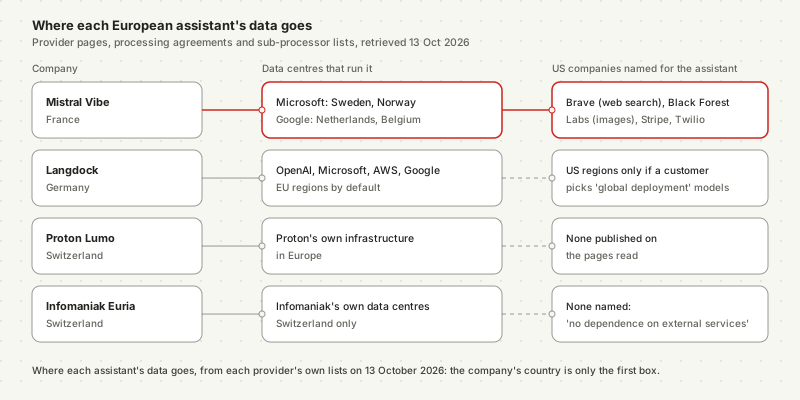
A European provider keeps your chats on European servers, but often on American companies' servers. Mistral's sub-processor list, read on 13 October 2026, names Microsoft data centres in Sweden and Norway and Google data centres in the Netherlands and Belgium for its assistant, plus US companies for web search and image generation.[⁴]
That is not hidden. Mistral publishes the list, with 25 entries, on its trust centre. It does mean a "European alternative" can still depend on the same cloud companies as ChatGPT. Our guide to where AI providers process your data explains why a regional promise usually excludes some sub-processors.
A European company is not a European supply chain. Mistral's own assistant runs on Microsoft and Google data centres in the EU.
Langdock is explicit about its version of this. Its processing agreement lists OpenAI, Microsoft, AWS and Google entities in Ireland and Luxembourg as sub-processors processing in the EU. A second list applies only when a customer "actively chooses AI Models of these providers with 'global deployment'": then requests can be processed "in other Microsoft data zones, including US".[⁷] The default keeps processing in Europe; one setting changes it.
Langdock also changed its own structure. In September 2026 it dismantled its US holding company and became a European company registered in Germany, after customers' lawyers kept asking about the US parent.[⁸]
Lumo and Euria run on their own infrastructure. Proton AG is governed by Swiss law, and Infomaniak says Euria is "hosted exclusively in Switzerland".[¹⁰][¹¹] Switzerland is outside the EU, but it is on the European Commission's list of countries with an adequacy decision, so transfers there need no extra contract clauses.[¹⁷]
Which European assistants train on your company's chats?
Mistral Vibe does by default, on every plan below Enterprise. Mistral's Help Center, dated 3 September 2026, says Vibe users "are not opted out by default", that Team administrators "can disable data training usage for the entire organization", and that Enterprise customers "are opted out of training by default".[²]
On Mistral's Team plan, chats and uploaded documents are used to train Mistral's models until an administrator switches training off for the organisation. ChatGPT Business does the opposite: OpenAI does not train on business data by default.
The processing agreement says the same in legal terms. Section 2.3 of Mistral's agreement, effective 27 July 2026, lets Mistral process personal data as a controller for "Training its artificial intelligence models … unless Customer is or has opted-out of training".[³] Mistral also notes that "Documents attached or uploaded within Vibe are considered as input data".[²]
The fix takes one setting. In the Vibe admin panel, under Privacy, turn off "Allow your interactions to be used to train our models". The API has a separate toggle, so a team using both needs to switch off both.[²] Our comparison of which AI providers train on business data covers the feedback exceptions that remain after opting out.
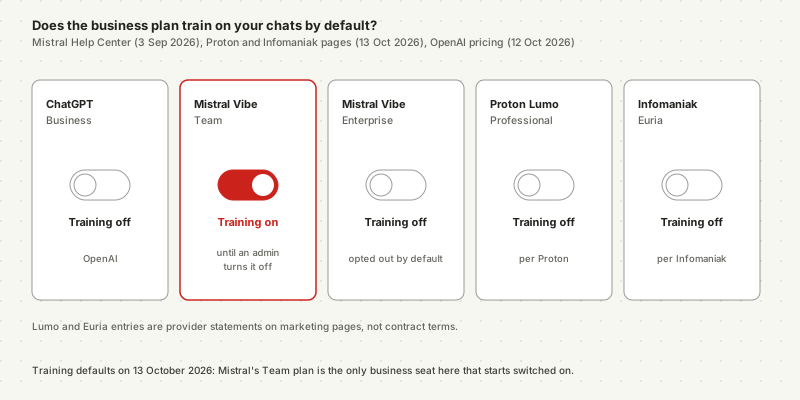
Lumo and Euria state the opposite. Proton says Lumo keeps "no record of your chats" and lets businesses "prevent AI training on your data"; Infomaniak says Euria data is "neither saved nor used to train AI".[⁹][¹¹] Proton's privacy policy, modified 17 September 2026, adds one exception: feedback a user chooses to send can be shared with the Swiss universities ETH Zurich and EPFL to improve their Apertus model.[¹⁰]
Langdock's processing agreement, version 2.1, contains no training clause; requests go to the model makers' EU business entities listed as its sub-processors.[⁷]
What do you give up compared with ChatGPT Business?
Mostly admin features and a measured answer on quality. On Mistral, audit logs and single sign-on come only with Enterprise, which has no published price; Mistral's Team plan offers domain verification, data export and an admin API instead, as of 13 October 2026.[¹] Lumo and Euria run open-source models, and none of these vendors publishes an independent business-task comparison with ChatGPT.
There is no neutral test of these assistants on German or European business tasks. We have not run one for this page, so we make no ranking. Language is a real cost difference: our measurement of what German costs in AI tokens found German text used a median 21.5% more tokens across 63 article pairs.
What each option keeps or loses against ChatGPT Business:
- Langdock keeps the same models: GPT, Claude and Gemini run in EU data centres under a German contract. It loses nothing on quality and gains a model choice, but the models are still American.[⁶][⁷]
- Mistral Vibe keeps a broad feature set on Mistral's own models: connectors, scheduled tasks, and document libraries of up to 30 GB per user on Team.[¹]
- Lumo and Euria cost less and promise not to keep chats, and both are sold inside Proton's and Infomaniak's office suites rather than as stand-alone team assistants.[⁹][¹²]
ChatGPT Business has a gap too. OpenAI's pricing page lists EU data residency for Enterprise, not Business.[¹⁵] Our guide to using ChatGPT under the GDPR sets out what Business does and does not cover.
How do you choose a European assistant for your team?
Choose on the terms that decide what happens to client data, then test quality on your own work. The six checks below use only what each provider publishes; all four providers above offered a trial or free tier on 13 October 2026.[¹][⁶][⁹][¹¹]
Decide what staff will type
Read the sub-processor list
Find the training switch
Sign the processing agreement
Check the admin features you need
Test on your own tasks
The one-page check sheet holds the comparison table and these six checks with their check dates: Download the European AI assistant check sheet (PDF).
When is a custom agent on a European model the better fit?
A custom agent fits when the work goes beyond chat: when it reads several systems, acts on client files or must stay within one hosting region you choose. Open models are available from German cloud providers by the token; IONOS listed Mistral Small 24B at $0.11 per million input tokens on 13 October 2026.[¹⁴]
A seat licence gives every employee the same assistant with the same defaults. A custom agent is built around one workflow. It runs on a model and region you pick, reads only the systems that workflow needs, and asks before it sends anything.
The model can be one of the European options above, or an open model hosted by IONOS in Germany. IONOS also lists Llama 3.3 70B and gpt-oss-120b, and supports searching your own documents.[¹⁴] Running costs then follow usage instead of seats.
For a team that drafts emails and summarises documents, a seat licence with training switched off is usually enough. When the work touches several clients' files and ends in an action, a controlled build is the safer shape.
Frequently asked questions
Is there a European alternative to ChatGPT for business? Yes. As of 13 October 2026, four European assistants sell business seats: Mistral Vibe Team (France, €29.99 per user per month including VAT), Langdock Business (Germany, €25), Proton Lumo Professional (Switzerland, €11.99 billed yearly) and Infomaniak Euria inside kSuite Pro (Switzerland, from €1.58). All prices exclude VAT. Their training defaults, data locations and sub-processors differ, so compare the terms, not only the country.
Does Mistral train on business chats? On the Team plan, yes, until an administrator turns it off. Mistral's Help Center, dated 3 September 2026, says Team administrators can disable training for the whole organisation, while Enterprise customers are opted out by default. Mistral's data processing addendum, effective 27 July 2026, names training as a purpose unless the customer has opted out. Uploaded documents count as input.
Is Mistral Vibe the same as Le Chat? Yes. Mistral renamed its assistant Le Chat to Vibe on 28 May 2026. Existing conversations carried over and the app still runs at chat.mistral.ai. Mistral's pricing page now lists Vibe Free, Pro, Team and Enterprise plans.
Does a European AI provider keep all data in Europe? Not necessarily. Mistral's sub-processor list names Microsoft data centres in Sweden and Norway and Google data centres in the Netherlands and Belgium for its assistant, and US companies for web search and image generation. Langdock processes in the EU by default but sends requests to US regions when a customer chooses models with global deployment. Read each sub-processor list before signing.
Notes
- Mistral AI, Pricing, accessed October 13, 2026 (EUR view). Used for the Vibe plans, Team price, storage, admin features, Enterprise-only audit logs and SSO.
- Mistral AI Help Center, Can I opt out of my input or output data being used for training?, September 3, 2026, accessed October 13, 2026. Used for training defaults per plan and the opt-out steps.
- Mistral AI, Data Processing Addendum, effective July 27, 2026, section 2.3, accessed October 13, 2026.
- Mistral AI Trust Center, Subprocessors, accessed October 13, 2026. 25 entries; used for cloud locations and US service providers.
- heise online, Mistral's chatbot is now called "Vibe", May 2026, accessed October 13, 2026. Used for the rename on May 28, 2026.
- Langdock, Pricing, accessed October 13, 2026. Used for the Business seat price, SSO and the model list.
- Langdock, Data Processing Agreement, version 2.1, accessed October 13, 2026. Used for the sub-processor lists, processing locations and global deployment.
- Euronews Business, Why this fast-growing German AI start-up is moving its parent company from the US, September 16, 2026, accessed October 13, 2026.
- Proton, Lumo for Business plans and pricing, accessed October 13, 2026 (EUR, yearly). Used for the price and Proton's statements on logs, training and models.
- Proton, Lumo Privacy Policy, last modified September 17, 2026, accessed October 13, 2026. Used for Proton AG, Swiss law and the feedback exception.
- Infomaniak, Euria, accessed October 13, 2026. Used for Swiss hosting, open models and Infomaniak's statement on storage and training.
- Infomaniak, kSuite Pro, accessed October 13, 2026. Used for the kSuite Pro prices and which plan includes which Euria features.
- tech.eu, Aleph Alpha to be acquired by Cohere, April 24, 2026, accessed October 13, 2026.
- IONOS, AI Model Hub, accessed October 13, 2026. Used for model availability and per-token prices.
- OpenAI, ChatGPT pricing, accessed October 12, 2026. Used for the Business price, training default and data residency on Enterprise only.
- OpenAI, Data Processing Addendum, effective January 1, 2026, accessed October 12, 2026.
- European Commission, Adequacy decisions, accessed October 13, 2026. Switzerland is listed.