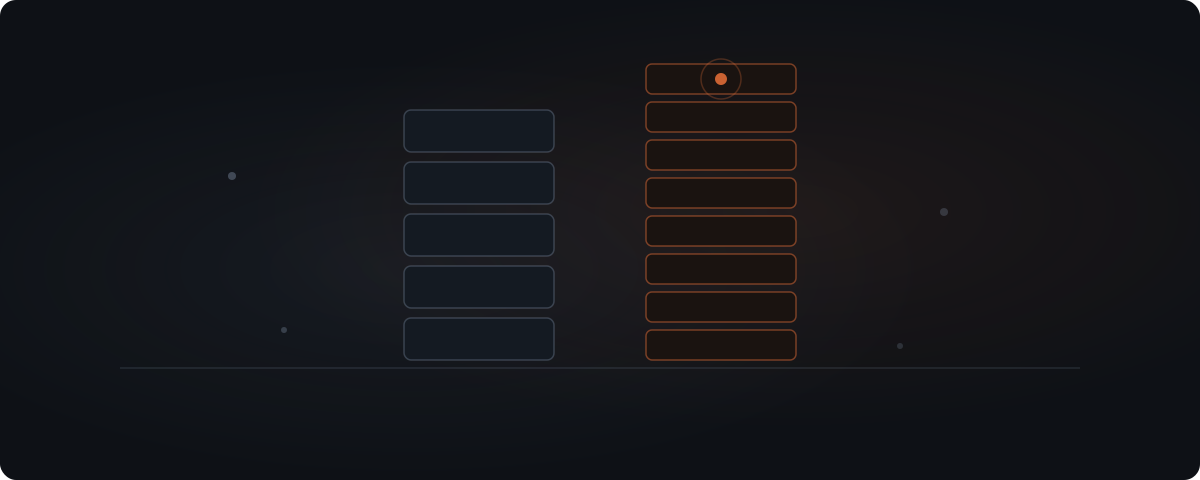
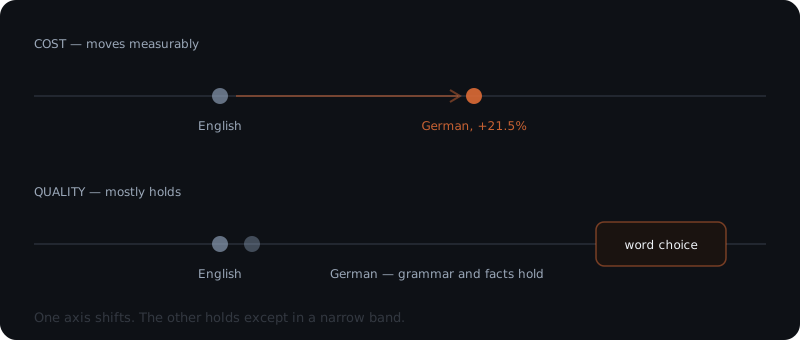
Two things change when an agent switches to German, and only one of them is what people worry about. The cost change is real, measurable and stable: across 63 published English/German article pairs, the German version consumed a median 21.5% more tokens than the English — while using fewer words. The quality change is the one everyone asks about, and the honest answer is that the published evidence does not support the numbers being repeated about it. Here is what each side actually shows, and how to test your own case.
The worry is specific and reasonable. Your agent is going to write to your clients in German, and you are afraid it will produce something that reads fine and is subtly, embarrassingly off — the register slightly wrong, the phrasing slightly translated, the sort of thing a German client notices immediately and never mentions.
Two things actually change when an agent works in German, and the popular worry is aimed at the wrong one.
The cost change is real and measurable. Across 63 published English/German article pairs, the German versions consumed a median 21.5% more tokens than the English ones under OpenAI's current encoding. You pay per token, so German output costs more to produce and more to feed back in.
The quality change is smaller than advertised, and the numbers circulating about it are mostly not measuring what they claim to. That is the more useful finding, and it takes the rest of this article to earn.
Why does German cost more to run than English?
Language models bill by the token, not the word. A token is a fragment — sometimes a whole word, often a piece of one — and the tokenizer decides how finely a language gets cut up. German gets cut more finely than English.
To put a number on it, we measured our own bilingual corpus: 63 article pairs published on this site in English and German. Both halves were written for publication by the same publisher for the same reader. They are not machine translations, which is the point — machine-translated corpora inherit the artifacts of the translator and cannot tell you what real bilingual writing costs.
| Measure | o200k_base (current) | cl100k_base (previous generation) |
|---|---|---|
| Median German-to-English token ratio | 1.215 | 1.504 |
| Mean | 1.204 | 1.473 |
| Range across pairs | 0.908 – 1.366 | 1.097 – 1.680 |
| Pairs where German cost more | 60 of 63 | 63 of 63 |
| Corpus totals | 157,740 EN / 189,087 DE tokens | — |
Two things in that table matter more than the headline.
The premium moved. Under the previous-generation encoding the same corpus showed a median 50.4% German premium. The current encoding cuts it to 21.5%. Tokenizer generations change what non-English languages cost, so any figure you read about this has a shelf life — including this one.
Three pairs went the other way. In three of 63 articles the German cost fewer tokens than the English. The effect is a strong tendency, not a law, and an article heavy on product names and quoted English terms can invert it.
It is not that German is wordier
The German versions of these articles used fewer words than the English ones and still cost more. That is why the premium cannot be argued away by writing more concisely.
| Ratio, German ÷ English (median) | Value |
|---|---|
| Words | 0.907 |
| Characters | 1.081 |
| Tokens | 1.215 |
| Tokens per word | EN 1.208 · DE 1.654 |
The German versions used about 9% fewer words than the English ones and only 8% more characters. Yet they cost 21.5% more tokens. Per word, German needed 36.9% more tokens than English.
German is not more verbose here. It is denser — long compounds carry in one word what English spreads across three — and the tokenizer punishes exactly that density.
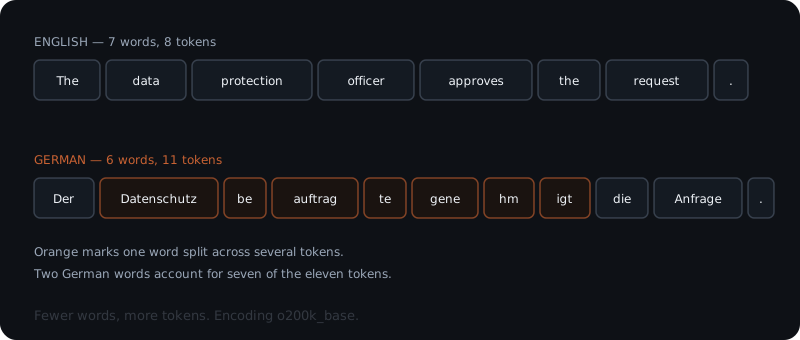
One sentence shows it. The data protection officer approves the request is seven words and eight tokens. Der Datenschutzbeauftragte genehmigt die Anfrage is six words and eleven tokens. Two German words account for seven of them: Datenschutz | be | auftrag | te and gene | hm | igt. Every one of those fragments is billed.
Compression that helps a human reader costs money at the API.
What gives AI-written German away?
Word choice gives it away — not grammar. A translationese classifier flagged 60.2% of one model's German output as translation-like, while the study's native German annotator, reading the same kind of material, flagged none of the annotated sample. For a weaker model the annotator marked 37.5% as translated, including 12.5% they judged could be either.
That evidence comes from a study presented at COLM 2026, which asked whether text generated by multilingual models — not translated, generated — carries the statistical fingerprints of translation. It ran across five languages and collected human annotations for two of them, one being German.
A machine can tell that the German was written by a machine. For the stronger model, a native reader could not.
So the honest answer to "will my clients notice" depends on which model, and the difference between models is larger than the difference between languages.
What the annotator did notice is the practical part. The paper reports that annotator rationales "cited unusual words or word combinations, rather than broader issues such as abnormal frequencies of common words." Not broken grammar. Not wrong facts. Diction — a word that is correct but not the word a German professional would have chosen.
That is precisely the failure mode that damages a client relationship, and precisely the one a benchmark score will never surface. It is also the most fixable: word choice responds well to a glossary and a handful of real examples, in a way that a reasoning failure does not.
The authors offer two explanations worth knowing. English and German are a common parallel-data pairing, so there is likely more translated German in training data than for less-resourced languages. And German's structural features — the V2 constraint, verb-final subordinate clauses — require real restructuring when moving from English, rather than word-order-by-word-order mapping.
Both point the same way: German's closeness to English is part of the problem, not protection against it. This sits alongside the broader picture of what AI agents are genuinely bad at — the failures are rarely where people expect them.
What can the German benchmarks actually tell you?
Go looking for a number on German quality and you will find one. The problem is how it was built — and the two most-quoted sources cannot support the readings put on them.
Ask what the benchmarks say about German and you will find numbers. The problem is how they were built.
| Source | What it can support | What it cannot |
|---|---|---|
| OpenGPT-X European LLM Leaderboard (2024) | Comparison across 21 European languages on a consistent set | A claim about native German — ARC, HellaSwag, TruthfulQA, GSM8K and MMLU were machine-translated into those languages with DeepL |
| EU MMLU (DG Translation, July 2026) | Human-reviewed multilingual evaluation, 16 EU languages, over 1,000 questions, around 250 student translators from 21 universities | Results for the commercial models you would actually deploy — it is a dataset, not a leaderboard of vendors |
| LEXam (ICLR 2026) | Legal reasoning ability, in each of two languages | A German-versus-English gap. See below |
| Translationese generation study (COLM 2026) | Whether generated German carries the fingerprints of translation | A general quality score |
The first row is the one that quietly undermines most German benchmark numbers in circulation. If a benchmark was machine-translated into German, a model's German score is partly a score on the translator's German. That is a real artifact, not a nitpick, and it is why the European Commission's translation directorate built EU MMLU in the first place — its stated reason is that existing datasets "often fail to reveal how well an LLM performs in other languages."
LEXam is frequently cited as evidence that models perform worse in German than English. The paper says otherwise about its own design: its English and German questions "are independent items drawn from distinct exams and are not parallel translations," and the authors "deliberately avoided translation due to the complexity and risk of semantic drift in legal contexts." Different questions in each language means the scores cannot be read as a language gap. If someone quotes you a German-versus-English percentage from LEXam, it is not measuring that.
The conventions a benchmark never tests
Every benchmark above measures knowledge or reasoning. None of them measures whether the German is appropriate for the person receiving it, and that is most of what a business is actually worried about.
Sie or du. German has a formality distinction English does not, and getting it wrong in a client email is a real error with no English equivalent. No knowledge benchmark tests it. It has to be an explicit instruction and a review item — this site's own German content specifies formal Sie throughout as a standing rule, not a preference the model infers.
Salutation and closing conventions. German business correspondence has settled forms. A model that scores well on German factual questions can still open a letter in a way that reads like it was composed in English.
Terminology that should not be translated. Product and tool names stay in English in German business writing — Gmail, Slack, Notion. A model translating them produces text that is grammatically fine and immediately wrong to the reader.
Regional variation. Austrian and Swiss German differ from German German in vocabulary and, for Switzerland, orthography. None of the evidence here measured that, and no claim is made about it.
These are not model weaknesses. They are specification gaps — the model was never told, and a benchmark was never going to tell you it needed telling. That is the same category of problem as reliability generally: the system does what it was scoped to do, and the scoping is the work.
How to test this on your own German in an afternoon
You do not need a benchmark. You need twenty real messages and a native reader.
Take twenty real messages
Have the agent write its version
Mark only what you would change before sending
Sort the edits into two piles
Measure the token difference on your own text
Twenty samples will not give you a confidence interval. It will show you the pattern, which is what the decision needs. If nearly every edit is in the first pile, the problem is specification and it is solvable this week. If the second pile is full, no amount of prompting will fix it.
What this does not tell you
The token measurement is one publisher's corpus — 63 article pairs in one domain, in a consistent register, written by people who write this way for a living. Your ratio will be different. The method is disclosed so you can rerun it rather than trust it.
The quality evidence is thinner than anyone would like. The COLM study's human-annotation sets are small and cover two models; the authors say so themselves. It is the best directly relevant evidence available, and it is still two models and a small sample. Nothing here supports a claim that any named model is a specific percentage worse in German, which is exactly why this article does not make one.
Nothing here addresses translation quality, which is a different task from generation. Nothing here addresses Austrian or Swiss German. And nothing here measured spoken German or transcription, where the limits of what a model can read are a separate question with separate evidence.
The defensible summary is short. German costs about a fifth more to run and the premium is shrinking as tokenizers improve. German quality is closer to English than the anxiety suggests, the tell is word choice rather than grammar, and the gap between two models is wider than the gap between two languages.
Frequently asked questions
Do AI models write German as well as English? For general business writing, closer than the common assumption, but not identically. A 2026 study presented at COLM measured whether text generated by multilingual models carries the statistical fingerprints of translation. A classifier flagged 60.2% of one model's German output as translation-like, while the study's native German annotator flagged none of the annotated sample. For a weaker model the annotator flagged 37.5%. What the annotator noticed was unusual word choices rather than broken grammar.
Why does German cost more than English with an AI agent? Because tokenizers split German into more pieces. Across 63 published English/German article pairs measured with OpenAI's o200k_base encoding, the German versions used a median 21.5% more tokens than the English ones. That is not because German is wordier — the same German texts used about 9% fewer words. German compounds and inflections get broken into more sub-word tokens, and you pay per token.
Is there a benchmark that shows how good AI is in German? Not a clean one. Most multilingual benchmark scores for German come from benchmarks machine-translated into German — the OpenGPT-X European LLM Leaderboard translated ARC, HellaSwag, TruthfulQA, GSM8K and MMLU into 21 European languages using DeepL. The European Commission's DG Translation released EU MMLU in July 2026 specifically to address this, using around 250 student translators across 16 EU languages instead of machine translation.
Does an AI agent use formal Sie or informal du in German? Whichever the instruction specifies, and it needs to be specified. Register is not something a knowledge benchmark measures, so a model scoring well on German factual questions tells you nothing about whether it will address your client correctly. Treat the choice of Sie or du, along with salutation and sign-off conventions, as an explicit instruction and a review item — not as something the model infers from context.
How do I check whether an AI agent's German is good enough for my clients? Take twenty real messages you have already sent, have the agent produce its version of each, and have a native speaker mark only the places they would change before sending. Count the edits and read what kind they are. Word choice and register problems are fixable with instructions and examples; factual and structural problems are not. Twenty samples is enough to see the pattern.
Notes
- Token measurement: 63 published English/German article pairs from this site, measured 24 August 2026 with
tiktoken0.14.0 using theo200k_baseandcl100k_baseencodings. Frontmatter, MDX components, tables and link syntax were stripped; body prose only. Median, mean, range and per-pair counts as reported in the tables above. The measurement script is retained with the article's working notes so the figures can be reproduced. - Maria Valentini, Téa Wright, Julisa Granados, Eliana Colunga and Katharina von der Wense, An Investigation of Translationese in the Generations of Multilingual Large Language Models, COLM 2026, arXiv preprint 18 August 2026. Source for the classifier and native-annotator figures, the annotator rationales, and the parallel-data and word-order explanations.
- Yu Fan et al., LEXam: Benchmarking Legal Reasoning on 340 Law Exams, ICLR 2026. Source for the benchmark's composition and for its statement that the English and German questions are independent items and not parallel translations.
- European Commission, Directorate-General for Translation, Towards fair multilingual AI: EU MMLU, a new EU benchmark for LLMs, 22 July 2026. Source for the dataset's method, scale and stated rationale.
- OpenGPT-X consortium, coordinated by Fraunhofer IAIS with TU Dresden, European LLM Leaderboard, 12 July 2024. Source for the DeepL machine-translation method behind the leaderboard's non-English benchmarks.
- Yafu Li et al., Lost in Literalism: How Supervised Training Shapes Translationese in LLMs, 6 March 2025. Source for translationese as a bias introduced during supervised fine-tuning rather than a fixed capability limit.