For companies deciding how far to trust AI with their work: how often current models get facts wrong, which tasks carry the most risk, and how to test an agent on your own workflow before relying on it.
What you'll learn
- How often current AI models state false facts, by model and by task
- Why accuracy figures for the same model disagree
- What current benchmark versions and completion scores measure
- How repeated runs and changed inputs reveal different weaknesses
- Which outcomes, corrections and review minutes to record
- Which errors should block launch or pause an action
- How to retest and maintain the workflow after changes
AI models still get facts wrong, and how often depends on the task. In Vectara's hallucination leaderboard of October 16, 2026, models added unsupported content to between 1.8% and 24.2% of summaries of documents they were given. Answering knowledge questions from memory, the best model in Artificial Analysis's 6,000-question test got 67% right in October 2026, and most featured models gave a confident wrong answer more often than they admitted not knowing. Agent benchmarks show the same gap: Stanford's 2026 AI Index reports OSWorld task success rising from about 12% to about 66%, which is not a success rate for your workflow. This guide sets out error rates by model and task, why the figures disagree, and how to test reliability on your own work.
What do AI agent benchmarks actually show?
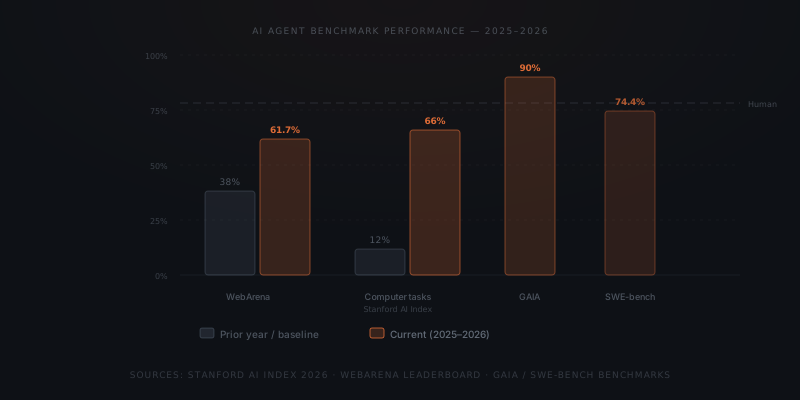
Stanford’s 2026 AI Index reports a rise from about 12% to about 66% task success on OSWorld, a benchmark of computer tasks across operating systems.[1] This is evidence of improving performance in that evaluation. It does not mean every agent completes two-thirds of your work correctly.
OSWorld, WebArena, coding benchmarks and business-task tests measure different tasks under different conditions. A score from one cannot be compared with a human baseline from another. Report the benchmark, tested system, date and conditions together before interpreting a result.
The practical question is narrower than whether an agent is reliable in general: can the agent perform this defined job with acceptable errors and controls?
What do the newer public benchmarks measure?
OSWorld 2.0 tests longer computer workflows than the original benchmark. In the paper’s July 2026 revision, Claude Opus 4.8 with maximum thinking and batched tool calls completed 20.6% of its 108 tasks under the binary-completion measure at a 500-step budget, while its partial score was 54.8%.[3] Those two scores answer different questions: whether the whole task finished and how much of it was completed.
The original project announced OSWorld 2.0 in June 2026.[4] Its lower reported completion result cannot be read as a decline from the AI Index’s older OSWorld trend: the task set and test conditions changed. A harder evaluation can expose failures that a shorter task never reaches.
| Public evidence | What the result concerns | What to ask a supplier |
|---|---|---|
| Stanford’s 2026 OSWorld trend | Performance improvement in a specified computer-task evaluation | Which version and tested system does the quoted score refer to? |
| OSWorld 2.0, July 2026 paper | End-to-end completion and partial progress on longer workflows | Was the whole job correct, or only some checkpoints? |
| Current τ-bench releases | Simulated customer-service work under domain policies, including text and voice | Which domain, modality and grading version were used? |
| Reliability study, June 2026 revision | Consistency, robustness, predictability and safety alongside success | Did repeated runs and changed inputs get tested? |
As of October 2026, Sierra’s current τ-bench repository describes text and voice evaluation and a knowledge-retrieval domain. It warns that the July 2026 grading update changed banking-knowledge scores: results from before and after version 1.0.1 are not comparable on that domain.[5] Even a carefully reported percentage needs a version and a task definition beside it.
For a buying decision, ask for the evidence closest to your work. A computer-use result is relevant to a workflow navigating several applications. A customer-service simulation may be closer to a policy-bound conversation. Neither includes your particular contracts, incomplete records or colleagues’ review time unless those were part of the test.
How often do AI models get facts wrong?
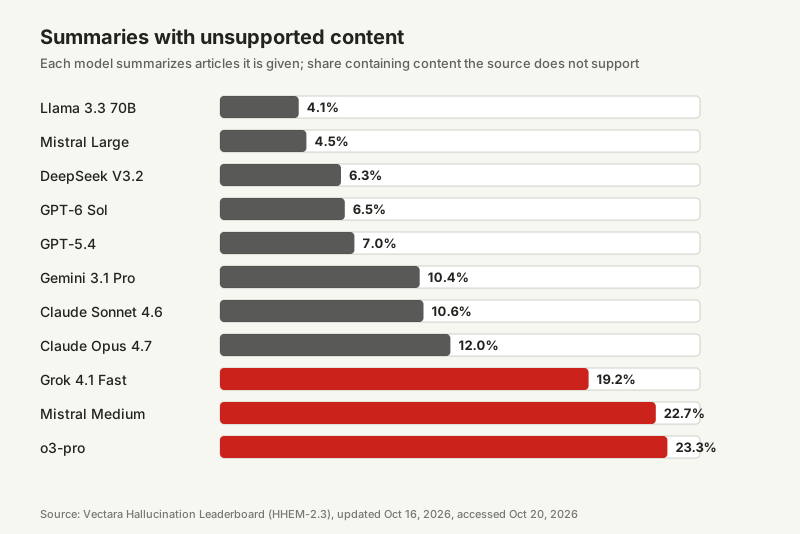
How often AI models get facts wrong depends on the task. In Vectara's hallucination leaderboard of October 16, 2026, models added content not supported by the source to between 1.8% and 24.2% of summaries of documents they were given.[7] Asked knowledge questions without a source, the best model in Artificial Analysis's AA-Omniscience test answered 67% of 6,000 questions correctly in October 2026.[8]
The two tests measure different things. Vectara gives each model more than 7,700 articles, from news, science, legal and business sources, and asks for a summary using only the facts in the article; its own evaluation model then checks each summary against the source.[7] AA-Omniscience asks factual questions in business, finance, law, health, science and software, and penalizes a wrong answer more than an honest "I don't know".[8][9]
| Model (version tested) | Summaries with unsupported content (Vectara, Oct 16, 2026) |
|---|---|
| Llama 3.3 70B (Meta) | 4.1% |
| Mistral Large (2411) | 4.5% |
| DeepSeek V3.2 | 6.3% |
| GPT-6 Sol (OpenAI) | 6.5% |
| GPT-5.4 (OpenAI) | 7.0% |
| Gemini 3.1 Pro (preview, Google) | 10.4% |
| Claude Sonnet 4.6 (Anthropic) | 10.6% |
| Claude Opus 4.7 (Anthropic) | 12.0% |
| Grok 4.1 Fast (reasoning, xAI) | 19.2% |
| Mistral Medium (2508) | 22.7% |
| o3-pro (OpenAI) | 23.3% |
The knowledge test is harsher. Among the 32 models Artificial Analysis features on its AA-Omniscience page, the share of non-correct answers that were confidently wrong, rather than partial or declined, ranged from 15% to above 70% in October 2026.[8] When the benchmark was published in November 2025, only three of the models evaluated answered more questions correctly than incorrectly once wrong answers were penalized.[9]
A model that summarizes your contract faithfully can still invent a fact when asked from memory. The figure you need is the one for your task.
Which business tasks carry the highest error rates?
The riskiest business tasks are the ones where the AI has to find or recall information rather than work from a source you give it. Summarizing a provided document produced unsupported content in 1.8% to 24.2% of cases on Vectara's leaderboard in October 2026; finding the source of a news article went wrong on more than 60% of queries across eight AI search tools in a March 2025 test.[7][11]
| Task | Published error or success rate | Source and date |
|---|---|---|
| Summarizing a document you provide | 1.8% to 24.2% of summaries contain unsupported content | Vectara, Oct 16, 2026[7] |
| Answering factual questions from memory | Best model correct on 67%; 15% to over 70% of the remaining answers confidently wrong | AA-Omniscience, Oct 2026[8] |
| Finding and citing a source | Over 60% of queries answered incorrectly; Perplexity 37%, Grok 3 94% | Tow Center, Mar 6, 2025[11] |
| Legal research from curated sources | 17% to 33% of answers hallucinated | Stanford, May 30, 2024[13] |
| Multi-sheet business spreadsheets | Best model completed 34.89% of workflows | SpreadsheetBench 2, Jun 29, 2026[12] |
The pattern is the same across these tests. Errors fall when the model works from the right document and rise when it must search, remember or edit several connected parts. The Tow Center researchers also noted that most tools presented wrong answers "with alarming confidence".[11]
The legal row and the spreadsheet row each have a full guide: knowledge bases built on company documents and spreadsheet analysis with ChatGPT, Copilot, Claude and Gemini.
Why do accuracy figures for the same model disagree?
Accuracy figures for the same model disagree because they measure different tasks under different definitions and settings. On Vectara's leaderboard a hallucination is a summary that adds something the source does not support; on AA-Omniscience it is a wrong answer given instead of declining, counted as incorrect answers divided by all non-correct responses, in October 2026.[7][8]
- The task. Summarizing a document in front of the model and recalling a fact are different jobs. One model can rank well on one and poorly on the other.
- The definition. "Hallucination rate" can mean the share of all outputs with an error, or the share of wrong answers among those that were not correct. The same model gets two different numbers.
- Guessing. A September 2025 paper by OpenAI and Georgia Tech researchers argues that models guess because training and most benchmarks reward a guess over an admission of uncertainty.[10] A test that penalizes guessing reports more hallucinations than one that does not.
- Settings and versions. Vectara runs models at temperature 0.[7] On AA-Omniscience, GPT-6 Astra's hallucination rate was 45% at high reasoning effort, 48% at extra-high and 51% at maximum in October 2026: more effort did not mean fewer confident errors.[8]
- Who measured it. Vendors report results under their own conditions. Independent tests publish their method; read it before comparing.
Language matters as well. German output has its own failure modes and costs, covered in whether an AI agent writes German as well as English.
What lowers an AI model's error rate in business use?
Error rates fall when the AI works from the right source, may say "I don't know", and shows the passage behind each answer. Vectara's test, where every model has the source document, produced rates mostly in single digits for widely used models in October 2026, far below the confident-error rates on questions answered from memory.[7][8]
- Give it the source. Put the document, record or table the answer must come from into the request. Summaries from a provided source are the most reliable task measured.[7]
- Let it decline. Instruct the system to say when the source does not contain the answer, and treat a refusal as a correct outcome. Penalizing honest uncertainty encourages guessing.[10]
- Show the passage. Require the quote or cell behind each answer, so a reviewer checks the source rather than the wording.
- Keep actions behind approval. A wrong fact in a draft costs a correction. The same fact in a sent message or a changed record costs more.
- Test on your own cases. Benchmark rates set expectations; your own trial sets the threshold. The trial design below shows how.
These controls change the job from "trust the model" to "check a claim against its source". That is a review task a team can carry, which the next sections turn into launch criteria.
Why can capable agents fail after launch?
Strong benchmark performance does not establish a successful implementation. A model may misunderstand a message, a source may be missing, a connection may fail or an approval path may allow an action too early. Process and technical problems can both matter.
Three operational checks are useful:
- Action limits: what can the agent read, send or change, and which actions must wait?
- Ongoing evaluation: does it still meet the requirements after tools, inputs or instructions change?
- Correction work: how much time does the team spend fixing and reviewing its output?
For each failure, record the intended action, the information available and the actual result. A workflow that pauses for a missing contract needs a different response from one that sends a message to the wrong client. Separate unresolved work from incorrect completed work so your review tells you what to change.
A deployment failure figure needs a defined population, period and outcome. Do not treat “not yet in production” as “failed,” or an untraceable statistic as an acceptance criterion.
How is task reliability different from deployment reliability?
The 2026 paper Towards a Science of AI Agent Reliability, first submitted in February and revised in June, argues for evaluating consistency, robustness, predictability and safety in addition to a single success score.[2]
For a business, that means checking whether the same request gets a suitable result repeatedly, whether ordinary variations break it, whether failures are recognizable and whether errors can cause unacceptable actions. Model capability, tools, access controls and operating practice all contribute.
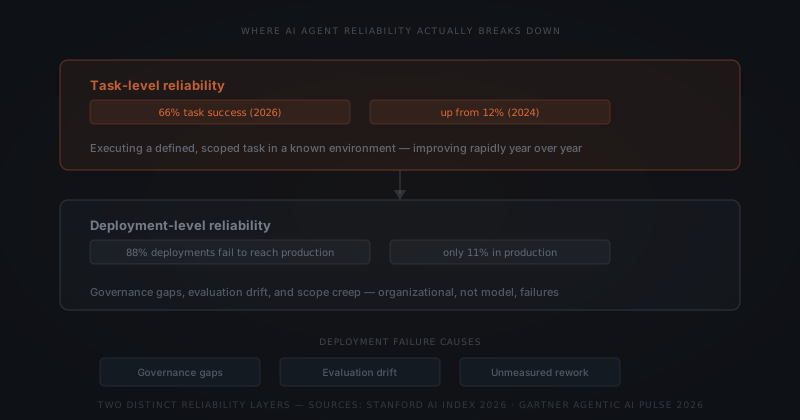
A good draft in one test is not evidence that its sending permissions are safe. A well-designed review process is not evidence that the model produces accurate figures. Evaluate both.
Why one successful run is not enough
An agent’s reliability test should include repeated attempts on the same case and realistic variations of that case. The June 2026 reliability study examined 15 models and separates consistency from robustness: repeating a task and changing its inputs reveal different weaknesses.[2]
Say a reporting agent correctly assembles an update from a complete project record. Repeat the case, then test a record with a missing date, conflicting status fields or a new message that changes the required result. Keep the expected answer written down before running each case. Otherwise you can end up accepting whatever the system produced because it sounds plausible.
Check the completed artifact, not just the final chat response. If the agent says it updated the CRM, inspect the intended client record. If it says a report contains every project, compare the report with the source list. A fluent completion message is one output; the changed business record is another.
Preserve difficult cases as examples for later testing. When instructions are revised, rerun both the case that caused the change and earlier cases that had worked. A correction for one client format should not quietly break another.
What should a service business measure?
Choose a workflow rather than a broad category. “Draft a follow-up for proposals with no reply after the agreed interval” gives you defined inputs and an output to inspect. “Manage client relationships” does not.
Write the successful-output requirements before testing. For a follow-up, that could include the correct recipient, accurate reference to the proposal, an appropriate next step and no invented commitment.
| Measure | What it tells you |
|---|---|
| Outputs accepted without editing | Suitability against the agreed criteria |
| Errors by type and consequence | Where correction or stricter controls are needed |
| Escalations and unresolved work | Whether exceptions have a workable owner |
| Review and correction minutes | Actual effort remaining |
| Attempts to act outside scope | Whether permissions and review paths hold |
| Tool failures and recovery | Whether the workflow can stop or resume safely |
Preserve the test conditions and sample when comparing revisions. Changing the input mix can change the measured rate even if the system has not improved.
Count the work that still needs a person
Measure the whole job, including reading the review queue, checking facts, correcting output and investigating exceptions. An agent can shorten draft preparation while leaving most of the checking work with your team. Record those parts separately so you can see where the benefit comes from.
Keep the denominator clear. If some requests were never attempted because the connection was unavailable, show them as uncompleted work; do not leave them out of a “successful outputs” rate. If an output was accepted after an edit, record both the final acceptance and the required correction. Your team needs to know whether it can use the draft as delivered.
Use ordinary and difficult work in the trial. Include the accounts, document formats and language combinations you expect the workflow to handle. Ask the colleague who currently does the task to select cases, including the ones they routinely return for clarification. A convenient demo sample tells you little about that review burden.
The record can be simple: case, expected result, actual result, edit needed, reviewer minutes and final outcome. Add a link to the resulting draft or record. Keep personal data and access to the trial record within the same business controls as the underlying work.
How do you evaluate an agent before relying on it?
Evaluate an agent with a bounded trial, a written expected result and controls on consequential actions. Anthropic’s December 2024 guidance recommends extensive testing because errors can compound.[6] A useful trial shows both what the agent completes and what happens when it cannot finish.
Define the boundary
Set the acceptance criteria
Test with restricted actions
Record outcomes and effort
Decide from evidence
There is no universal number of days, consecutive correct drafts or benchmark percentage that makes a workflow safe. An editable internal draft and an unreviewed payment have different acceptance requirements.
For the scoping decisions, see whether a process is ready for an AI agent. For review controls, see human-in-the-loop in practice.
Which errors should block an agent’s launch?
Block launch when a tested failure can create a consequence your team cannot accept or recover from. Set that boundary by action: an internal draft with an obvious missing field needs a different control from sending a false commitment to a customer.
| Failure in a trial | Decision to resolve before launch |
|---|---|
| Wrong customer record retrieved | Correct identity matching and test similar names |
| Missing source filled in with a guess | Require missing information to stop or escalate |
| Held message sent without approval | Close that sending route and retest the approval boundary |
| Same action performed twice after a retry | Check the existing result before allowing a repeat |
| Reviewer cannot see the evidence | Show the relevant source and proposed action before approval |
| Failed case disappears from the queue | Give the exception a visible status and a named owner |
These are proposed test cases, not a measured ranking of failure frequency. Choose the cases for the consequence of your actual workflow. A payment, a hiring decision and a customer-status update can have different owners and legal requirements even when they use the same AI.
Test the unavailable-reviewer path too. A message held for approval should stay held if the reviewer is away or the review screen fails. Ask the operator to demonstrate it with a harmless test message. Instructions that merely ask the AI to wait need to be backed by the actual action control.
For an error already affecting a customer, use the agent-mistake response guide. Reliability testing should make that response easier: you know what was attempted, which records changed and who can pause further actions.
How do you keep reliability after launch?
Keep the accepted test cases, monitor the completed work and recheck the workflow when its inputs or tools change. Reliability is a continuing operating decision: a successful launch test covers the setup that was tested, not every later variation.
Choose a review schedule the team can carry out. Inspect completed outputs as well as error reports. A missing paragraph in an otherwise successful report may never produce a technical alert, so ask the owner to compare a sample with the underlying records. Track the time required for that work.
Changes need a visible decision. A new model, a revised prompt, a different document template or a new permission can alter the result. Ask what changed, rerun the relevant cases and confirm who approves returning to normal operation. Keep an earlier working configuration available where the setup supports it.
If errors recur, narrow the job rather than compensate with unlimited checking. A workflow might continue preparing records while customer messages stay with a person. Decide from the benefit left after review, and pause the affected action when an important boundary has failed.
AI agent management covers responsibility and review routines; AI agent maintenance covers keeping the connections and setup working. Use is your agent actually working? when you need to compare completed work with the intended result.
Frequently asked questions
How reliable are AI agents for business tasks? Reliability depends on the task, AI, tools, permissions and evaluation conditions. Stanford’s 2026 AI Index reports OSWorld computer-task success rising from about 12% to about 66%, but that is a benchmark trend, not a success rate for your business. Test representative work and consequential failure cases before relying on an agent.
Why can an AI agent fail after launch? An agent can fail because of model errors, missing information, changed tools, excessive access, weak review or an unclear exception owner. Investigate the affected outputs and records, pause consequential actions when needed and retest the cause before resuming.
What is the difference between task reliability and deployment reliability? Task reliability concerns completing a defined task under specified conditions. Deployment reliability also includes repeatability, changing inputs, tool availability, permissions and safe failure over time. A benchmark score cannot be transferred directly to a live workflow or interpreted as its project success probability.
How do I evaluate reliability for my business workflow? Define the workflow and successful output, test ordinary and exceptional inputs, restrict important actions, and log edits, failures and escalations. Compare the time saved after review with the operating cost. Choose an acceptance threshold based on the consequences, not a generic benchmark score.
How often does ChatGPT get facts wrong? It depends on the task. When summarizing a document it was given, OpenAI's GPT-6 Sol added unsupported content to 6.5% of summaries and GPT-5.4 to 7.0% in Vectara's leaderboard of October 16, 2026. Answering questions from memory is less reliable: in Artificial Analysis's 6,000-question test, no model answered more than 67% correctly in October 2026. Give it the source document and check the answer against it.
Which AI model hallucinates the least? No single model leads on every test. On Vectara's summary test of October 16, 2026, the lowest rate was 1.8% and widely used models ranged from 4.1% (Llama 3.3 70B) to 12.0% (Claude Opus 4.7). On Artificial Analysis's knowledge test, Claude Opus 5.5 had the best overall score in October 2026. Choose by the task you need, and test it on your own documents.
Notes
- Stanford HAI, AI Index 2026. April 2026; accessed 14 October 2026.
- Rabanser et al., Towards a Science of AI Agent Reliability. v3, 2 June 2026; accessed 14 October 2026.
- Yuan et al., OSWorld 2.0. v2, 13 July 2026; accessed 14 October 2026.
- XLANG Lab, OSWorld version notice. 26 June 2026 version notice; accessed 14 October 2026.
- Sierra Research, Tau benchmark current release. July2026 v1.0.1 note; current tau3 readme; accessed 14 October 2026.
- Anthropic, Building effective agents. 19 December 2024; accessed 14 October 2026.
- Vectara, Hallucination Leaderboard, HHEM-2.3, last updated October 16, 2026; accessed October 20, 2026. Used for the per-model rates, the range and the method.
- Artificial Analysis, AA-Omniscience: Knowledge and Hallucination Benchmark, accessed October 20, 2026. Used for the top score and accuracy, the hallucination-rate definition, the range among featured models and the GPT-6 Astra settings.
- Jackson, Keating, Cameron and Hill-Smith, AA-Omniscience: Evaluating Cross-Domain Knowledge Reliability in Large Language Models, arXiv:2511.13029, November 2025; accessed October 20, 2026.
- Kalai, Nachum, Vempala and Zhang, Why Language Models Hallucinate, arXiv:2509.04664, September 4, 2025; accessed October 20, 2026.
- Jaźwińska and Chandrasekar, AI Search Has a Citation Problem, Columbia Journalism Review, Tow Center for Digital Journalism, March 6, 2025; accessed October 20, 2026.
- Zhu et al., SpreadsheetBench 2: Evaluating Agents on End-to-End Business Spreadsheet Workflows, arXiv:2606.29955, June 29, 2026; accessed October 20, 2026.
- Magesh, Surani, Dahl, Suzgun, Manning and Ho, Hallucination-Free? Assessing the Reliability of Leading AI Legal Research Tools, arXiv:2405.20362, May 30, 2024; accessed October 13, 2026.