A founder reads the AI agent case study: twelve workflows automated, an ops team maintaining the system, clear ROI in the first quarter. The business in that case study has a dedicated ops person. A 10-person service firm that copies that model ends up with a platform nobody has time to run. The right implementation for a small business is two or three tightly scoped workflows that run without management — built once, maintained externally, and reviewed by the founder in minutes each week.
Enterprise AI platforms are built for teams that can manage them
Enterprise AI agent implementations assume a dedicated person who manages integrations, updates prompts when business language shifts, monitors outputs, and handles edge cases as they surface. At a company with fifty or more employees, that responsibility distributes across operations staff.
A 10-person recruiting firm does not have that person. The founder is also the recruiter, the account manager, and the one fielding client calls. A platform requiring ongoing management produces one outcome for that firm: a new job nobody planned to hire for.
The reference point most small business owners use when evaluating AI agents is wrong. Enterprise case studies describe what AI agents can do at scale — with dedicated teams, budget for ongoing integration work, and someone whose full job is keeping the system running. That model does not transfer to a lean service business.
What "managing the platform" actually costs a small team
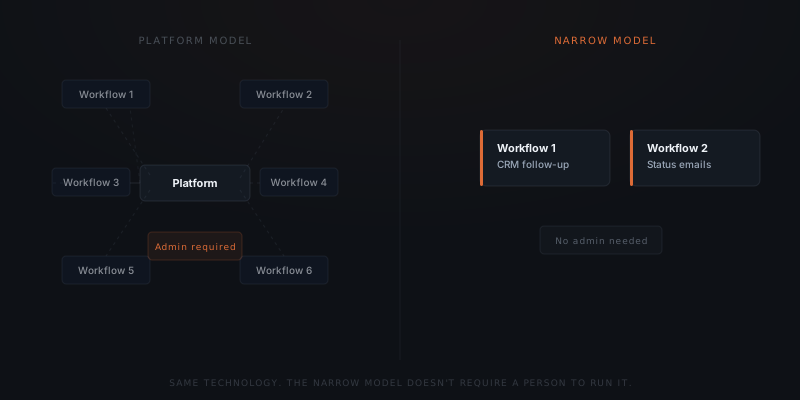
A broad AI implementation generates specific ongoing obligations. Prompt updates are needed when business language shifts — a new service tier, a rebranded product, a change in how the team describes its process. Integration maintenance happens when vendors update APIs or change field names. Exception handling falls on whoever is closest to the system when an input arrives the agent wasn't briefed for.
For an enterprise team, these tasks distribute across roles. For a 10-person firm, they accumulate on the founder. A platform of eight workflows can generate three to four hours of maintenance per week before producing a single hour of useful output. The U.S. Small Business Administration's 2023 Small Business Profile found that businesses with fewer than 100 employees represent 89.8% of all US employer firms — the majority of the business population operates without an operations role to absorb that overhead.[¹]
Two workflows with tight scope produce none of that overhead. The trigger conditions are narrow. The input format is consistent. The exception rate is low. When an update is needed, it is isolated to one workflow rather than cascading across eight.
Every integration point added to a small business implementation is also a maintenance obligation. Narrow scope isn't a limitation — it's what makes the system sustainable for a team with no dedicated ops.
What two or three workflows can handle for a small service business
The workflows that produce the most value for a small B2B service firm share a common shape: high volume, consistent inputs, defined outputs, low stakes per instance.
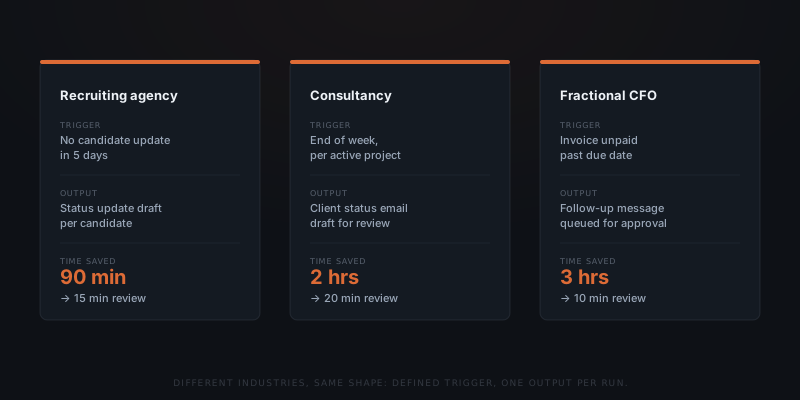
For a recruiting agency, candidate status follow-up is the highest-value starting point — a weekly message to every active candidate who hasn't had an update in five days. The trigger is a CRM field. The output is one message per candidate. A founder who spent ninety minutes every Friday on this task reviews a queue of drafts in fifteen minutes.
For a consultancy, client project status emails follow the same pattern. The agent pulls the week's activity from the project management tool, assembles a summary, and queues a draft for the account lead to review and send. Two hours of assembly becomes twenty minutes of review.
For a compliance or fractional CFO firm, invoice follow-up is the most consistent win. The trigger is an unpaid invoice past its due date. The output is a polite follow-up message. The escalation path is a human call when three follow-ups go unanswered.
None of these require a platform. Each requires one workflow, one integration, and one defined output.
Two agents you don't manage save time. A platform that needs managing creates a role.
What makes a workflow right for a small team
The workflows that work for a small business are not defined by industry — they are defined by structure. The table below shows how to evaluate any workflow against the criteria that determine whether a small team can sustain it.
| Criterion | Good fit for a small team | Poor fit for a small team |
|---|---|---|
| Trigger consistency | Trigger fires automatically from a system event (CRM field update, invoice date, form submission) | Trigger requires a human to initiate or judge when conditions are met |
| Input format | Every input arrives in the same format from the same source | Inputs vary by sender, channel, or internal context |
| Output judgment | Output can be evaluated as correct without interpretation (sent / not sent, correct amount / wrong amount) | Output requires professional judgment to evaluate quality |
| Exception rate | Edge cases are rare and predictable; the exception path is defined | Exceptions are frequent, unpredictable, or require case-by-case decisions |
| Maintenance surface | One system connected, one output type, one defined scope | Multiple systems, variable outputs, scope that expands over time |
| Consequence of error | Errors are visible and correctable before they reach a client | Errors may reach clients before the team catches them |
A workflow that clears all six columns does not require ongoing management — which is what "sustainable for a small team" means in practice. A workflow that fails two or more columns is a platform project, not a small business workflow.
How a small business implementation is scoped and maintained
A small business implementation starts with one workflow. The selection criterion is not value — it is structural simplicity: a consistent trigger, consistent inputs, a defined output, and a low exception rate. The boring-first principle applies directly: the workflow that runs correctly two hundred times before an exception appears is the right starting point.
The second workflow is added after the first runs reliably for thirty days. The third follows the same pattern. At three workflows, most small B2B service firms have covered their highest-volume, lowest-judgment tasks and saved five to eight hours per week of founder time.
Yardwork builds and maintains these implementations. The build phase scopes the workflow, writes the brief, and ships the agent. Maintenance — prompt updates, integration changes, exception handling — stays in the engagement rather than returning to the founder. The founder reviews outputs. The founder does not manage the agent.
The distinction between a founder who uses an agent system and one who manages one is the difference between five hours saved each week and five hours redirected to keeping the system running.
What the first six months look like
A small business implementation does not feel dramatic when it is working correctly. That is the point.
Month one: the first workflow launches. The founder reviews the queue on Fridays. Some drafts need edits — the agent is learning the business's voice and the brief is being refined. By week three, the founder is reviewing in fifteen minutes instead of ninety.
Month two: the first workflow is running without active attention. The monthly review takes an hour: checking the logs, confirming the integrations are stable, reviewing any exceptions flagged during the month. Nothing significant needs addressing.
Month three: the second workflow is scoped and launched. Same process. By now, the team has seen what reliable looks like and the second scoping is faster.
Months four through six: both workflows run without attention. The combined time saving is six to eight hours per week. The founder uses that time for the work that requires judgment — the work the agent cannot do.
At month six, the question is whether there is a third workflow with the same structural fit. For most small B2B service firms, there is. For some, two workflows at full volume is the right steady state. Neither answer requires a platform to sustain it.
Frequently asked questions
What does an AI agent implementation look like for a small business?
A small business AI implementation is two or three tightly scoped workflows — each with a defined trigger, consistent inputs, and a specific output. The workflows run without management from the founder. Maintenance, prompt updates, and integration changes are handled externally. The founder reviews outputs, not the system itself.
Why do enterprise AI implementation models fail for small businesses?
Enterprise AI platforms assume a team to manage them: someone who updates prompts when business language shifts, handles integration maintenance when vendors change APIs, and monitors outputs for edge cases. A 10-person firm adopting that model gets a platform generating more maintenance work than time saved. The fix is narrow scope — not a better platform.
How many AI agent workflows should a small business start with?
One. The first workflow is chosen for structural simplicity — a consistent trigger, consistent inputs, a defined output, and a low exception rate. A second workflow is added after the first runs reliably for thirty days. Three workflows covers the highest-volume, lowest-judgment tasks for most small B2B service firms and saves five to eight hours of founder time per week.
What workflows make sense for a small B2B service business?
The highest-return workflows are high-volume, low-judgment tasks: candidate status messages for recruiting agencies, client project summaries for consultancies, invoice follow-up for compliance and fractional CFO firms. Each has a defined trigger, consistent inputs, and a single output per run — the shape that produces reliable agent behavior without ongoing management.
How much time should a founder spend maintaining an AI agent system?
A well-implemented single-workflow system requires one to two hours per month for a monthly review — log sampling, prompt check against current process language, integration spot-check. Two or three workflows require two to three hours per month. If maintenance consistently takes longer than this, the scope was too wide or the workflows were not chosen for structural simplicity. The maintenance burden should feel like reviewing something that is working — not managing something that is not.
What is the difference between an AI agent and a platform for a small business?
An AI agent handles one specific workflow: a defined trigger, consistent inputs, one output. A platform manages multiple workflows, requires ongoing configuration, and typically needs someone whose job includes keeping the system running. For a small business, an agent is the right unit — not a platform. The goal is two or three agents that run without management, not a platform that requires a role to sustain.
When should a small business not implement AI agents?
When the workflows it needs to automate have highly variable inputs, require professional judgment per instance, or involve decisions with significant client-facing consequences before a human reviews them. High-judgment work — novel client situations, sensitive communications, decisions that depend on relationship context — is not suitable for the first (or second) implementation. Those workflows require a different level of oversight than a small team can sustain. Start with the low-judgment high-volume tasks and build trust before adding complexity.
Notes
- U.S. Small Business Administration Office of Advocacy. "2023 Small Business Profile." SBA, March 2023. https://advocacy.sba.gov/2023/03/28/2023-small-business-profiles-for-the-states-and-territories/