For small B2B businesses in the US and Europe thinking about an AI sales agent, this guide sets out what the agent may send by email, phone and LinkedIn, what you must record, and where a person has to stay in the loop.
What you'll learn
- What the CAN-SPAM Act requires of every commercial email, business-to-business included
- Why cold email to companies is allowed in the UK and France but needs consent in Germany
- Why sales calls in an AI voice need written consent in the US and consent in most of Europe
- What LinkedIn's terms mean for automated messages
- How opt-outs, consent records and AI disclosure have to work
- Which steps the agent may take on its own and which need a person
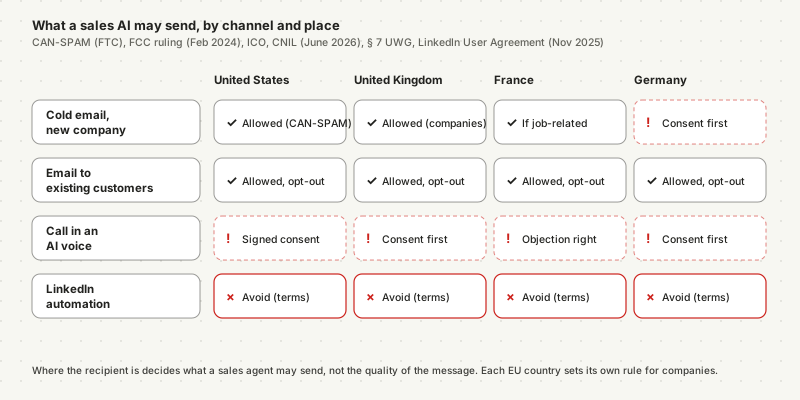
Whether cold email is legal depends on where the recipient is. In the US, the CAN-SPAM Act allows unsolicited commercial email, business-to-business included, as long as each message is honest, carries a postal address and offers an opt-out that you honor within 10 business days. In the EU, the ePrivacy Directive requires prior consent for marketing email to individuals and leaves email to companies to each country: the UK and France allow it under conditions, while Germany requires consent from businesses too. Calls in an AI voice are the strictest channel everywhere, since the FCC ruled in February 2024 that AI-generated voices count as "artificial" under the TCPA. This guide goes channel by channel through what an AI sales agent may send, what you must record, how opt-outs must work, and which steps a person should approve.
An AI sales agent can research companies, find the right person, write a tailored first message and follow up on time. The hard limit is not what the AI can do. It is what the law where each recipient sits lets anyone send.
This guide takes each channel in turn: email, AI-made calls and LinkedIn, for recipients in the US and in Europe, with Germany as the strictest case. It covers where contact data may come from, how opt-outs must work, what you have to record, and the fines. It ends with a simple split: what the agent may do on its own, and what a person should approve.
Is cold email legal?
In the US, yes, within the rules of the CAN-SPAM Act. In Europe it depends on the country and on whether the recipient is a person or a company. The Federal Trade Commission (FTC) says CAN-SPAM "makes no exception for business-to-business email", yet the law requires no consent: each message needs honest headers and subject lines, a postal address and a working opt-out.[1] The EU's ePrivacy Directive requires prior consent for marketing email to individuals and leaves email to companies to each member state.[2]
So the same campaign can be lawful in Chicago, allowed under conditions in London or Paris, and unlawful in Berlin. Plan by the rules of the place each recipient is in, not the place where your company or your AI tool sits.
What counts as marketing is broad on both sides of the Atlantic. CAN-SPAM covers any email whose "primary purpose" is to advertise or promote a commercial product or service.[1] A friendly introduction to your services, a webinar invitation that leads to your product, or a "quick question" that ends in a pitch all qualify. The tone of the message does not change its purpose.
For an AI agent, that means it needs to know where each contact is and what relationship you have with them before it writes a word. The sections below give the rules channel by channel.
What must every sales email from an AI include in the US?
Every commercial email to a US recipient must meet the same short list, whether a person or an AI writes it. The FTC's CAN-SPAM guide sets the rules: no false header information, no deceptive subject lines, the message identified as an ad, your valid physical postal address, and a clear way to opt out, with opt-outs honored within 10 business days.[1] The guide puts the penalty at up to $53,088 for each email that breaks the law.[1]
| Rule | What it means for your agent |
|---|---|
| Honest sender and routing | Send from your real domain and a named sender, not a lookalike domain. |
| Subject line matches the content | Subject lines describe the message; they do not bait a reply. |
| Identify the message as an ad | A plain statement that this is a commercial message. |
| Your physical postal address | In every email, follow-ups included. |
| A working opt-out | Honored within 10 business days, and able to take requests for at least 30 days after sending. |
Two further rules matter for AI agents in particular. The first is responsibility. The FTC says "you can't contract away your legal responsibility", and both the company being promoted and the company that sends the message may be held liable.[1] An outreach tool or an agency sending for you does not move the risk.
The second is where the addresses come from. The statute treats a breach as more serious when the addresses were collected by software from a website that promised not to share them, or generated by combining names, letters or numbers into guesses.[3] An agent that scrapes or guesses addresses turns an ordinary breach into an aggravated one.
Is cold email to businesses legal in Europe?
Cold email to businesses in Europe depends on the country. The ePrivacy Directive's consent rule for marketing email applies to subscribers who are natural persons, and Article 13(5) leaves it to each member state to protect companies.[2] The UK's Information Commissioner's Office (ICO) says its email rule "does not apply to corporate subscribers"; France's data protection authority, the CNIL, allows email to professionals when it relates to their job; and Germany requires prior consent from businesses too.[4][5][6]
| Country | Email to a company address | What still applies |
|---|---|---|
| United Kingdom | Allowed to limited companies and LLPs without consent. Sole traders and some partnerships count as individuals and need consent.[4] | Name the sender and give an address to opt out. UK data protection law covers named contacts.[4] |
| France | Allowed when the message relates to the recipient's job, such as software offered to an IT director.[5] | Tell people how their address will be used, and let them object in every message.[5] |
| Germany | Needs prior express consent from businesses too, under §7 of the Act against Unfair Competition (UWG), except for existing customers.[6] | The strictest rule in this guide. |
These three are examples, not the whole map. Each member state sets its own rule for companies, so the agent needs the rule for each country it sends to.
The UK rule has a trap for automated lists. The ICO warns that an email address does not tell you whether a business is a sole trader or a limited company, and says to treat the contact as an individual when in doubt.[4] An agent working from a scraped or bought list meets that question on every row.
Existing customers are the common ground across Europe. The directive lets a business email customers whose address it obtained "in the context of the sale of a product or a service" about its own similar products, as long as they could object when the address was collected and can object in every message.[2] Follow-ups to past buyers, renewal reminders and offers matched to past purchases are where an AI agent can work most freely, as long as the opt-out works.
Can an AI make sales calls?
An AI voice is the strictest channel on both sides of the Atlantic. In February 2024 the Federal Communications Commission (FCC) ruled that AI-generated voices are "artificial" under the Telephone Consumer Protection Act (TCPA), so a telemarketing call in an AI voice to a mobile number needs the called person's prior express written consent.[7][8] In the EU, "automated calling and communication systems without human intervention" need prior consent from individuals, and the UK and Germany require it from businesses as well.[2][4][6]
In the US, the consent has a precise form. FCC rules define it as a written agreement "bearing the signature of the person called" that authorises calls in an artificial or prerecorded voice to a named number; an electronic signature can count.[8] The rule covers any mobile number, a business mobile included.[9] A business landline falls outside the federal artificial-voice rule, but an agent working from a list rarely knows which numbers are mobiles. The safe practice is to treat every AI-voiced sales call as needing written consent.
The penalties come per call. The TCPA lets the person called sue for $500 for each violation, and a court may triple that for a willful or knowing one.[9] Enforcement against AI voices has already happened: the FCC fined a political consultant $6 million for robocalls that used an AI-cloned voice of President Biden and a spoofed caller ID.[10]
In Europe the rule for companies varies again. The ICO says automated B2B marketing calls need consent that specifically covers automated calls from you.[4] Germany requires prior express consent from every recipient, businesses included, for advertising with an automatic calling machine.[6] France's CNIL lets professionals object instead of requiring their prior consent, under the same job-related condition as email.[5] No European court has yet said whether a modern voice agent is an automatic calling machine, but the directive's wording, "without human intervention", fits it closely.[2] Treat it as one.
Calls by a person are a separate question. In the US, the National Do Not Call Registry protects residential subscribers, so it does not bar a person from calling a business number.[8] In the UK, live B2B calls must be screened against both the TPS and the CTPS registers.[4] Germany allows calls to businesses only with at least presumed consent.[6]
Inbound calls are different again. An AI that answers your phone when customers call you is not advertising to anyone who did not ask. The risk sits with outbound sales calls, so the rule is simple: an AI dials only people whose consent is on record, in the form that place requires.
Is LinkedIn outreach by an AI allowed?
Not by automation on LinkedIn itself, in any country. LinkedIn's User Agreement, effective 3 November 2025, prohibits using "bots or other unauthorized automated methods to access the Services, add or download contacts, send or redirect messages", and using software to "scrape or copy" profiles.[11] A sales agent that logs in and messages people for you breaks those terms, and the account is at risk.
The law adds further layers. In the EU, the ePrivacy Directive defines electronic mail as "any text, voice, sound or image message sent over a public communications network" that can be stored until the recipient collects it.[2] A promotional direct message can fit that definition, which would put it under the email rules above. In California, a law makes it unlawful to use a bot online, social networks included, to mislead people about its artificial identity in order to sell to them; disclosing that it is a bot avoids liability.[12]
That still leaves room for an AI agent to help:
- Research. It can work from information you are allowed to use, such as company websites and public announcements, and prepare a short brief on each prospect.
- Drafting. It can write a first message that refers to something specific and relevant, for a person to review.
- Sending. A person sends from their own account, after deciding the contact is appropriate.
Connection requests, comments and conversations that people start with you are ordinary use. The line is crossed when software sends promotional messages on its own or copies profiles at scale.
Where may your agent get contact data, and what must it tell people?
In Europe, the name and work email of a business contact are personal data, and people whose data you did not collect from them must be told where it came from. Under Article 14 of the GDPR you must inform them at the latest with your first message, and within one month of obtaining the data in any case.[13] The ICO confirms that a contact's details are personal data "even if they are acting in their business capacity".[4] In the US no federal law requires that notice, but CAN-SPAM's rules on harvested addresses and on hired senders still apply.[1][3]
Article 14 asks for more than a link. People must learn who you are, why you process their data, the source of the data and "whether it came from publicly accessible sources", and that they can object to direct marketing.[13]
For an AI agent, the data source matters in three ways:
- Scraped lists. LinkedIn's terms forbid scraping its profiles, and CAN-SPAM treats addresses collected by software from websites that promised not to share them as an aggravating factor.[11][3]
- Bought lists. A purchased list does not carry the consent Germany requires, or that individuals in the EU must give. Ask the seller exactly what the people on it agreed to, and keep the answer. In the US, buying the list does not shift responsibility for how you use it.[1]
- Public company data. A company's website, published contacts and press releases can inform research. They do not create consent where a country requires it.
The agent should record, for every contact, the country, where the data came from and on what basis it may be used. Those columns answer most of the questions a regulator, a lawyer or the recipient will ask. Our guide to GDPR for AI agents covers the wider data protection duties in Europe.
What happens when someone opts out?
An opt-out has to stop every promotional message, in every system. In the US, CAN-SPAM requires opt-outs to be honored within 10 business days.[1] In the EU, Article 21 of the GDPR lets a person object to direct marketing at any time, after which their data "shall no longer be processed for such purposes".[13] In October 2026 Italy's data protection authority announced a €5,508,000 fine on the bank BBVA because a customer's objection never reached the system that sent its marketing.[14]
The BBVA case is a warning for anyone running an AI agent alongside other tools. The customer objected in the bank's app and again through customer service. BBVA recorded the objection correctly, but "a technical failure prevented synchronisation" between its internal systems and the unit that sent commercial messages, and promotions continued for seven months.[14] The authority also rejected the bank's argument that the customer should have used a dedicated email address: a valid objection counts whichever channel it arrives through.[14]
BBVA recorded the customer's objection correctly. Its marketing system never heard about it, and the bank was fined €5.5 million.
An AI sales agent adds one more place where an opt-out must land. It works from a list, drafts follow-ups and may schedule sequences weeks ahead. If an opt-out reaches your CRM but not the agent's list, the agent keeps writing.
Three rules keep this under control:
- One suppression list. Every system that sends anything promotional checks the same list before each send.
- Any channel counts. "Please stop" in a reply email, on the phone or in a LinkedIn message is an opt-out. The agent should recognise it and record it.
- Stop sequences at once. Scheduled follow-ups to that person are cancelled, not left to run out. Ten business days is the US deadline, not a target.
What must you document?
You must be able to show why each contact could be messaged. Under the GDPR, a business that relies on consent must "be able to demonstrate" that the person consented.[13] In the US, written consent for telemarketing calls in an AI voice must carry the called person's signature and name the number it covers.[8] Germany adds a specific rule: consent to phone advertising from consumers must be documented when it is given and kept for five years.[15]
The formal duties differ by place. The practical need is the same everywhere: if a recipient complains, a regulator asks or a competitor's lawyer writes, the question is "why could you contact this person?"
For an AI agent, documentation should be part of its routine, not an afterthought:
Record the country and the source
Record the basis
Check before each send
Log what was sent
Keep the records
The checklist holds these steps with the channel rules: Download the sales AI outreach checklist (PDF).
Must the agent say it is an AI?
In Europe, when the agent talks with people directly, yes. Article 50 of the EU AI Act, which applies from 2 August 2026, requires AI systems that interact directly with people to be designed so that people are informed from the start, unless it is obvious.[16] In the US there is no general federal rule for AI-written email, but a call in an artificial voice must state the identity of the business "at the beginning of the message", and California bans bots that hide their artificial identity to sell online.[8][12]
An email drafted by AI and sent by a person under their own name is a different case. The person is the one communicating; the AI helped write. Article 50's direct-interaction duty is aimed at systems that interact with people themselves, such as chatbots and AI agents.[16] Breaches of Article 50 can be fined up to €15 million or 3% of turnover, and for small businesses the lower of the two.[17]
The grey zone is an agent that holds an email conversation on its own, replying to prospects without a person reading first. That looks like direct interaction. If you run an agent that way, say so in the signature, for example "This reply was written by our AI assistant".
Being open about AI has a commercial upside too. A prospect who later finds out that the "personal" exchange was automated is less likely to trust you than one who knew from the start. Our guide to what the EU AI Act asks of deployers covers Article 50 in more detail.
What are the fines, and who enforces them?
Fines differ by place, but most are counted per message, per call or as a share of turnover. In the US, the FTC puts CAN-SPAM penalties at up to $53,088 per email, and the TCPA gives each person called $500 per unlawful call, up to three times that when willful.[1][9] In the UK, the ICO can fine breaches of the marketing rules up to £17.5 million or 4% of global turnover.[18] In Germany, the federal network agency fined companies more than €1.09 million for unlawful phone advertising in 2025.[19]
| Breach | Where | Consequence |
|---|---|---|
| Commercial email that breaks CAN-SPAM | US | Up to $53,088 per email (FTC)[1] |
| Sales call in an AI voice without written consent | US | $500 per call in a private lawsuit, up to $1,500 if willful[9] |
| Robocalls with an AI-cloned voice and spoofed caller ID | US | $6 million FCC fine on the consultant behind them, 2024[10] |
| Marketing email or calls that break the UK rules | UK | Up to £17.5 million or 4% of global turnover (ICO)[18] |
| Advertising or automated call to a consumer without consent | Germany | Up to €300,000 (Bundesnetzagentur)[20] |
| Ignoring an objection to direct marketing | EU | GDPR fine; BBVA €5,508,000 in Italy[14] |
| AI not disclosed in direct interaction | EU | Up to €15 million or 3%, the lower for small businesses[17] |
Volume is what turns a mistake into a large bill. Under the TCPA each call is a separate violation, and the German agency received 39,842 written complaints about unlawful phone advertising in 2025 alone.[9][19] An AI agent that sends or calls quickly produces breaches just as quickly. For the wider picture of AI-related penalties in Europe, see our record of AI fines in Europe so far.
What should a sales agent do on its own, and what needs a person?
A sales agent can research, draft and follow up on its own, within the rule for each country and your consent and customer lists. A person should approve cold email lists and templates, every first contact in a country that requires consent, every outbound call and anything sent on LinkedIn. That split follows from CAN-SPAM, the FCC's February 2024 ruling on AI voices, the EU ePrivacy rules and LinkedIn's terms.[1][7][2][11]
| Task | Agent on its own | Person approves |
|---|---|---|
| Research companies and contacts from lawful sources | Yes | |
| Draft first messages and call notes | Yes | |
| Email existing customers, with an opt-out | Yes | |
| Cold email to US businesses, CAN-SPAM rules met | Sends within an approved list and template | Approves the list and the template |
| Cold email to companies in the UK or France | Sends within an approved list and template | Checks the country rule and the list |
| First email to a new contact in Germany | Only with consent on record | |
| Phone call to a business by a person | Prepares only | Decides and calls |
| Outbound call in an AI voice | Only with consent on record, signed in the US | |
| LinkedIn message | Drafts only | Sends from their own account |
| Opt-outs and objections | Yes, immediately |
This is how we build sales agents: the agent does the work that takes hours, and a person spends minutes on the decisions the law puts on them. Our guide to approval workflows in an AI agent system covers how the approval step works in practice, and what an AI lead-generation agent does covers the sales job itself. If your process does not fit an off-the-shelf tool, a custom agent can be built around your lists, channels and countries.
Frequently asked questions
Is cold email legal in the US? Yes, if each message follows the CAN-SPAM Act. The law covers business-to-business email and does not require consent, but every commercial email needs honest headers and subject lines, a valid postal address and a working opt-out, and opt-outs must be honored within 10 business days. The Federal Trade Commission puts the maximum penalty at $53,088 per email.
Is cold email legal in Europe? It depends on the country and the recipient. The EU ePrivacy Directive requires prior consent for marketing email to individuals and lets each country set the rule for companies. The UK allows it to limited companies without consent, France allows it when the message relates to the recipient's job, and Germany requires prior consent from businesses too, except for existing customers.
Is it legal to use AI for cold calling? It is the riskiest channel. The FCC ruled in February 2024 that AI-generated voices are "artificial" under the Telephone Consumer Protection Act, so a telemarketing call in an AI voice to a mobile number needs the called person's prior express written consent. In the EU, automated calls need prior consent from individuals, and the UK and Germany require it from businesses as well.
Can an AI agent send LinkedIn messages for my sales team? LinkedIn's User Agreement, effective 3 November 2025, prohibits using bots or other unauthorised automated methods to send messages or add contacts, and prohibits scraping profiles, in every country. Let the agent research and draft, and have a person send from their own account.
Notes
- Federal Trade Commission, CAN-SPAM Act: A Compliance Guide for Business, accessed October 15, 2026. Used for the business-to-business coverage, the commercial-message definition, the requirements, the 10-business-day and 30-day opt-out rules, liability when another company sends, and the $53,088 maximum penalty per email.
- Directive 2002/58/EC (ePrivacy Directive), consolidated version, Articles 2(h) and 13, accessed October 15, 2026.
- 15 U.S.C. § 7704, Other protections for users of commercial electronic mail, subsection (b)(1), Legal Information Institute, accessed October 15, 2026.
- Information Commissioner's Office, Business-to-business marketing, accessed October 15, 2026. The ICO states that this guidance is under review after the Data (Use and Access) Act.
- CNIL, La prospection commerciale par courrier électronique, SMS-MMS et automate d'appel, June 10, 2026, accessed October 15, 2026.
- Gesetz gegen den unlauteren Wettbewerb (UWG), § 7 Unzumutbare Belästigungen, accessed October 15, 2026.
- Federal Communications Commission, FCC Makes AI-Generated Voices in Robocalls Illegal, news release, February 8, 2024, accessed October 15, 2026.
- 47 CFR § 64.1200, Delivery restrictions, paragraphs (a)(2), (b)(1), (c)(2) and (f)(9), Legal Information Institute, accessed October 15, 2026.
- 47 U.S.C. § 227, Restrictions on use of telephone equipment, subsections (b)(1) and (b)(3), Legal Information Institute, accessed October 15, 2026.
- Federal Communications Commission, news release on the $6 million fine for the New Hampshire robocalls, September 26, 2024, accessed October 15, 2026.
- LinkedIn User Agreement, effective November 3, 2025, section 8.2, accessed October 15, 2026.
- California Business and Professions Code, sections 17940–17943 (Bots), operative July 1, 2019, accessed October 15, 2026.
- Regulation (EU) 2016/679 (GDPR), Articles 7(1), 14 and 21, accessed October 15, 2026.
- European Data Protection Board, Italian DPA fines BBVA EUR 5 508 000 for failing to respect a customer's objection to direct marketing, October 9, 2026 (decision of July 3, 2026), accessed October 15, 2026.
- UWG, § 7a Einwilligung in Telefonwerbung, accessed October 15, 2026.
- European Commission, Transparency obligations under Article 50 AI Act (FAQ), last updated July 24, 2026, accessed October 15, 2026.
- AI Act Service Desk, Article 99: Penalties, consolidated text as of July 27, 2026, accessed October 15, 2026.
- Information Commissioner's Office, One year on: marking the 12-month commencement of the Data (Use and Access) Act, June 23, 2026, accessed October 15, 2026.
- Bundesnetzagentur, press release on unlawful telephone advertising in 2025, January 26, 2026, accessed October 15, 2026.
- UWG, § 20 Bußgeldvorschriften, accessed October 15, 2026.