For owners and managers deciding whether their company needs its own AI server: what local AI solves under data-protection law, what the hardware and running costs are against a European cloud, and which open models may be used commercially.
What you'll learn
- The four ways to run AI for a company, and where the data goes in each
- What German data-protection regulators prefer, and why that is not the same as owning hardware
- Hardware list prices on October 30, 2026, and which models fit in how much memory
- A worked month: own machine, rented server and European cloud for the same model
- Licences of six open model families, including an EU restriction in Llama 4's terms
- Who keeps a local AI server running, and a decision table
Companies are told that only AI running on their own server is safe under data-protection law, and are offered the server to go with it. The cost picture says otherwise for most of them. On October 30, 2026, NVIDIA listed its DGX Spark desk AI computer at $6,950, while the same open model cost €3.60 to €12.25 a month at three European clouds for 10,000 requests. This guide compares the routes: your own hardware, a rented server, a European cloud and a US provider's EU region. It covers what German regulators actually prefer, what the hardware costs, which open models a company may use commercially, and who keeps the server running.
On October 30, 2026, NVIDIA listed its DGX Spark, a desk computer built to run AI models, at $6,950. The same open model it is built for cost €3.60 to €12.25 a month at three European clouds for an example workload of 10,000 requests. A server pays for itself only at many times that volume.
Cost is rarely the reason companies ask about local AI. The question usually comes from data protection: someone has said that only AI on your own hardware is safe. This guide separates what that claim gets right from what it leaves out.
Do you need your own AI server?
Most companies do not need their own AI server to use AI safely with business data. Germany's data-protection authorities (DSK), in guidance of May 6, 2024, prefer "technically closed" AI systems, and they define closed by criteria, not by who owns the hardware.[1] A cloud provider under the right contract can meet those criteria.
An own server is worth considering in three situations. A client contract or professional rule forbids any processing outside your premises. The system has to work without an internet connection. Or the volume is so high and steady that paying per request costs more than hardware and staff. The rest of this guide gives the numbers for each.
Everything else is decided by contract and configuration: where requests are processed, whether the provider stores them, whether it trains on them. Those questions have answers in writing for every cloud route, and they are the same questions an own server answers by design.
What are the ways to run AI for a company?
A company can run AI in four places: on its own hardware, on a rented server in a data centre, at a European cloud that bills per use, or at a US provider's European region. On October 30, 2026, all four had public prices, from about $2,500 for a desk computer to fractions of a cent per request.[3][5][6][7]
| Route | Who runs the AI model | Where requests go | How you pay | Example price |
|---|---|---|---|---|
| Own hardware | Your company or your IT partner | Your office or server room | Buy once, plus electricity and staff time | DGX Spark $6,950 / €7,490[5] |
| Rented server | Your partner, on a machine you rent alone | A named data centre | Monthly rent | Hetzner GEX63, €999 a month plus €999 setup, before VAT[7] |
| European AI cloud | The provider | The provider's European data centre | Per token, a unit of text | gpt-oss-120b at IONOS, €0.15 per million input tokens, before VAT[3] |
| US provider, EU region | The provider | The region you choose | Per token | gpt-oss-120b on Amazon Bedrock Frankfurt, $0.20 per million input tokens[3] |
The two own-server routes run open models, whose makers publish them for anyone to run. The two cloud routes offer the same open models, and the US providers add their own closed ones. Our reference of European AI clouds and their prices lists every model the six European providers price publicly.
Is local AI more GDPR compliant than cloud AI?
Local AI is not automatically more GDPR compliant. Germany's DSK guidance of May 6, 2024 calls technically closed systems "preferable from a data-protection point of view" and describes closed by four features: processing in a delimited environment, a narrow group of users, the company in control of inputs and outputs, and no training by the provider on what is entered.[1]
Germany's data-protection authorities prefer closed AI systems. Closed means control over inputs and no training by the provider, not hardware in your own building.
The open systems the DSK warns about are run "as a cloud solution", accessible over the internet to an unrestricted group of users, where inputs leave the company and may be reused for other purposes or sent to countries outside the EU.[1] A consumer chatbot fits that description. A company account at a cloud provider can be set up the other way.
The same guidance describes the contract that makes the difference. When a company uses an external provider's AI "as a cloud solution", the provider usually acts as a processor and the company has to sign a data processing agreement under Article 28 of the GDPR.[1] The provider then processes only on the company's instructions.
What stays with your company on every route: a legal basis for the data, transparency towards the people concerned and, for higher-risk uses, an impact assessment. Running the model yourself removes the processor, not these duties. Our guide to GDPR obligations for companies deploying AI sets them out.
For a company outside the EU, the same three questions decide the matter and are answered in the provider's business terms: where requests are processed, whether they are stored, and whether they train models. Our comparison of which AI providers train on business data answers the last one for the large US providers.
What does a US provider's EU region solve?
A US provider's European region decides where the AI model processes requests, not who the provider is. On October 26, 2026, Amazon Bedrock charged $0.20 per million input tokens for gpt-oss-120b in Frankfurt and $0.15 in US East, a premium of a third for the European location.[3]
The DSK guidance points to the remaining question: transfers of personal data to countries outside the EU follow the separate rules of Chapter V of the GDPR.[1] A European region does not settle whether account, billing or support data still reach the US. Our guide to whether AI data residency keeps your data in Europe goes through what Microsoft, Google, OpenAI, AWS and Anthropic promise there.
For US companies, the region choice usually follows a client's request rather than the law at home. A company serving European clients can meet a contractual EU-processing clause this way without moving its whole AI setup to a European provider.
What hardware does local AI need?
The deciding figure for local AI hardware is memory: the model has to fit into it. OpenAI states that gpt-oss-20b runs within 16 GB of memory and gpt-oss-120b on a single graphics card with 80 GB.[8] Mistral states that its Small 3.2 model needs about 55 GB of graphics memory at full precision.[9]
Larger open models need far more. DeepSeek-V3.1 lists 671 billion parameters, the numbers a model learns in training; NVIDIA says its DGX Spark, with 128 GB of memory, runs models of up to 200 billion parameters.[11][4] Each step up in model size moves the hardware into a different price class.
| Machine (list price, October 30, 2026) | Memory for the model | US price | German price | Fits, by the makers' own figures |
|---|---|---|---|---|
| Apple Mac Studio, M5 Max | from 36 GB, shared | from $2,499 | from €2,999 | gpt-oss-20b |
| Apple Mac Studio, M5 Ultra | from 96 GB, shared | from $5,499 | from €6,599 | Mistral Small 3.2, gpt-oss-120b |
| NVIDIA DGX Spark | 128 GB, shared | $6,950 | €7,490 | gpt-oss-120b; models up to 200 billion parameters |
| Hetzner GEX45, rented | 24 GB graphics memory | – | €214 a month + €209 setup, before VAT | gpt-oss-20b |
| Hetzner GEX63, rented | 96 GB graphics memory | – | €999 a month + €999 setup, before VAT | Mistral Small 3.2, gpt-oss-120b |
Prices come from Apple's and NVIDIA's own stores and Hetzner's GPU server page.[6][5][7] "Fits" compares the makers' memory figures with the machine's memory; it says nothing about speed, which we did not test. Hetzner rents its GPU servers in Falkenstein, Germany, and Helsinki, Finland.[7]
What does an own AI server cost compared with the cloud?
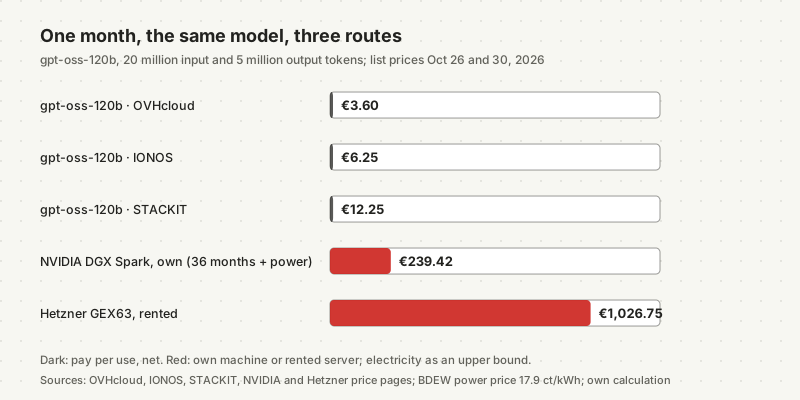
For a typical company workload, an own AI server costs many times more than paying per use. In our example month of 20 million input and 5 million output tokens, gpt-oss-120b costs €3.60 to €12.25 at three European clouds. A DGX Spark spread over three years costs about €239 a month, and a rented Hetzner GEX63 about €1,027 (own calculations, October 2026 prices).[3][5][7][16]
The example volume is the one used in our European AI clouds reference: 10,000 requests a month, each sending about 2,000 tokens and receiving about 500. A token is a piece of a word; 100 tokens make about 75 English words. That is roughly an email thread with instructions per request, a busy internal assistant for a small team.
| Route, gpt-oss-120b | Calculation | Month |
|---|---|---|
| OVHcloud, per use | 20 × €0.08 + 5 × €0.40 | €3.60 |
| IONOS, per use | 20 × €0.15 + 5 × €0.65 | €6.25 |
| STACKIT, per use | 20 × €0.45 + 5 × €0.65 | €12.25 |
| Amazon Bedrock US East, per use | 20 × $0.15 + 5 × $0.60 | $6.00 |
| NVIDIA DGX Spark, own | €7,490 ÷ 36 months + at most €31.36 electricity | €239.42 |
| Hetzner GEX63, rented | €999 rent + €999 setup ÷ 36 months | €1,026.75 |
The electricity line is an upper bound. NVIDIA rates the DGX Spark's power supply at 240 watts; running at that limit around the clock uses 175.2 kWh a month.[4] At 17.9 cents per kWh, the average BDEW gives for small and medium industrial businesses in 2026, that is €31.36.[16] Cloud and Hetzner prices are before VAT; NVIDIA's German store does not say whether its price includes it.
When does an own AI server pay for itself?
An own AI server pays for itself only at a volume far above most companies' use. At the same mix of input and output, a DGX Spark at €239.42 a month matches the cloud bill at about 490 million tokens a month at STACKIT's prices and about 1.66 billion at OVHcloud's (own calculation, October 2026 prices).
That is 20 to 66 times the example month, or roughly 195,000 to 665,000 requests of the same size. Whether a single desk machine can even process that much depends on the model and on how many people use it at once; we did not test it. A rented GEX63 breaks even only at 2.1 to 7.1 billion tokens a month.
The comparison leaves out the largest cost on the own-server side: the time of the person who keeps it running. The cloud prices include that work. Our breakdown of what an AI implementation costs in Europe shows where a company's AI budget actually goes: into building and running the system, not into tokens.
Which open AI models may a company use commercially?
Most open models may be used commercially under their published licences. On October 30, 2026, gpt-oss, Mistral Small 3.2, Qwen3 and Gemma 4 were released under Apache 2.0, a licence that allows commercial use, and DeepSeek-V3.1 under the MIT licence.[8][9][10][12][11] Meta's Llama models and older Gemma models carry their makers' own terms.
| Model family | Licence as published | What it means for a company |
|---|---|---|
| gpt-oss-20b and 120b (OpenAI) | Apache 2.0[8] | Commercial use allowed; keep the licence notice |
| Mistral Small 3.2 24B (Mistral AI) | Apache 2.0[9] | Commercial use allowed; keep the licence notice |
| Qwen3-235B-A22B (Alibaba) | Apache 2.0[10] | Commercial use allowed; keep the licence notice |
| DeepSeek-V3.1 (DeepSeek) | MIT[11] | Commercial use allowed; keep the licence notice |
| Gemma 4 (Google) | Apache 2.0, page updated April 1, 2026[12] | Commercial use allowed; earlier Gemma models fall under the Gemma Terms of Use, whose use restrictions must be passed on to anyone you give the model to |
| Llama 3.3 and Llama 4 (Meta) | Llama community licences of December 6, 2024 and April 5, 2025[15][13] | Commercial use allowed below 700 million monthly users; "Built with Llama" shown when you distribute it; Meta's use policy applies |
Llama 4's use policy withholds the rights to its multimodal models, those that read images as well as text, from any company with its principal place of business in the European Union. The restriction does not apply to end users of a product that already contains the model. A German company that wants to run Llama 4 itself should read that clause first.[14]
A licence covers the model, not what you do with it. The data protection, client-confidentiality and copyright questions of a use stay the same whether the model runs at home or in a cloud. Our article on who owns what AI produces covers the output side.
Are open models as good as ChatGPT or Claude?
The question has a hard limit: the models behind ChatGPT, Claude and Gemini cannot run on your own server at all, because OpenAI, Anthropic and Google do not publish them. Local AI means open models. OpenAI describes its own open gpt-oss-120b as made "for production, general purpose, high reasoning use cases".[8]
Quality then depends on how large a model your hardware holds. OpenAI positions the smaller gpt-oss-20b "for lower latency, and local or specialized use cases"; a machine with 24 or 36 GB of memory holds that class, not the 120b one.[8] A cheaper server usually means a smaller model, and a smaller model usually means more mistakes on harder tasks.
The same open models run in the European clouds, so a company can test them on its own tasks for a few euros before buying anything. That test answers the quality question better than any published ranking. Our guide to how reliable AI agents are explains how to judge the results.
Who keeps a local AI server running?
On your own server, your company or its IT partner keeps the AI running: updates, security, backups, monitoring and model changes. A report written for the European Data Protection Board's expert programme in April 2025 says that whoever runs an open model "is responsible for all aspects of system integration, maintenance, and security".[2]
The same report notes that this operator still depends on the model's maker "for updates or bug fixes".[2] In practice, the server needs someone who notices when a new model version appears, tests it on the company's tasks, installs it and restores the old one if the answers get worse. A cloud provider does that work in its price; it also retires models on its own schedule.
The hardware itself needs care: power, cooling, a place to stand, replacement parts and a plan for the day it fails. A rented server removes the hardware part but leaves the software work. Our guides to what keeps an AI agent working after launch and to AI model retirements describe that ongoing work.
Local AI or cloud: which route fits your company?
Choose the route by the strictest requirement your data carries, not by the strongest sales argument. On October 30, 2026, the cheapest compliant route for most companies was a European cloud under a data processing agreement. An own server fits when contracts, connectivity or volume demand it.
| Your situation | Route that fits | Why |
|---|---|---|
| Client contract or professional rule forbids any external processing | Own hardware | The only route with no outside processor |
| The system must work without internet | Own hardware | Cloud routes need a connection |
| Data must stay in Germany or the EU, normal volume | European AI cloud, or a rented server in a named data centre | Location in the contract, no hardware to run |
| You already work with a US cloud and need EU processing | US provider's EU region | Same setup, European location, check where other data goes |
| Steady volume of hundreds of millions of tokens a month | Compare own hardware with the cloud on your own figures | Hardware can pay off at that volume |
| You want the strongest closed models | US provider, in its EU region where available | Closed models do not run on your own server |
Whichever route fits, the AI model is one part of a working system. The process it takes over, the data it touches and the tools it connects to decide the rest. That is the work Yardwork does: we choose the route and the model with you, build the system around the process, and keep it running after launch.
Frequently asked questions
Is local AI more GDPR compliant than cloud AI? Not automatically. Germany's data-protection authorities (DSK, guidance of May 6, 2024) prefer technically closed systems: processing in a delimited environment, a narrow group of users, the company in control of inputs and outputs, and no training by the provider. A company's own server can meet that, but so can a cloud provider under a data processing agreement that excludes training. The GDPR obligations of the company stay the same on either route.
How much does a local AI server cost? On October 30, 2026, NVIDIA listed its DGX Spark desk AI computer with 128 GB of memory at $6,950 in the US and €7,490 in Germany. Apple's Mac Studio started at $2,499 (M5 Max) and $5,499 (M5 Ultra). Hetzner rented a server with a 96 GB graphics card for €999 a month plus a €999 setup fee, before VAT. Staff time to run it comes on top.
Can open-source AI models be used commercially? Most can, under their published licences. gpt-oss, Mistral Small 3.2, Qwen3 and Gemma 4 are released under Apache 2.0, and DeepSeek-V3.1 under the MIT licence, as checked on October 30, 2026. Llama models carry Meta's own community licence with attribution rules and a 700-million-user threshold, and Llama 4's use policy withholds the rights to its multimodal models from companies based in the EU.
Is a local AI model as good as ChatGPT? The models behind ChatGPT, Claude and Gemini cannot be run on your own server at all, because their makers do not publish them. What runs locally are open models such as gpt-oss, Qwen or Mistral Small, and the larger ones need more memory than a desk machine has. The only reliable comparison is a test on your own tasks before you buy hardware.
Notes
- Datenschutzkonferenz (DSK), Orientierungshilfe Künstliche Intelligenz und Datenschutz, version 1.0, May 6, 2024, accessed October 30, 2026. Section 1.7 (closed and open systems, paras. 15–20), para. 21 and para. 32 (processing agreement). Quotations translated by Yardwork.
- Isabel Barbera for the EDPB Support Pool of Experts, AI Privacy Risks & Mitigations: Large Language Models (LLMs), April 2025, accessed October 30, 2026. The report states that it does not necessarily reflect the EDPB's official position.
- Provider price pages as recorded in Yardwork's European AI clouds reference, accessed October 26, 2026: OVHcloud AI Endpoints catalogue, IONOS AI Model Hub, STACKIT AI Model Serving, AWS Amazon Bedrock price list files (published October 16, 2026).
- NVIDIA, DGX Spark, accessed October 30, 2026. Used for 128 GB memory, models up to 200 billion parameters and the 240 W power supply.
- NVIDIA Marketplace, Personal AI Supercomputers (US) and German store, accessed October 30, 2026. DGX Spark 4 TB: $6,950.00 and €7,490.00.
- Apple Store, Buy Mac Studio (US) and German store, accessed October 30, 2026. Starting prices and memory of the listed configurations.
- Hetzner, Dedicated servers with GPU, accessed October 30, 2026. Monthly prices and setup fees excluding VAT; locations.
- OpenAI, gpt-oss repository and gpt-oss-120b model card on Hugging Face, accessed October 30, 2026. Used for the Apache 2.0 licence, memory requirements and intended uses.
- Mistral AI, Mistral-Small-3.2-24B-Instruct-2506 on Hugging Face, accessed October 30, 2026.
- Qwen, Qwen3-235B-A22B on Hugging Face, accessed October 30, 2026.
- DeepSeek, DeepSeek-V3.1 on Hugging Face, accessed October 30, 2026. Used for the MIT licence and 671 billion parameters.
- Google, Gemma 4 license (last updated April 1, 2026) and Gemma Terms of Use (last modified April 1, 2026), accessed October 30, 2026.
- Meta, Llama 4 Community License Agreement, effective April 5, 2025, accessed October 30, 2026.
- Meta, Llama 4 Acceptable Use Policy, accessed October 30, 2026.
- Meta, Llama 3.3 70B Instruct and Llama 3.3 Community License on Hugging Face, release date December 6, 2024, accessed October 30, 2026.
- BDEW, Strompreisanalyse Oktober 2026, October 28, 2026, accessed October 30, 2026. Average electricity price for small and medium industrial businesses in 2026 to date: 17.9 ct/kWh.