For companies whose software runs on an AI model from OpenAI, Anthropic, Google or Mistral, directly or through Azure, Amazon Bedrock or Google Cloud: when each model is switched off and what to do before that date.
What you'll learn
- Which AI models are being switched off between November 2026 and September 2027, with announced and checked dates
- What deprecated, legacy and retired mean at each provider
- How much notice each provider promises, and how much it has given in 2026
- Why the same model retires on different dates at OpenAI, Azure, Bedrock and Google Cloud
- What happens to a running system on shutdown day, from error messages to automatic model swaps
- Six steps to plan a model change before the date
Every AI model has a switch-off date, and the one that counts is set by the platform your system actually uses. On October 26, 2026, OpenAI listed GPT-4o for removal from its API on January 14, 2027, while Microsoft keeps the same versions running on Azure until April 14, 2027. Anthropic retires Claude Sonnet 4.5 on November 30, 2026; Amazon Bedrock keeps it until April 8, 2027. Published notice periods range from at least 60 days at Anthropic to six months at OpenAI and Mistral, and the notice actually given has sometimes been shorter. This calendar lists the shutdown dates from the official pages of OpenAI, Anthropic, Google, Microsoft, AWS and Mistral, each row with the date it was checked, and the steps to take before your model goes.
An AI model is not a permanent part of the software built on it. Every model gets a switch-off date, set by its maker and again by each cloud that resells it. When that date passes, a system that calls the old model either stops answering or starts using another model.
This page lists those dates from the official pages, with the date each was checked, and explains what they mean for a company whose quoting, order or document system depends on one.
Which AI models are being switched off in 2026 and 2027?
The next shutdowns of widely used models are close. Anthropic retires Claude Sonnet 4.5 on November 30, 2026. OpenAI removes GPT-5, GPT-5 mini and o3 from its API, the connection developers build software on, on December 11, 2026, and GPT-4o and GPT-4.1 on January 14, 2027.[1][4] On Microsoft Azure, the o-series reasoning models retire on November 19, 2026, and GPT-4o and GPT-4.1 on April 14, 2027.[9] All dates were checked on October 26, 2026.
The full calendar below runs from the end of October 2026 to September 2027. It covers models that read and write text, transcribe or speak, or index documents for search, wherever a company is likely to buy them: from the maker directly, or through Microsoft Foundry (Azure), Amazon Bedrock or Google Cloud.
Three points matter before reading any date:
- The platform decides the date. A model your partner reaches through Azure has Microsoft's date, not OpenAI's.
- Some dates are earliest possible, not fixed. Google's Gemini API and Anthropic's "not sooner than" dates can move later.[4][6]
- Dates change. Providers add rows every few weeks. The change log at the end records every change to this page.
What do deprecated, legacy and retired mean?
Deprecated, legacy and retired describe three stages that every provider uses, under different names. Legacy means the model gets no more updates. Deprecated means a switch-off date is set. Retired, shut down or end-of-life means requests to it fail. As of October 2026, Microsoft also closes deprecated models to new customers, and Amazon does the same with legacy models.[10][12]
The words differ enough to cause mistakes. At OpenAI, a model is "deprecated" from the day the switch-off is announced.[1] At Microsoft Foundry, "Deprecated" means existing customers can still use it but new ones cannot.[10] The table maps each provider's terms.
| Provider | Still works, date set | Switched off | What requests get afterwards |
|---|---|---|---|
| OpenAI | Deprecated (from the announcement); legacy = no more updates | Shut down, sunset | The model "will no longer be accessible"[1] |
| Anthropic | Legacy, then Deprecated with a retirement date | Retired | "Requests to retired models fail"[4] |
| Google Gemini API | Deprecation announced in release notes | Shutdown | The model is "completely turned off"; some names are redirected to a newer model[6] |
| Google Cloud | Retirement date listed | Retired | Errors, until the software is pointed at a newer model[7] |
| Microsoft Foundry (Azure) | Legacy, then Deprecated (no new customers) | Retired | An error message ("410 Gone"), unless the deployment was upgraded automatically[10] |
| Amazon Bedrock | Legacy (no new customers; higher prices possible) | End-of-life (EOL) | Requests fail; no automatic move to another model[12] |
| Mistral | Deprecated | Retired | An error message ("404")[14] |
Treat any of these warnings as the start of a project, not a footnote. The switch-off date is the day the system stops working on that model, whatever the provider calls it.
How much notice do AI providers give before switching a model off?
The warning a provider promises and the warning it gives are not always the same. OpenAI told developers on October 14, 2026 that GPT-4o leaves its API on January 14, 2027: 92 days, half of the six months its own rule sets for standard models.[1] For models out of testing, the eight platforms in the table promise between 45 days and six months in October 2026; test versions and other makers' models can go within two to four weeks.
| Platform | Published minimum notice | Exceptions stated |
|---|---|---|
| OpenAI API | 6 months for generally available models; 3 months for specialised variants (chat, coding, deep research) | Previews "such as 2 weeks"; faster if safety or compliance require[1] |
| ChatGPT | No minimum published | GPT-4o: announced Jan 29, retired Feb 13, 2026[2] |
| Anthropic | At least 60 days for publicly released models | Email to customers with active use[4] |
| Google Gemini API | Dates are "the earliest possible"; exact date "with advance notice" | No minimum stated[6] |
| Google Cloud | Stable models at least 12 months after release; short-term models at least 45 days | Dates "won't be moved to an earlier date"[7] |
| Microsoft Foundry | 60 days for generally available models, 30 days for previews; dates fixed at launch (18 months; 12 for Anthropic, Mistral, DeepSeek, Fireworks) | Fireworks models 15 days; emergency retirements for security[10][9] |
| Amazon Bedrock | Legacy for at least 6 months before EOL (models launched before Sep 7, 2026); 6 months or 45 days on each model card (later models) | Dates can differ by Region[12][11] |
| Mistral | 6 months for generally available models | 1 month for Labs, preview and third-party models[14] |
The minimums are not what every announcement gets. In 2026, these gaps between announcement and switch-off appear on the providers' own pages:
- ChatGPT, GPT-4o: 15 days (January 29 to February 13, 2026).[2]
- OpenAI API, GPT-4o and GPT-4.1: 92 days (October 14, 2026 to January 14, 2027), against a six-month minimum for generally available models.[1]
- Anthropic, Claude Sonnet 4.5: 61 days (September 30 to November 30, 2026).[4]
- Amazon Bedrock, Claude 3 Haiku in three Asia-Pacific Regions: 34 days of legacy status (October 10 to November 13, 2026), against a stated six-month legacy period.[12]
- Mistral, OCR 4.0: one day (September 29 to 30, 2026).[13]
None of these pages gives a reason for the shorter gap. For planning, count on the shortest notice the platform has given, not the minimum it publishes. What the switch then involves for your system is covered in what moves when you change AI providers.
AI model retirement calendar: November 2026 to September 2027
The calendar lists every announced shutdown of a text, chat, speech or search model from OpenAI, Anthropic, Google and Mistral between October 28, 2026 and September 30, 2027. It covers the makers' own platforms, Microsoft Foundry, Amazon Bedrock and Google Cloud. Each row was checked against the official page on October 26, 2026.[1][4][6][7][9][12][13]
| Shutdown | Platform | Model | Replacement named | Announced | Checked |
|---|---|---|---|---|---|
| Oct 31, 2026 | Mistral | Z.ai GLM 5.2 (third-party model) | Z.ai GLM 5.3 | Sep 29, 2026 | Oct 26, 2026 |
| Nov 13, 2026 | Amazon Bedrock (data-centre Regions Seoul, Mumbai, Singapore, London, Zurich, São Paulo, Canada) | Claude 3 Haiku, Claude 3 Sonnet, Claude 3.5 Sonnet (v1 and v2), Claude 3.7 Sonnet, Region by Region | None listed | Legacy from Oct 10–15, 2026 | Oct 26, 2026 |
| Nov 15, 2026 | Microsoft Foundry | claude-haiku-4-5 (see the conflict note below) | None listed | Not stated | Oct 26, 2026 |
| Nov 17, 2026 | Google Gemini API | Gemini 3.1 Flash TTS preview, Gemini 3.1 Flash Live preview, Gemini 2.5 Flash and Pro TTS previews, Gemini 2.5 Flash native audio preview | Gemini 3.8 Flash TTS / Gemini 3.8 Live | Not stated | Oct 26, 2026 |
| Nov 19, 2026 | Microsoft Foundry | o1, o1-pro, o3, o3-pro, o3-mini, o3-deep-research, o4-mini | GPT-5.6 Sol (o4-mini, o3-mini: GPT-5.6 Terra) | Not stated | Oct 26, 2026 |
| Nov 19, 2026 | Google Cloud | Gemini 3.6 Flash | Gemini 3.8 Flash | Not stated | Oct 26, 2026 |
| Nov 24, 2026 | Microsoft Foundry | claude-opus-4-5 | None listed | Not stated | Oct 26, 2026 |
| Nov 30, 2026 | Anthropic and Microsoft Foundry | Claude Sonnet 4.5 (claude-sonnet-4-5-20250929) | Claude Sonnet 5.5 | Sep 30, 2026 | Oct 26, 2026 |
| Nov 30, 2026 | OpenAI | Agent Builder, Evals platform, reusable prompts (building tools, not models) | Migration guides on OpenAI's page | Jun 3, 2026 | Oct 26, 2026 |
| Dec 9, 2026 | Microsoft Foundry | GPT-4o (2024-05-13); Mistral Medium 3 (mistral-medium-2505); Ministral 3B | GPT-5.6 Sol (automatic upgrade); Mistral Medium 3.5; Ministral 4B | Not stated | Oct 26, 2026 |
| Dec 11, 2026 | OpenAI | GPT-5, GPT-5 mini, GPT-5 nano, GPT-5 pro, o3, o3-pro | GPT-5.6 Sol, Terra, Luna | Jun 11, 2026 | Oct 26, 2026 |
| Dec 13, 2026 | Google Cloud | Gemini Live 2.5 Flash native audio | Gemini 3.8 Live | Not stated | Oct 26, 2026 |
| Dec 15, 2026 | Microsoft Foundry | whisper, tts, tts-hd (speech) | None listed | Not stated | Oct 26, 2026 |
| Jan 6, 2027 | OpenAI | tts-1, tts-1-hd, gpt-4o-mini-tts (speech) | gpt-realtime-2.1-mini | Oct 1, 2026 | Oct 26, 2026 |
| Jan 8, 2027 | Amazon Bedrock (three US Regions) | Claude Opus 4.1 | None listed | Legacy from Jul 8, 2026 | Oct 26, 2026 |
| Jan 14, 2027 | OpenAI | GPT-4o (2024-08-06, 2024-11-20), GPT-4o mini, GPT-4.1, GPT-4.1 mini | GPT-6 Luna | Oct 14, 2026 | Oct 26, 2026 |
| Jan 20, 2027 | OpenAI | gpt-realtime, gpt-audio, gpt-4o-audio, gpt-4o-realtime and their mini versions (voice) | gpt-realtime-2.1, gpt-audio-1.5 | Jul 20, 2026 | Oct 26, 2026 |
| Jan 28, 2027 | Google Cloud | Gemini 3.7 Flash | Gemini 3.8 Flash | Not stated | Oct 26, 2026 |
| Feb 9, 2027 | Microsoft Foundry | GPT-5, GPT-5 mini, GPT-5 nano (2025-08-07) | None listed | Not stated | Oct 26, 2026 |
| Feb 15, 2027 | Microsoft Foundry | Mistral Small 3.1 (mistral-small-2503) | Mistral Small 4 | Deprecated Oct 9, 2026 | Oct 26, 2026 |
| Feb 26, 2027 | OpenAI | whisper-1, gpt-4o-transcribe, gpt-4o-mini-transcribe, gpt-4o-transcribe-diarize (transcription) | gpt-live-transcribe or gpt-transcribe | Aug 26, 2026 | Oct 26, 2026 |
| Mar 30, 2027 | Amazon Bedrock | Mistral 7B, Mixtral 8x7B, Devstral 2, Voxtral Mini and Small; Gemma 3 (4B, 12B, 27B) | None listed | Legacy from Sep 30, 2026 | Oct 26, 2026 |
| Apr 1, 2027 | OpenAI | GPT-5.1, GPT-5.4 nano | GPT-6 Sol / GPT-6 Luna | Oct 1, 2026 | Oct 26, 2026 |
| Apr 1, 2027 | Google Cloud | text-embedding-004, text-embedding-005, text-multilingual-embedding-002 (search models) | None listed | Not stated | Oct 26, 2026 |
| Apr 7, 2027 | Microsoft Foundry | GPT-5 pro | None listed | Not stated | Oct 26, 2026 |
| Apr 8, 2027 | Amazon Bedrock (31 Regions) | Claude Sonnet 4.5; higher "extended access" prices possible from Jan 8, 2027 | None listed | Legacy from Oct 8, 2026 | Oct 26, 2026 |
| Apr 14, 2027 | Microsoft Foundry | GPT-4o (2024-08-06, 2024-11-20), GPT-4o mini, GPT-4.1, GPT-4.1 mini, GPT-4.1 nano | GPT-5.1 (for GPT-4o) | Not stated | Oct 26, 2026 |
| May 7, 2027 | Google Gemini API | Gemini 3.1 Flash-Lite | Gemini 3.5 Flash-Lite | Not stated | Oct 26, 2026 |
| May 15, 2027 | Microsoft Foundry | GPT-5.1 | None listed | Set at launch | Oct 26, 2026 |
| Jun 8, 2027 | Microsoft Foundry | GPT-5.2 | None listed | Set at launch | Oct 26, 2026 |
| Sep 2–21, 2027 | Microsoft Foundry | GPT-5.4, GPT-5.4 pro, GPT-5.4 mini, GPT-5.4 nano | None listed | Set at launch | Oct 26, 2026 |
"Not stated" means the official page gives the shutdown date but not the day it was announced. Microsoft sets the date for its generally available models when they launch, 18 months out, so those rows have no separate announcement.[10]
A conflict between two official pages. Microsoft's schedule lists claude-haiku-4-5 on Foundry for November 15, 2026. Anthropic lists Claude Haiku 4.5 as active, with no retirement date set, and says its dates apply on Microsoft Foundry.[9][4] If your system uses Claude Haiku 4.5 on Azure, ask Microsoft which date applies.
Many models that are not scheduled yet carry an earliest possible date. Anthropic and Google Cloud publish these for their current models, as of October 26, 2026:[4][7]
| Model | Earliest possible switch-off | Platform |
|---|---|---|
| Claude Opus 4.5 | Not before Nov 24, 2026 | Anthropic |
| Claude Opus 4.6 / Sonnet 4.6 | Not before Feb 5 / Feb 17, 2027 | Anthropic |
| Claude Opus 4.8 | Not before May 28, 2027 | Anthropic |
| Gemini 3.5 Flash | May 19, 2027 or later | Google Cloud |
| Claude Sonnet 5 / Opus 5 | Not before Jun 30 / Jul 24, 2027 | Anthropic |
| Gemini 3.8 Flash | Sep 2, 2027 or later | Google Cloud |
| Claude Opus 5.5 / Sonnet 5.5 / Haiku 5.5 | Not before Sep 22 / Sep 28 / Oct 7, 2027 | Anthropic |
| Gemini 4 Argon | Oct 13, 2027 or later | Google Cloud |
Image, video and coding models, and models from other makers on these platforms, are left out. Their dates are on the same official pages, listed in the section on where providers publish their dates.
Which AI models were switched off in 2026?
In 2026, the models that business tools were built on in 2024 and 2025 started to go. GPT-4o left ChatGPT on February 13, 2026. Claude Sonnet 4 and Opus 4 were retired on June 15, 2026. Google Cloud retired Gemini 2.5 Pro and Flash on October 20, 2026.[3][4][7] A system still configured for one of these models has already stopped working on that platform, or has been moved to another model.
| Switched off | Platform | Models |
|---|---|---|
| Jan 5, 2026 | Anthropic | Claude Opus 3 |
| Feb 13, 2026 | ChatGPT | GPT-4o, GPT-4.1, GPT-4.1 mini, o4-mini, GPT-5 Instant and Thinking (Enterprise kept GPT-5 to Feb 19) |
| Feb 19, 2026 | Anthropic | Claude Sonnet 3.7, Claude Haiku 3.5 |
| Mar 11, 2026 | ChatGPT | GPT-5.1 Instant, Thinking and Pro |
| Mar 26, 2026 | OpenAI API | gpt-4-0314, gpt-4-0125-preview |
| Apr 3, 2026 | ChatGPT (Business, Enterprise, Edu) | GPT-4o inside custom GPTs |
| Apr 20, 2026 | Anthropic | Claude Haiku 3 |
| May 11, 2026 | Google Cloud | Claude 3.7 Sonnet |
| Jun 1, 2026 | Gemini API and Google Cloud | Gemini 2.0 Flash, Gemini 2.0 Flash-Lite |
| Jun 15, 2026 | Anthropic | Claude Sonnet 4, Claude Opus 4 |
| Jul 5, 2026 | Google Cloud | Claude 3.5 Haiku |
| Jul 23, 2026 | OpenAI API | gpt-5-chat-latest, gpt-5.1-chat-latest, search and computer-use previews |
| Jul 31, 2026 | Mistral | Mistral Small 3.2, Mistral Nemo, Devstral 2, Magistral Medium and Small 1.2 |
| Aug 5, 2026 | Anthropic and Microsoft Foundry | Claude Opus 4.1 |
| Aug 10, 2026 | OpenAI API | gpt-5.2-chat-latest, gpt-5.3-chat-latest |
| Aug 23, 2026 | Google Cloud | Claude 3 Haiku |
| Aug 26, 2026 | OpenAI API | Assistants API (an older way of building assistants, not a model) |
| Aug 31, 2026 | Mistral | Mistral Medium 3 and 3.1 |
| Sep 10, 2026 | Amazon Bedrock (nine Regions, including Frankfurt, Ireland, London, Paris, US) | Claude 3 Haiku |
| Sep 28, 2026 | OpenAI API | gpt-3.5-turbo-instruct, gpt-3.5-turbo-1106, babbage-002, davinci-002 |
| Oct 14, 2026 | Amazon Bedrock | Claude Sonnet 4 |
| Oct 20, 2026 | Google Cloud | Gemini 2.5 Pro, Gemini 2.5 Flash, Gemini 2.5 Flash-Lite |
| Oct 23, 2026 | OpenAI API | gpt-4o-2024-05-13, gpt-4-turbo, gpt-4-0613, gpt-3.5-turbo-0125, gpt-4.1-nano, o1, o1-pro, o3-mini, o4-mini |
Sources: OpenAI, Anthropic, Google, Microsoft, AWS and Mistral pages, all checked on October 26, 2026.[1][3][4][6][7][8][9][12][13]
The named replacement is usually the provider's current model, not the next version up. For Claude Sonnet 4, retired in June 2026, Anthropic named Claude Sonnet 5.5; for GPT-4o in its API, OpenAI names GPT-6 Luna.[4][1]
Is GPT-4o going away?
GPT-4o is already gone from ChatGPT and is scheduled to leave OpenAI's API on January 14, 2027. OpenAI retired it from ChatGPT on February 13, 2026, after announcing it on January 29; only 0.1% of users were still choosing it each day.[2] Business, Enterprise and Edu workspaces kept it inside custom GPTs until April 3, 2026.[3]
The API date came later. On October 14, 2026, OpenAI notified developers that GPT-4o (versions 2024-08-06 and 2024-11-20), GPT-4o mini, GPT-4.1 and GPT-4.1 mini will be removed on January 14, 2027, with GPT-6 Luna as the replacement.[1] Fine-tuned (custom-trained) versions of these models follow the same date. The oldest version, gpt-4o-2024-05-13, was already shut down on October 23, 2026.[1]
On Microsoft Azure, GPT-4o has two dates as of October 26, 2026:[9][10]
- Version 2024-05-13 retires on December 9, 2026. Standard (pay-per-use) deployments are upgraded automatically to GPT-5.6 Sol on that day.
- Versions 2024-08-06 and 2024-11-20 retire on April 14, 2027, three months after OpenAI's own date, with GPT-5.1 named as the replacement.
Azure OpenAI itself is not being discontinued. Microsoft retires individual model versions on a fixed schedule; the service continues with newer models.[10] Voice mode and image generation in ChatGPT were not part of the GPT-4o retirement, according to OpenAI.[3]
Why do Azure, Bedrock and Google Cloud switch the same model off on different dates?
Each platform that resells a model sets its own retirement schedule. Anthropic states that its dates cover its own platform and Microsoft Foundry, while Amazon Bedrock and Google-managed Claude on Google Cloud "set their own retirement schedules". Amazon writes that for Bedrock "only the dates on the model card apply".[4][11] As of October 2026, the same model can run months longer, or end weeks earlier, depending on where it is bought.
| Model | Maker's own platform | Microsoft Foundry | Amazon Bedrock | Google Cloud |
|---|---|---|---|---|
| Claude Sonnet 4.5 | Nov 30, 2026 | Nov 30, 2026 | Apr 8, 2027 | Marked deprecated; no shutdown date published |
| Claude 3.7 Sonnet | Feb 19, 2026 | — | Nov 13, 2026 (Mumbai, London) | May 11, 2026 |
| Claude 3 Haiku | Apr 20, 2026 | — | Sep 10, 2026 (nine Regions); Nov 13, 2026 (six others) | Aug 23, 2026 |
| GPT-4o (2024-08-06) | Jan 14, 2027 | Apr 14, 2027 | — | — |
| GPT-5 (2025-08-07) | Dec 11, 2026 | Feb 9, 2027 | — | — |
| o3 | Dec 11, 2026 | Nov 19, 2026 | — | — |
| Mistral Medium 3 | Aug 31, 2026 | Dec 9, 2026 | — | — |
| Gemini 2.5 Pro | Gemini API: no date (past users only) | — | — | Oct 20, 2026 |
Sources: official pages of Anthropic, OpenAI, Mistral, Google, Microsoft and AWS, checked October 26, 2026.[1][4][5][6][7][8][9][12][13]
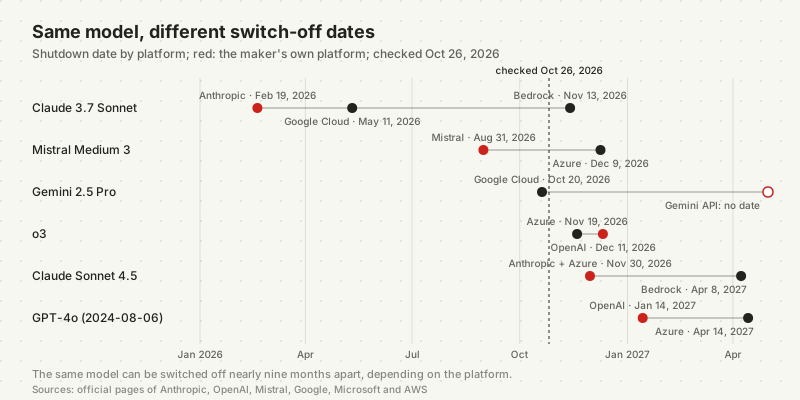
The reseller is not always later. Microsoft retires o3 on November 19, 2026, three weeks before OpenAI does.[9][1] Google Cloud switched Claude 3 Opus off on August 1, 2025, five months before Anthropic's January 5, 2026.[8][4] Amazon's dates can also differ between Regions, which matters when a system must run in a specific country for data-protection reasons; where AI providers process your data covers that choice.
Longer is not free either. Amazon moves legacy models into "public extended access" after at least three months, where "you should expect higher pricing, which will be set by the model provider". For Claude Sonnet 4.5 on Bedrock that phase starts January 8, 2027.[12]
What happens to a running system when its model is retired?
On the retirement date, a system that calls the old model gets one of two outcomes: an error, or an answer from a different model. Anthropic, OpenAI's API, Amazon Bedrock, Google Cloud and Mistral return errors as of October 2026. Microsoft Azure, parts of Google's Gemini API and ChatGPT move the work to a newer model automatically.[4][1][12][7][14][10][6][3]
| Platform | What happens on the day | What else changes before it |
|---|---|---|
| OpenAI API | Requests fail; custom-trained versions end with their base model | Dedicated capacity after shutdown may be possible through OpenAI sales[1] |
| ChatGPT | Chats, projects and custom GPTs move to the closest current model | Nothing to configure[3] |
| Anthropic | Requests fail | Deprecated models "are likely to be less reliable"[4] |
| Gemini API | The model is turned off; Gemini 3.5 Flash and 3.7 Flash are instead redirected to a newer model | Gemini 2.5 is limited to past users[6] |
| Google Cloud | Requests fail until the software uses the recommended model | —[7] |
| Microsoft Foundry | Standard (pay-per-use) deployments switch to the replacement automatically; deployments set to never upgrade, and reserved-capacity deployments, stop working ("410 Gone") | Deprecated models are closed to new subscriptions; dates "aren't extendable"[10] |
| Amazon Bedrock | Requests fail; "migration will not happen automatically" | Legacy models are closed to new customers; existing ones "may lose access after 15 days of inactivity"; extended access may cost more[12] |
| Mistral | Requests fail ("404") | Names ending in -latest move to new models without notice, which can change behaviour and price[14] |
A system that keeps answering after a retirement date may already be running on a different model. Microsoft upgrades standard Azure deployments automatically, Google redirects some Gemini model names, and ChatGPT moves custom GPTs, so the change can arrive without an error message and without anyone retesting the results.
An automatic switch keeps the lights on, but the new model reads the same instructions differently. Formats, the length of answers, and how strictly it follows rules can all change. For a system that fills in an order, a quote or a customer record, that is a quiet change to a business process. Watch for the signs in how to tell whether a live AI system is still working, and expect accuracy to differ between models, as measured error rates by model show.
An error is easier to notice but stops the work. Amazon also warns that an existing customer may lose access to a legacy model after 15 days without use, so a system that runs only at month-end can find its model gone before the official date.[12]
Can an AI model be switched off without notice?
Yes. On June 12, 2026, Anthropic disabled Claude Fable 5 and Claude Mythos 5 for all customers worldwide on the day it received a US government export-control directive. It could not check every user's nationality in real time, so it switched both models off for everyone.[15][16] Access to Fable 5 returned from July 1, 2026, 19 days later, after the controls were lifted on June 30.[16]
Anthropic's other models kept running during those 19 days.[15] After the return, requests that Fable 5's new safeguard blocks are sent to Claude Opus 4.8 instead, a second example of a model switch inside a running system.[16]
Short notice also comes through ordinary channels:
- Preview models. OpenAI says preview models may be retired "with much shorter notice, such as 2 weeks" and advises against them for business-critical work.[1] Microsoft can force-upgrade or end preview models after 30 days' notice.[10]
- Specialised models. OpenAI's gpt-5.4-cyber model was deprecated on September 11, 2026 and shut down on October 1, 2026, 20 days later.[1]
- Smaller platforms. Mistral retired OCR 4.0 one day after deprecating it, in September 2026.[13] Microsoft gives Fireworks models on Foundry 15 days.[9]
- Security problems. OpenAI and Microsoft both reserve the right to retire a model faster for safety, security or compliance reasons.[1][10]
A system that depends on one model, on one platform, has no fallback on such a day. Whether a second model is worth keeping ready depends on what stops when the system stops.
How often do applications miss a model shutdown?
Most applications are fixed after the shutdown, not before, according to a study of open-source software published on September 25, 2026. It found that an estimated 82% of changes away from retired OpenAI, Anthropic and Google models were made after the shutdown date, when the software had already started failing.[17] The study matched 5,139 such changes on GitHub, from 2024 to 2026, to the providers' announcements.
Four in five fixes came after the model had already been switched off.
Longer notice helped. The share fixed late was 89% for Anthropic's notices of 60 to 114 days, against 13% for the one year OpenAI gave before ending its Assistants API.[17] In 94% of the applications, the model's name was written directly into the code rather than kept in a setting.[17]
Read these figures with their limits. The study is a preprint by one author, not yet peer-reviewed. It covers open-source projects on GitHub, not company systems run by a partner under contract.[17] It still matches what the providers' own pages say: none of them moves a customer's system for them, except where an automatic upgrade replaces one model with another.
Where do providers publish their retirement dates?
Each provider keeps one official page with its dates, and most also send email to customers who use an affected model. As of October 2026, OpenAI, Microsoft and Amazon also let software read a model's status or switch-off date directly, so a developer can check every model a system uses without opening the pages.[1][10][12]
| Platform | Official page | How customers are told | Automatic check |
|---|---|---|---|
| OpenAI | API "Deprecations" page; ChatGPT help center for ChatGPT | Email to active users; blog posts for larger changes | Each model's shutdown date is published to software[1] |
| Anthropic | "Model deprecations" page | Email to customers with active use | Usage export in the Claude Console shows which models are used[4] |
| Google Gemini API | "Gemini deprecations" page; release notes | Release notes; exact date in advance | —[6] |
| Google Cloud | "Model versions and lifecycle"; "Partner model deprecations" | Not stated | —[7][8] |
| Microsoft Foundry | "Model retirement schedule"; "lifecycle and support policy" | Email to subscription owners; Azure Service Health alerts | Each model's lifecycle status and date are published to software[10] |
| Amazon Bedrock | "Model lifecycle" pages and model cards | Notice when a model enters legacy | Each model's lifecycle status is published to software[12] |
| Mistral | Models page, "Deprecated & retired models"; lifecycle policy | Not stated | —[13][14] |
Two practical gaps follow from the table. The emails go to whoever holds the account, often a developer who has since left or a partner's address. And the page to check is the platform's, not the maker's: a company using Claude through Amazon Bedrock needs Amazon's page, not Anthropic's.[4][12] Mistral's own assistant terms are compared in European alternatives to ChatGPT; its retirement dates are on the models page.
How do you plan for a model being switched off?
Plan from the platform's date, with the shortest notice the platform has given in mind, and finish testing before the switch-off. Anthropic advises testing replacement models "well before the retirement date", and Microsoft advises evaluating candidates against "your own application, prompts, and representative data" rather than public benchmarks alone, as of October 2026.[4][10] The steps below turn that into a routine a company without developers can ask for.
List every model your systems use
Look up the platform's date
Make sure the warnings reach someone
Decide on automatic switches
Test the replacement on your own cases
Switch well before the date
The six steps and the shutdown dates up to April 2027 fit on one printable page: AI model retirement checklist and calendar (PDF).
Each model change is a small project: inventory, test cases, the switch itself and a check afterwards. The work of moving instructions, connections and stored data is set out in what moves when you change AI providers. For a system built around one business process, this belongs to its ongoing maintenance, alongside fixes to its instructions and connections. A custom agent or custom software built with the model name kept in one setting, and a test set on file, turns a retirement notice into routine work rather than an outage.
Change log
The calendar on this page was first published on October 28, 2026, and every later change to its rows and tables is logged here with its date.
- October 28, 2026: Page published. All rows checked against the official pages of OpenAI, Anthropic, Google (Gemini API and Google Cloud), Microsoft Foundry, Amazon Bedrock and Mistral on October 26, 2026.
Frequently asked questions
Which OpenAI models have been deprecated? OpenAI's deprecations page lists GPT-5, GPT-5 mini, GPT-5 nano, GPT-5 pro, o3 and o3-pro for shutdown on December 11, 2026, and GPT-4o, GPT-4o mini, GPT-4.1 and GPT-4.1 mini on January 14, 2027, as of October 26, 2026. GPT-5.1 follows on April 1, 2027. Older models such as GPT-4 Turbo, o1 and o4-mini were shut down on October 23, 2026.
Is GPT-4o going away? GPT-4o left ChatGPT on February 13, 2026, and custom GPTs on business plans on April 3, 2026. In OpenAI's API it is scheduled for removal on January 14, 2027, announced October 14, 2026. On Microsoft Azure the 2024-05-13 version retires December 9, 2026, and the 2024-08-06 and 2024-11-20 versions on April 14, 2027.
Which Claude models have been deprecated? As of October 26, 2026, Anthropic lists Claude Sonnet 4.5 as deprecated, retiring on November 30, 2026, with Claude Sonnet 5.5 as the replacement. Claude Opus 4.1 retired on August 5, 2026, Claude Sonnet 4 and Opus 4 on June 15, 2026, and Claude Haiku 3 on April 20, 2026. Amazon Bedrock and Google Cloud set their own dates for the same models.
Which Gemini models are deprecated? On Google Cloud, Gemini 2.5 Pro, 2.5 Flash and 2.5 Flash-Lite retired on October 20, 2026, and Gemini 3.6 Flash retires November 19, 2026. In the Gemini API the 2.5 models have no shutdown date, but only past users can call them. Gemini 2.0 Flash was shut down on June 1, 2026 on both.
Notes
- OpenAI, Deprecations, accessed October 26, 2026. Used for notice periods, terms, every API announcement and shutdown date, replacements and the published shutdown-date field.
- OpenAI, Retiring GPT-4o, GPT-4.1, GPT-4.1 mini, and OpenAI o4-mini in ChatGPT, January 29, 2026, accessed October 26, 2026.
- OpenAI Help Center, Retiring GPT-4o and other ChatGPT models, accessed October 26, 2026. Used for the ChatGPT retirement dates and what happens to chats and GPTs.
- Anthropic, Model deprecations, accessed October 26, 2026. Used for terms, notice, scope across platforms, model status and retirement history.
- Anthropic, Claude Models on Google Cloud (Google managed), accessed October 26, 2026.
- Google AI for Developers, Gemini deprecations, last updated October 22, 2026, accessed October 26, 2026.
- Google Cloud, Model versions and lifecycle, last updated October 23, 2026, accessed October 26, 2026.
- Google Cloud, Partner model deprecations, last updated October 22, 2026, accessed October 26, 2026.
- Microsoft Learn, Model retirement schedule (Microsoft Foundry), accessed October 26, 2026.
- Microsoft Learn, Microsoft Foundry Models lifecycle and support policy, accessed October 26, 2026. Used for stages, notice, automatic upgrades and notifications.
- AWS, Model lifecycle (Amazon Bedrock), accessed October 26, 2026. Policy for models launched on or after September 7, 2026.
- AWS, Model lifecycle (Legacy) (Amazon Bedrock), accessed October 26, 2026. Used for legacy and end-of-life dates by Region, extended access and the 15-day rule.
- Mistral AI, Models: deprecated and retired models, accessed October 26, 2026.
- Mistral AI, Model lifecycle policy, accessed October 26, 2026.
- Anthropic, Statement on the US government directive to suspend access to Fable 5 and Mythos 5, June 12, 2026, accessed October 26, 2026.
- Anthropic, Claude Fable 5 and Mythos 5 redeployed, June 30, 2026, accessed October 26, 2026.
- Kim, When the Model Retires: An Empirical Study of LLM Migration in Open-Source Applications, arXiv:2609.31288, preprint, September 25, 2026, accessed October 26, 2026.