At YardWork we implement AI agent systems for other businesses. A lean agency asked us to build an outbound sales pipeline that could research prospects, compose bespoke emails, send them, and track follow-ups — without a CRM or a full-time sales person. We delivered an agent-driven workflow where the AI handles the research, the lead import, and the sequence creation — the human only reviews and approves before the crucial steps. The result: 1,000 prospects reached with a 4% positive reply rate.

1,000Prospects reached
4%Positive reply rate

The challenge

A lean professional services agency was doing outbound sales the way every small team does it: manually. When a founder identified a promising prospect, they researched the company, wrote a personalised email, sent it, and tried to remember to follow up a week later. Every new prospect meant another round of research. Every follow-up depended on whoever remembered to check the spreadsheet.

The team knew personalised outreach outperformed templates — but it took too long. Researching a single prospect could take 15–20 minutes. Writing a genuinely bespoke email added another 20. With multiple ICPs to test and dozens of prospects to reach, the manual process consumed hours that should have gone into client work. Volume was limited by time, not by opportunity.

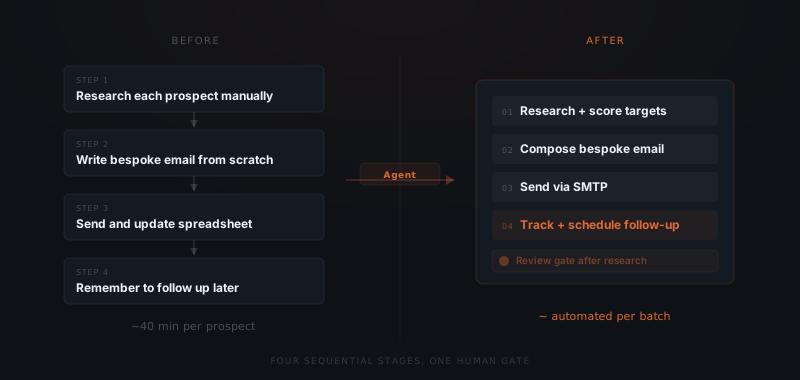
Before: manual research, writing, and tracking scattered across browser tabs and a spreadsheet. After: single pipeline handling research, scoring, composition, and follow-ups.
The manual process required separate passes for research, composition, and follow-up tracking — each a context switch. The pipeline runs them in sequence with one human approval gate.

The solution

We built an agent pipeline that handles the entire outbound workflow — from targeting to send to follow-up — with one human approval gate at the midpoint.

Targeting and research. The agent starts with three ICP hypotheses — recruiting firms, boutique B2B services, and distributors — and scores prospects against firmographic fit and buying signals. Early versions over-indexed on theoretical fit (company size, tech stack, hiring patterns) and under-indexed on active intent. We simplified to three questions: does this prospect have the problem, do they have budget, and are they actively looking? Everything else became secondary.

Prospects are sourced through API-based job board searches and direct research. Every listing is verified before it enters the pipeline — 29% of sourced leads were already stale. Verification runs before scoring, not after.

The human reviews and approves the target list. The research, the verification, and the prioritisation are produced by the agent.

The scoring was simplified not because complexity is unnecessary — but because the wrong kind of complexity obscures the only signal that matters: whether someone is ready to buy.

Composition and sending. Once targets are approved, the agent manages the full execution inside a single Google Sheet that serves as both database and interface. Every prospect has a row: company name, contact, ICP score, bespoke email copy, send status, follow-up draft, and pipeline stage. The sheet is the source of truth — not a CRM, not a separate platform. We add tooling only when the simple version breaks.

Each email is written from scratch per prospect. Different subject lines, different angles, different body text based on the company's actual website, team page, and positioning. No templates, no variable substitution. The goal was relevance, not volume.

The first sending attempt used Instantly's API — a poor fit for bespoke outreach. We switched to direct SMTP, with the sheet tracking send status. The first batch of emails went out without proper greetings (jumping straight into the pitch). We fixed the follow-up sequence: proper openings, warmer tone, more human pacing.

We chose the tool that matched the workflow — even when that tool was a spreadsheet and SMTP.

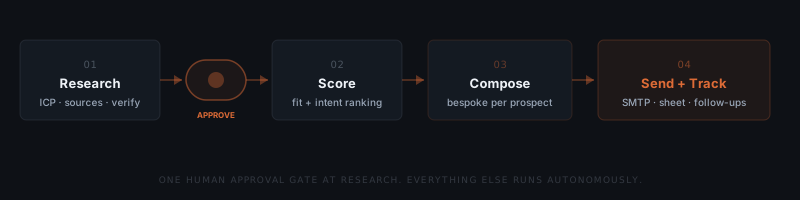
Four-stage pipeline: Research → Score → Compose → Send & Track — with a human approval gate after Research
One human gate after targeting and scoring. Everything between approval and send runs without interruption.

The results

After going live — the initial build took roughly two weeks — here is what the pipeline changed:

  • The human went from doing to approving. Research, lead import, email composition, and follow-up creation — all handled by the agent. The team's job became reviewing the target list, confirming the approach, and reading responses. That is the time saving: what used to be hours of manual work became minutes of review.
  • 1,000 prospects reached without a full-time sales person. The pipeline ran in the background alongside client work. Volume was no longer constrained by founder hours.
  • 4% positive reply rate on bespoke outreach. Responses came from prospects the team would not have had time to reach manually. A subset led to conversations the team qualified as worth pursuing.
  • Follow-ups stopped falling through the cracks. Every prospect had a send status and a follow-up trigger in the sheet — set by the agent, reviewed by the human. Nothing was forgotten because it depended on someone's memory.

What this took

The initial build took roughly two weeks. The pipeline has been running and improving since.

The research layer came first: defining the scoring criteria, testing it against real prospect lists, and learning which signals predicted responses versus theoretical fit. We narrowed from three ICPs to two when market signal clearly favoured one segment.

The operations layer came next. The sheet structure went through several iterations before the field layout supported both agent writes and human reads. The Instantly integration was a false start — we lost half a day debugging their API before switching to direct SMTP.

The first batch of emails taught us the greeting lesson: the agent wrote well-researched content but skipped the social signals that make an email feel human. The fix was a review step added to the pipeline, not a prompt change.