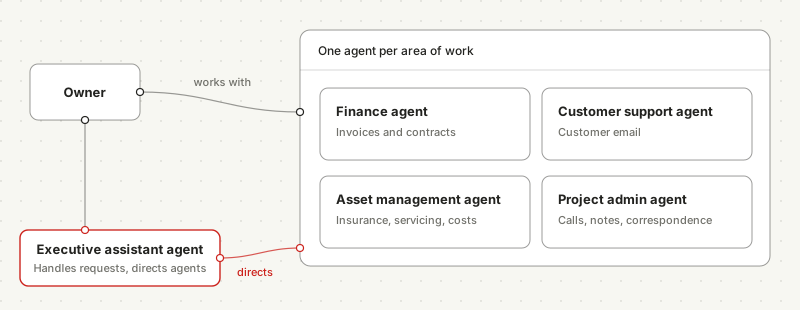
At YardWork we implement AI agent systems for owner-operated businesses. A solo owner running several ventures needed an operational memory layer — document intake, email triage, asset tracking, and finance filing across all businesses simultaneously. We built a persistent OpenClaw agent with a structured workspace and domain-specific memory. The result: 7–8 hours of weekly admin replaced, with ~2,755 finance files and ~2,036 vehicle records maintained automatically.
The challenge
Every business generates its own pile. Invoices, insurance papers, service records, bank confirmations, contracts — each arriving at a different time, through a different channel, with no one to file it. A solo owner running three or four ventures does not have an ops team to absorb this. They absorb it themselves, or it doesn't get done.
The owner in this case had built several businesses in parallel. Each had its own documents, finance records, and administrative obligations. Vehicle assets — 13 registered across his businesses — had their own insurance deadlines, service histories, and location notes. Finance folders were split by business but manually maintained. Email arrived across multiple inboxes, flagged mentally, and sometimes forgotten.
The constraint was not knowledge or capability. It was time and cognitive load. There were too many parallel operational tracks to maintain reliably by hand. Something was always slipping: a document unfiled, a deadline approaching unnoticed, a reminder that existed only as a mental note.
The solution
We built a persistent OpenClaw agent with a structured private workspace organized by domain — one folder for finance, one per vehicle, one per active project, plus personal and administrative areas. The workspace is the agent's continuity layer: files persist across sessions, and every action is logged to a daily memory file.
Document intake. When a document arrives — invoice, insurance confirmation, service record, booking — the agent identifies its type, extracts relevant fields (invoice number, period, amount, counterparty), saves the file to the correct folder, writes a summary index file, and logs the action. Nothing requires manual sorting. The owner forwards or drops the document; the agent handles the rest.
Email monitoring. The agent checks a dedicated mailbox automatically — every 30 minutes in steady state, with additional relevance passes in the morning and through the day. Roughly 50–70 automated checks run each day. Relevant messages are saved and summarized; irrelevant ones are skipped. The owner is notified only when something matters.
The monitoring runs whether the owner is working or not. The operational layer does not pause.
Vehicle and asset tracking. Each of the 13 vehicles has its own folder in the workspace. The agent tracks location, insurance status, TÜV and service deadlines, cost assumptions, and open issues. When an insurance document arrives or a service note needs updating, the agent routes it to the correct folder and updates the status file. The fleet register stays current without a manual reconciliation step.
Reminders and scheduling. The agent maintains roughly 20 active scheduled reminders and recurring checks — upcoming deadlines, appointment corrections, rotating follow-ups on open items. Reminders are stored as local files and surfaced in morning briefings. When a date changes or an item is resolved, the agent updates the file rather than creating a new one.
Long-term memory. Stable context — preferences, recurring priorities, business-specific assumptions, vehicle references — is stored in a curated memory file. The agent does not need to be re-briefed on established facts. Operational memory accumulates session by session.
Operational memory accumulates session by session.
The results
After the first two weeks of genuine use, here is what changed:
- 7–8 hours of weekly admin replaced. Document filing, email triage, reminder management, and vehicle record updates — previously done manually across scattered tools — now run through the agent. The owner's role shifted from doing to reviewing.
- ~2,755 finance files and ~2,036 vehicle records maintained automatically. In steady state, 20–40 documents arrive per week. During heavy import periods the volume is higher. The archive grows without manual effort.
- 50–70 automated checks run each day. Email monitoring, calendar checks, and proactive reminders run continuously. Nothing waits for the owner to remember to look.
- 13 vehicle assets tracked in real time. Insurance deadlines, service status, and location notes stay current. Open issues surface in proactive checks rather than being discovered late.
- ~20 active reminders maintained without a separate tool. Appointments, follow-ups, and deadlines are stored in the workspace and reviewed automatically. Nothing disappears because it only existed in someone's head.
What this took
Workspace and intake — days 1–2
The first usable version ran within a day or two. Most of that time went into the workspace structure: folder naming conventions, the identity and memory files, and the document intake workflow. Getting those right from the start meant the archive would actually be searchable later — not just a pile of files in the right directory.
First-week gaps — week 1
Real use surfaced the gaps quickly. Vehicle tracking needed its own status file format, not just a folder of PDFs. Email monitoring needed a processed-message flag to prevent duplicate saves. The reminder system went through two iterations — first as a single list file, then as individual dated files that could be updated and cleaned up independently.
Patterns stabilize — week 2
By the end of the second week, the operational patterns had settled. All five domains were running: document intake, email monitoring, vehicle tracking, reminder management, and long-term memory. The agent had enough accumulated context to stop needing manual corrections on routing and classification.
Continuous additions — February 2026 onward
Since stabilization, the workspace has received continuous additions: new vehicles, new finance categories, new project folders, new reminder types. The workspace grows with the businesses rather than being rebuilt each time something changes. The agent has been running in production since February 2026.