
Agentic AI statistics in 2026 describe a technology that crossed from pilots into production, yet returns stayed concentrated in a minority of companies. Stanford HAI's 2026 AI Index reports 88% organizational adoption and a jump in autonomous task completion from 12% to 66% on the OSWorld benchmark. PwC's 2026 CEO Survey found 56% of CEOs saw no measurable return. The dividing line is workflow redesign, not access to the tools.
88% of organizations now use AI, but only 12% of CEOs report getting both revenue gains and cost cuts from it.[¹][²] That gap is the whole story of agentic AI in 2026. The technology reached near-universal adoption and made its largest capability jump to date — and most companies still recorded no measurable financial return.
The 2026 agentic AI statistics separate two populations that the headline adoption numbers hide. A large majority deployed agents. A small minority restructured work around them. The first group generated activity. The second group generated returns. Every number below maps to one side of that divide.
Where to find the full 2026 data
Five categories make up the 2026 agentic AI story: how many companies use it, whether it pays off, how capable it got, how much time it saves, and how much money is moving toward it. Each has its own dedicated data post with the complete breakdown, primary sources, and full methodology. The table below is the fast reference — the sections that follow summarize each finding and link to the source data. Reading the summaries below is enough for the headline argument; the linked posts exist for citing the underlying study or checking a number against its primary source. Each linked post is reviewed on its own update cycle, so check its byline for the most recent revision date.
| Category | 2026 headline stat | Full data |
|---|---|---|
| Adoption | 88% of organizations use AI in at least one function (Stanford HAI) | AI agent adoption statistics |
| ROI | 56% of CEOs saw no return; 12% saw both revenue gains and cost cuts (PwC) | AI agent ROI statistics 2026 |
| Reliability | Task success on real computer-use benchmarks rose from 12% to 66% in a year (Stanford HAI) | How reliable are AI agents |
| Productivity | Workers save about 11 hours a week, net of oversight time (Glean) | AI agent ROI statistics |
| Market size | AI agent market reached about $10.9 billion in 2026 (Grand View Research) | AI agent market size 2026 |
| Global AI spend | Worldwide AI spending forecast at $2.59 trillion in 2026 (Gartner) | AI spending statistics 2026 |
How widely is agentic AI adopted in 2026?
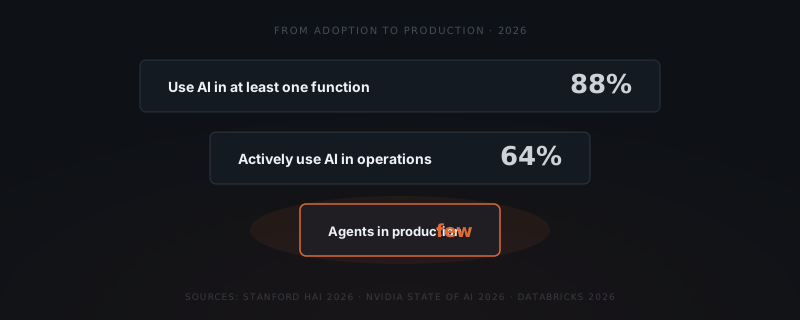
Agentic AI adoption reached near-universal levels among enterprises in 2026. Stanford HAI's 2026 AI Index reports 88% of organizations now use AI in at least one business function.[¹] NVIDIA's State of AI 2026 survey found 64% of companies actively using AI in operations, with a further 28% in an assessment phase and only 8% not using it at all.[³] For the full breakdown of adoption by business size and function, see AI agent adoption statistics and small business AI adoption statistics 2026.
Adoption of agents specifically — software that takes actions, not chatbots that answer questions — is where the picture narrows. Databricks' 2026 State of AI Agents report, drawn from more than 20,000 organizations, found that only a small share of companies have agents running in production against live workflows.[⁴] Most agent activity in 2026 still sits in testing and pilot environments.
The growth rate inside production, however, is steep. Databricks measured multi-agent systems — setups where several agents coordinate on a task — growing 327% in under four months.[⁴] More than 80% of new databases on its platform are now built by AI agents rather than by people.[⁴] The base is small, but the trajectory inside companies that reached production is near-vertical.
| Metric | 2026 figure | Source |
|---|---|---|
| Organizations using AI in at least one function | 88% | Stanford HAI 2026 AI Index |
| Companies actively using AI in operations | 64% | NVIDIA State of AI 2026 |
| Companies increasing AI budgets in 2026 | 86% | NVIDIA State of AI 2026 |
| Growth in multi-agent systems (under 4 months) | 327% | Databricks 2026 |
| New databases built by AI agents | over 80% | Databricks 2026 |
The adoption numbers describe access to the technology. They do not describe outcomes. A company that gave every employee an AI assistant counts as an adopter in these figures — whether or not that access changed a single business result.
Is agentic AI actually delivering ROI in 2026?
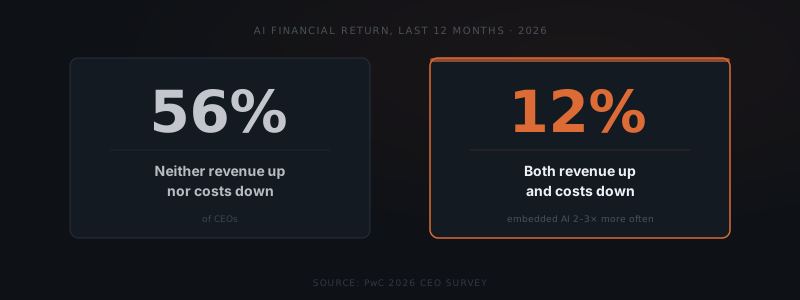
For most companies, agentic AI produced no measurable financial return in 2026. PwC's 2026 CEO Survey found 56% of CEOs reported neither increased revenue nor decreased costs from AI over the prior 12 months, while only 12% reported both.[²] NVIDIA's 2026 survey confirms the same split from the revenue side: nearly every company saw some gain, but few saw one large enough to change the business.[³] The gap between the two groups is workflow redesign, not the tool purchased — a pattern this post returns to below.
For the full ROI breakdown by function and deployment stage, see AI agent ROI statistics 2026.
How capable did AI agents become in 2026?
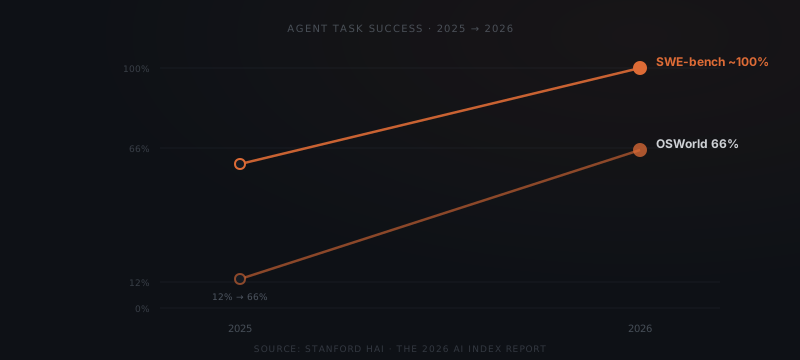
AI agents made their largest capability gains in 2026 in autonomous task completion — the ability to finish a multi-step job in real software without a human at each step. Stanford HAI's 2026 AI Index reports agent success on the OSWorld benchmark, which measures completing real computer tasks, rose from 12% to roughly 66% in a single year.[¹]
These benchmarks measure agents doing work, not chatbots answering questions. The 2026 capability jump is in autonomous task completion — finishing a job in real software — which is the specific ability that lets an agent take a workflow off a person's desk. Conversation quality was already solved; task reliability is what changed.
Anthropic's January 2026 economic data put the capability in business terms. Agents were handling software-development tasks that average 3.3 hours of human-equivalent work per task, and personal-management tasks averaging 1.8 hours.[⁵] The unit of work an agent completes autonomously grew from minutes to hours — which is the threshold at which a task stops being an assist and starts being a handoff. For the full reliability picture — including the gap between benchmark scores and real-world deployment success — see how reliable are AI agents in 2026.
Usage patterns confirm that capability alone does not create value. OpenAI's January 2026 usage data, drawn from more than 70 countries, found that advanced users invoke reasoning capabilities roughly seven times more often than typical users, producing a threefold gap in usage intensity worldwide.[⁶] The same tools, in different hands, produce very different results. Capability sets the ceiling. How a company uses the capability determines where it lands under that ceiling.
Which industries are adopting agentic AI fastest in 2026?
Telecommunications leads agentic AI adoption in 2026. NVIDIA's State of AI 2026 report found 48% of telecom companies deploying or assessing AI agents, with 99% reporting improved employee productivity from AI overall.[³] Retail and consumer packaged goods follow closely at 47%, with financial services and healthcare also named among the strongest adopters.[³] For the sector-by-sector breakdown, see AI ROI by industry in 2026.
The common thread is structural, not sectoral. These industries run high-volume, repeatable, structured work — transaction processing, claims handling, order management, service routing — where an agent can act on a clear input and produce a defined output. That is the profile agents convert into returns most reliably.
For a service business, the industry label matters less than the workflow shape. A 20-person recruiting firm and a telecom operator share the same structural opportunity: the repeatable, high-volume communication and coordination work that agents handle reliably. The sector data is a proxy for how much of that work each industry contains.
What's blocking agentic AI ROI in 2026?
In 2026, nearly everyone deployed agents. Almost no one restructured around them.
The barrier to agentic AI ROI in 2026 is organizational, not technical. NVIDIA's survey found the top obstacles were insufficient or poor-quality data (48%), a shortage of AI experts (38%), and uncertainty about ROI itself (30%).[³] None of those is a limit on what the models can do. Each is a limit on what the surrounding organization has prepared for them.
Databricks' data isolates the single practice that most separates production success from pilot failure: instrumentation. Organizations using evaluation tools — systems that measure whether an agent is doing its job correctly — moved nearly six times as many AI projects into production.[⁴] Organizations that implemented AI governance moved over twelve times as many projects into production.[⁴] The differentiator is not model access. It is the discipline of measuring and controlling what the agent does.
This is why pilot sprawl fails. A pilot with no success criteria cannot be distinguished from a pilot that is degrading — both generate output, neither generates a verifiable result. PwC's high performers avoided this by embedding AI into instrumented, redesigned workflows.[²] The majority ran disconnected experiments and had no mechanism to tell whether any of them worked. For the framework on defining success criteria before an agent goes live, see how to know if your AI agent is working.
These barriers scale down differently for a smaller business than for an enterprise survey respondent. "Insufficient or poor-quality data" at a large company usually means a fragmented data warehouse spanning dozens of systems. At a 20-person agency, it means the customer history lives across three inboxes, a shared drive, and one person's memory. The fix is not a data platform. It is picking a workflow narrow enough that the data it needs already sits in one system — a CRM, a shared calendar, a ticketing queue.
Uncertainty about ROI resolves the same way. NVIDIA's 30% figure describes companies that never defined what success would look like before they built anything.[³] A workflow agent scoped against one measurable outcome — hours reclaimed, response time cut, error rate reduced — removes the uncertainty before the agent goes live, not after launch. The 12% that profit are not the companies with the best model. They are the companies that decided what "working" meant before they turned the agent on.
Sequencing follows the same logic. A company scoping five workflows for agents at once recreates pilot sprawl inside a single project — five experiments, no measurement, no way to tell which one is working. One workflow, instrumented and measured against a defined outcome, produces a result fast enough to justify building the second.
Agentic AI budgets and market outlook for 2026
Agentic AI budgets rose across nearly every enterprise in 2026 despite the weak average return. NVIDIA found 86% of companies increasing their AI budgets, with 40% raising them by more than 10%.[³] The spending commitment runs ahead of the realized ROI — a pattern that describes a market betting on a trajectory rather than banking a current result. For the full 2026 global AI spending breakdown, see AI spending statistics 2026.
The structural shift under that spending is a move toward autonomy. IBM's 2026 CEO study, surveying 2,000 CEOs across 33 geographies, found 76% of organizations now have a Chief AI Officer, up from 26% a year earlier.[⁷] The same study reported that CEOs expect 48% of operational decisions to be made by AI without human intervention by 2030, up from 25% today.[⁷] Governance structures and decision authority are being rebuilt around agents, not just software licenses.
Gartner's projections, cited in Deloitte's 2026 Tech Trends, point in the same direction: 33% of enterprise software applications are expected to include agentic AI by 2028, up from under 1% today.[⁸] These are forward estimates, not 2026 measurements, but they set the scale that 2026 budgets are underwriting. For market size projections by segment, see AI agent market size 2026. For the definition of what an AI agent is beneath these numbers, see what is an AI agent.
Frequently asked questions
How many companies use agentic AI in 2026? Stanford HAI's 2026 AI Index reports 88% of organizations now use AI, up from 78% the year before. NVIDIA's State of AI 2026 survey found 64% of companies actively using AI in operations, with another 28% in the assessment phase. Adoption is near-universal among enterprises, but Databricks' 2026 State of AI Agents report notes only a small share have autonomous agents running in production rather than in testing.
Is agentic AI actually delivering ROI in 2026? For most companies, no. PwC's 2026 CEO Survey found 56% of CEOs reported neither increased revenue nor decreased costs from AI in the prior 12 months, while only 12% reported achieving both. The 12% that profit share one trait: they rewired operations around agents rather than distributing AI licenses across unchanged workflows. NVIDIA's 2026 data confirms the split — 88% of companies saw some revenue lift, but only 30% saw gains above 10%.
How capable did AI agents become in 2026? AI agents made their largest capability jump in autonomous task completion. Stanford HAI's 2026 AI Index reports agent success on the OSWorld computer-use benchmark rose from 12% to roughly 66% in a year, and SWE-bench Verified coding performance climbed from 60% to near 100%. Anthropic's January 2026 economic data found agents handling software-development tasks that average 3.3 hours of human-equivalent work per task.
Which industries are adopting agentic AI fastest in 2026? Telecommunications leads agentic adoption in 2026, with 48% of telecom companies deploying or assessing AI agents, according to NVIDIA's State of AI 2026 report. Retail and consumer packaged goods follow at 47%. NVIDIA identifies financial services, healthcare, and retail/CPG as the sectors showing the strongest combined adoption and ROI, because their core work is high-volume and structured enough for agents to act on reliably.
Notes
- Stanford Institute for Human-Centered AI, "The 2026 AI Index Report," Stanford HAI, 2026.
- PwC, "2026 CEO Survey," reported in Forbes, "56% Of CEOs See Zero ROI From AI—Here's What The 12% Who Profit Do Differently," January 28, 2026.
- NVIDIA, "State of AI 2026," NVIDIA, 2026.
- Databricks, "The State of AI Agents 2026: The agentic AI playbook for the enterprise," Databricks, 2026.
- Anthropic, "Anthropic Economic Index," Anthropic, January 15, 2026.
- OpenAI, usage report cited in Forbes, "AI ROI Measurement: New Metrics For 2026," January 2026.
- IBM Institute for Business Value, "2026 CEO Study," IBM, 2026.
- Deloitte, "Tech Trends 2026: The agentic reality check," Deloitte Insights, 2026, citing Gartner projections.