
AI ROI by industry in 2026 varies more by sector and deployment maturity than by which tool a company buys. NVIDIA's State of AI 2026 report ranks financial services, telecommunications, and retail/CPG as the sectors with the strongest returns, while PwC's 2026 CEO Survey found 56% of companies reported no measurable return at all. The pattern tracks how repeatable each industry's core work is — not which AI it deployed.
Financial services, telecommunications, and retail lead AI ROI in 2026 — while 56% of all CEOs report no measurable return at all.[¹][²] Both facts come from 2026 data, and together they define the shape of AI returns this year: highly concentrated, and predictable if you know what drives the concentration.
AI ROI by industry in 2026 is not a story about which sectors bought better technology. Every sector had access to the same models. The returns concentrated where the work was structured enough for an agent — see what an AI agent is — to act on reliably, and evaporated where companies bolted AI onto processes they never redesigned. This post breaks down the 2026 numbers by sector, then explains the variable underneath them.
Which industries get the highest AI ROI in 2026?
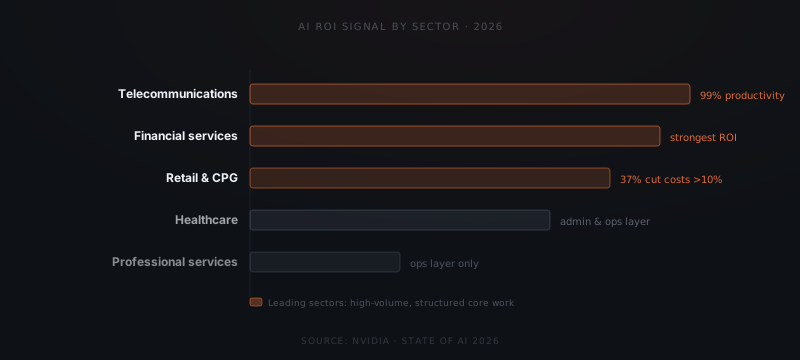
Financial services, telecommunications, and retail/CPG produced the highest AI ROI in 2026. NVIDIA's State of AI 2026 report, its annual survey of enterprise AI outcomes, names these three sectors as showing the strongest combined adoption and ROI results.[¹] The survey draws on NVIDIA's own audience of AI-engaged respondents rather than a random sample of all businesses in each sector, and it is not specific to small or mid-sized firms — the sector ranking is a useful signal of where structured, high-volume work concentrates, not a precise ROI percentage any individual business should expect.
The sector-level figures show why. In telecommunications, 99% of companies reported improved employee productivity from AI, and 48% are deploying or assessing AI agents — the highest agentic adoption of any sector.[¹] In retail and consumer packaged goods, 37% of companies achieved cost reductions greater than 10%, and 47% are deploying or assessing agents.[¹] Financial services and healthcare round out the group NVIDIA identifies as leading on returns.
Across all sectors, the aggregate 2026 picture is broad but shallow. 88% of companies reported that AI increased annual revenue, but only 30% saw increases above 10%.[¹] 87% reported AI reduced costs, with 25% cutting costs by more than 10%.[¹] Nearly every company saw a directional effect. The leading sectors are the ones where a large share crossed from directional to material.
| Sector | Strongest 2026 signal | Agentic adoption |
|---|---|---|
| Telecommunications | 99% report improved productivity | 48% deploying or assessing agents |
| Retail & CPG | 37% cut costs over 10% | 47% deploying or assessing agents |
| Financial services | Named strongest adoption and ROI | High |
| Healthcare | Named strongest adoption and ROI | Moderate to high |
| Cross-industry average | 30% saw revenue gains over 10% | 64% actively using AI |
Why AI ROI varies so much across industries in 2026
Higher AI ROI in a sector does not mean that sector has better AI. It means the sector's core work is more repeatable and structured — high-volume, rule-based tasks an agent can act on reliably. The variable is work structure, not tool quality. A firm in a "low-ROI" sector with structured workflows will outperform a firm in a "high-ROI" sector that never redesigned its processes.
The reason financial services, telecom, and retail lead in 2026 is structural. These sectors run high concentrations of the work profile that converts to AI returns: high task volume, structured inputs, defined outputs, and low per-task judgment. Transaction processing, claims handling, service provisioning, and order management all fit that profile. An agent reads a clear input, produces a defined output, and repeats it thousands of times.
Sectors dominated by advisory, creative, or relationship-driven work sit lower — not because their AI is worse, but because each task carries more context and requires more judgment. The same model that clears a payment exception in seconds cannot close a complex negotiation. The measurable, repeatable slice of the work is smaller, so the measurable return is smaller.
This is why the industry label is a proxy, not a cause. What predicts return is the proportion of a business's work that is high-volume and structured. A boutique firm with heavily systematized operations can beat a bank division that never redesigned a workflow. The sector ranking reflects the average density of structured work per industry — but any individual company's return depends on its own workflow mix.
AI ROI by sector: the 2026 numbers
AI ROI in 2026 splits cleanly along how structured each sector's core work is. The detailed breakdown, drawn primarily from NVIDIA's State of AI 2026 survey, maps returns to work type across the major sectors.
Financial services delivers the most consistent returns. Back-office processing, fraud detection, and document handling are high-volume and rule-bound. NVIDIA names financial services among its strongest-ROI sectors, and fraud management and detection ranks as a top AI use case at 43% of financial services deployments.[¹] The structured nature of the work is why finance repeatedly appears at the top of AI ROI rankings.
Telecommunications shows the strongest productivity effect. 99% of telecom companies reported improved employee productivity, and telecom leads all sectors in agentic AI adoption at 48%.[¹] Network configuration, service provisioning, and tier-one support are repeatable at massive scale — the profile agents automate most cleanly.
Retail and CPG shows the strongest cost effect, with 37% of companies cutting costs by more than 10%.[¹] Quality control ranks as a leading use case at 39% of retail/CPG deployments.[¹] Order management, inventory queries, and customer service run at high volume with structured inputs.
Healthcare delivers strong returns in its administrative and operational layers — scheduling, documentation, claims — while clinical judgment stays with people. NVIDIA groups healthcare among its leading sectors on adoption and ROI.[¹]
Professional and creative services sit lower on measurable ROI because a larger share of the work is advisory and non-repeatable. The returns are real but concentrated in the operational layer — client communication, coordination, reporting — rather than the billable judgment work.
Why most companies still see no AI ROI in 2026
In 2026, 56% of CEOs saw no return from AI. Twelve percent saw everything.
Despite the sector leaders, most companies recorded no measurable AI return in 2026. PwC's 2026 CEO Survey found 56% of CEOs reported neither increased revenue nor decreased costs from AI over the prior 12 months.[²] Only 12% reported achieving both a revenue increase and a cost reduction.[²]
The gap between the leading sectors and the majority outcome is deployment maturity. NVIDIA found that 30% of companies remain uncertain about ROI clarity — they cannot tell whether AI is paying off.[¹] IBM's 2026 CEO study, surveying 2,000 CEOs across 33 geographies, found only 25% of the workforce regularly using AI despite widespread deployment.[³] Access was distributed. Usage, and the workflow redesign that makes usage productive, was not.
This is the same pattern the sector data shows, viewed from the company level. A retail company that redesigned its order-management workflow around an agent lands in the 37% cutting costs over 10%. A retail company that gave staff an AI assistant and changed nothing lands in the 56% seeing no return. The sector sets the opportunity. The company's own maturity decides whether it captures it. For the function-level view of where returns come from inside a business, see AI agent ROI statistics.
What separates the sectors and companies that profit
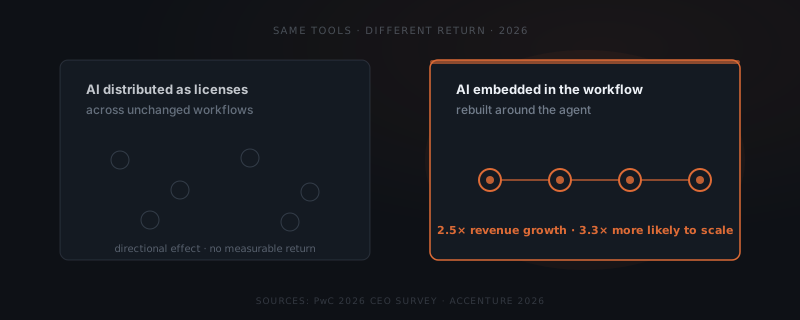
The companies that captured AI ROI in 2026 embedded AI into redesigned workflows rather than distributing it as licenses. PwC found high performers were two to three times more likely to have extensively embedded AI across their operations.[²] The distinction is not the tool. It is whether the work changed shape around the tool.
Accenture's 2026 research quantifies the gap. Companies that built AI-led processes — where AI runs the workflow rather than assisting a human step — grew revenue 2.5 times faster than peers.[⁴] Organizations with the highest operations maturity were 3.3 times more likely to succeed at scaling high-value AI use cases.[⁴] The returns follow operational discipline, not procurement.
Measurement is the practice underneath that discipline. Wharton's 2026 research found 72% of business leaders now use structured processes to measure AI ROI — tracking productivity, profitability, and operational efficiency rather than login counts.[⁵] Functions with established metrics cultures, such as finance and HR, moved fastest. The companies that measure are the companies that can tell a working deployment from a degrading one — and can redirect spend accordingly.
What AI ROI by industry means for a small service business
For a small service business, the 2026 AI ROI data carries a more useful lesson than the sector rankings suggest: your industry label matters less than the shape of your own workflows. A 15-person agency, recruiting firm, or accounting practice contains the same structured, high-volume work — client follow-up, document collection, scheduling, reporting — that drives returns in the leading sectors.
The sectors at the top of the 2026 ranking are there because a large share of their work is repeatable. A lean service firm can engineer the same advantage by identifying its own repeatable workflows and building agents against those specifically, rather than deploying AI broadly and hoping. The 56% that saw no return deployed widely. The 12% that profited deployed narrowly and deeply, into the workflows where returns were measurable.
This maps directly to how implementation should be sequenced. Two or three well-fitted workflow agents — client communication, document coordination, reporting — outperform a broad rollout that touches everything and changes nothing. For the framework on choosing which workflows to hand to an agent first, see which workflows to automate first. For the broader 2026 picture of where agentic AI stands, see agentic AI statistics 2026. For adoption stage broken down by professional-services industry specifically, see which industries use AI agents.
Frequently asked questions
Which industry has the highest AI ROI in 2026? Financial services, telecommunications, and retail/CPG show the highest AI ROI in 2026, according to NVIDIA's State of AI 2026 report. Telecom reported 99% of companies improving employee productivity, and 37% of retail/CPG companies cut costs by more than 10%. NVIDIA names financial services, healthcare, and retail/CPG as the sectors with the strongest combined adoption and ROI results, because their core work is high-volume and structured enough for AI to act on reliably.
Why does AI ROI vary so much by industry? AI ROI varies by industry because sectors differ in how repeatable and structured their core work is — not because some industries have better AI. Financial back-office processing, telecom service operations, and retail order management run high-volume, rule-based tasks that AI handles reliably. Advisory, creative, and relationship-driven work produces smaller measurable returns because each task requires more context and judgment. The sector gap reflects work structure, not tool quality.
What percentage of companies see no ROI from AI in 2026? In 2026, 56% of CEOs reported neither increased revenue nor decreased costs from AI over the prior 12 months, according to PwC's 2026 CEO Survey. Only 12% reported achieving both. NVIDIA's data shows a milder version of the same split: 88% of companies saw some revenue lift from AI, but only 30% saw increases above 10%. The variance is driven by deployment maturity, not by the choice of AI tool.
What separates companies that get high AI ROI from those that don't? Companies with high AI ROI in 2026 embed AI into redesigned workflows rather than distributing it as licenses across unchanged processes. PwC found high performers were two to three times more likely to have extensively embedded AI across operations. Accenture reported companies with AI-led processes grow revenue 2.5 times faster than peers. Wharton found 72% of leaders now track structured ROI metrics — the discipline that separates measurable returns from activity.
Notes
- NVIDIA, "State of AI 2026," NVIDIA, 2026. Survey of 3,200+ respondents (executives, data scientists, engineers) spanning North America, EMEA, and APAC, drawn from NVIDIA's own opted-in audience of people already investing in or curious about AI. The sample is self-selected toward more AI-engaged organizations, which likely inflates the reported adoption and ROI figures relative to the broader business population — the sector rankings below are best read as relative ordering, not absolute rates.
- PwC, "2026 CEO Survey," reported in Forbes, "56% Of CEOs See Zero ROI From AI—Here's What The 12% Who Profit Do Differently," January 28, 2026. The underlying survey covers 4,454 CEOs across 95 countries — a global sample of large-organization CEOs, not a US-only or small-business figure.
- IBM Institute for Business Value, "2026 CEO Study," IBM, 2026.
- Accenture, "Making reinvention real with gen AI," Accenture, 2026.
- Wharton, "Accountable Acceleration: Gen AI Fast Becomes the Norm," reported in CFO Dive, "72% of execs have ROI metrics for generative AI," 2026.