AI that knows your customers is an agent with persistent memory across your tools — not a chatbot that answers questions. It reads context from your inbox, CRM, and call notes into one customer record, updates that record on approval, and recalls it next time. Unlike native CRM AI, it sees the email and Slack threads where the real context lives.
A prospect emails on Tuesday asking about the thing they raised on last month's call. Nobody remembers the call. The CRM says nothing. The context is somewhere — a thread, a note, someone's head — but not anywhere reachable in the ten seconds before the reply goes out. That gap is what an AI agent with memory closes: it reads the scattered history of each customer into one record, updates that record as things happen, and recalls it the moment it's needed. Every word still waits for your approval before it sends.
Your CRM was never the problem
The context that closes deals never lived in your CRM. It lived in the email thread where the client explained why the timeline slipped, in the call where they mentioned a new decision-maker, in the Slack message where a teammate flagged that they were unhappy. The CRM holds the fields someone remembered to fill in. Everything that made the relationship legible lived somewhere else.
This is why "clean up the CRM" never fixes the problem. Gartner estimates poor data quality costs organizations an average of $12.9 million per year.[¹] For a lean team the cost is not a line item — it is the deal that stalled because nobody knew the client had gone quiet, the renewal missed because the context sat in a rep's inbox, the call taken cold because the last three interactions were never pulled together.
The people closest to the data spend their time reassembling it by hand. Salesforce's State of Sales found reps spend roughly 70% of their time on non-selling work — data entry, note-taking, and hunting for information — and only about 30% actually selling.[²] The dominant cost of a messy customer picture is not bad decisions. It is the hours spent reconstructing the picture before any decision gets made.
The context that closes deals never lived in your CRM.
An AI agent that knows your customers inverts the model. Instead of a person searching five tools to rebuild context, the agent holds the context already assembled. It read the thread, logged the call outcome, noticed the quiet account. The reconstruction work that ate the reps' week happens once, continuously, in the background — and the person starts from a complete record instead of a blank one.
Knowing your customers means holding context, not answering questions
An AI agent that knows your customers is defined by memory, not by conversation. A chatbot answers what you ask and forgets the exchange when the window closes. An agent with memory carries a persistent record of each customer across every interaction, and that record survives after the session ends.
Memory here is infrastructure the agent reads from and writes to across your tools — not a chat feature that recalls the current conversation. It persists after the session ends, spans your inbox, CRM, and call notes, and the agent writes updates back to your systems only after a person approves them.
Practitioners split agent memory into two working types, and both matter for customer context. Episodic memory holds specific events: the call on the 12th, the complaint in March, the invoice paid late twice. Semantic memory holds durable facts: this account bills monthly, the decision-maker is the COO not the founder, they care about response time over price. A useful customer agent maintains both — the timeline of what happened and the standing facts that shape every future interaction.
This is the capability the market is converging on. IBM, Salesforce, and infrastructure vendors like Cloudflare now ship dedicated "agent memory" products, because the industry has recognized that a model without memory is a tool, and a model with memory is a colleague.[³] The distinction is not academic. An agent that remembers is the difference between drafting a follow-up that references the last three conversations correctly and drafting one that reads like it came from a stranger.
The reason this matters now is the failure pattern behind most stalled AI projects. MIT's NANDA initiative studied 300-plus enterprise AI deployments and found only about 5% reached meaningful financial impact.[⁴] The pilots that failed shared a trait: the tools could not retain feedback, adapt to context, or improve over time. Memory is precisely the thing they lacked. A customer agent without memory is a demo. A customer agent with memory is the 5%.
Where your customer context actually lives
Customer context lives in five places at once, and no single one holds the whole story. The email thread has the reasoning. The call note has the commitment. The CRM field has the stage — if someone updated it. The invoice has the payment behavior. The chat message has the internal warning. A person reconstructs a customer by opening all five. An agent with memory reads all five and keeps the joined-up version current.
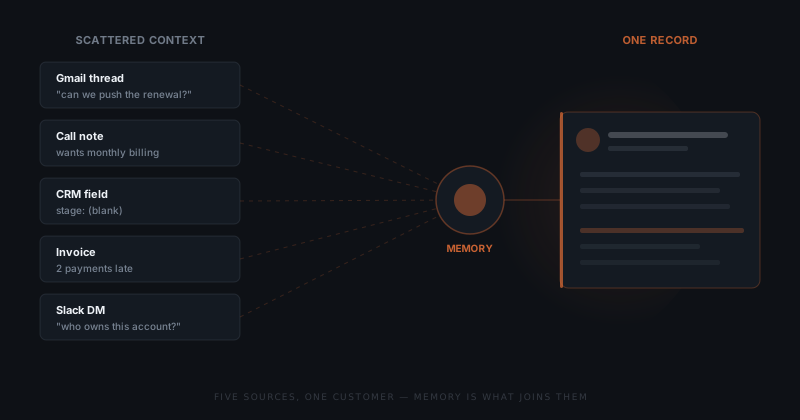
The table below shows how one customer looks fragmented across tools — and what the joined record holds once the agent reads them together.
| Source | What it holds in isolation | What memory adds |
|---|---|---|
| Gmail thread | "Can we push the renewal?" | Reason the timeline slipped |
| Call note | Wants monthly billing | Commitment made, not yet in CRM |
| CRM field | Stage: blank | Filled from the call outcome |
| Invoice history | Two payments late | Payment-risk signal on the account |
| Slack message | "Who owns this account?" | Internal ownership gap flagged |
Reading the rows top to bottom, no single source tells you this is a late-paying account that wants to renegotiate terms and has no clear internal owner. The joined record does. This is the read side of the agent's job: pull from every source where context already lives, and hold the version a person would only assemble by opening every tab.
The read step is also where the messy-data objection dissolves. The agent does not need a pristine CRM to start, because it reconstructs the account from email and call history — the sources people trust more than CRM fields anyway. A blank stage field is not a blocker. It is something the agent fills in from what the call actually decided.
What memory changes on a real Monday
The change memory makes is concrete, and it shows up in the first hour of the week. A follow-up that used to take twenty minutes of digging takes thirty seconds of reviewing. The account that quietly went dark surfaces before it churns, not after. The call gets prepped with the last three interactions attached, not taken cold.
Here is the mechanism. The agent works in a loop: it reads new context from your tools, holds it in the customer record, and writes structured updates back after you approve them. Each interaction adds to the record, so the agent knows more next week than it did this week. This is the read–write–accumulate cycle that separates a memory agent from a one-shot chatbot.
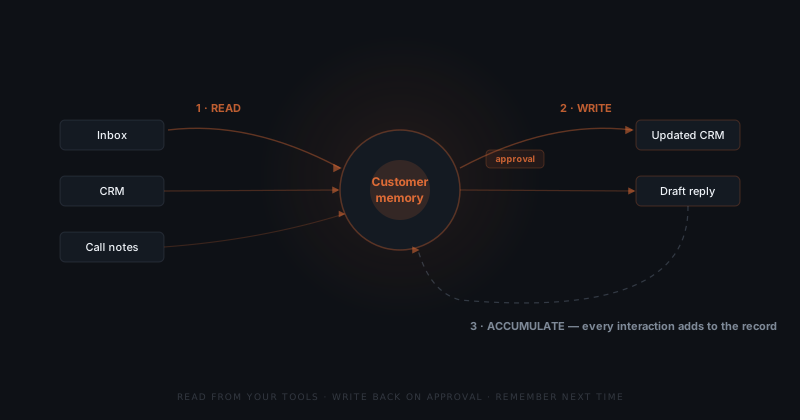
The write side is where control matters most, and where a customer agent differs from an autonomous one. The agent drafts the follow-up, proposes the CRM update, flags the at-risk account — and every one of those actions waits in a review queue until a named person approves it. Approving sends or writes. Editing opens the draft first. Rejecting logs the decision and teaches the agent what not to repeat. The agent never writes to a customer record or an inbox beyond what the queue releases.
That approval step is the same control pattern behind AI agents for CRM updates and customer support. The memory makes the draft accurate. The approval keeps the judgment with you. Neither works without the other: memory without approval is an agent acting on a picture it might have wrong, and approval without memory is a person still assembling context by hand before every sign-off.
What an AI agent with customer memory still gets wrong
An agent with memory inherits the quality of what it reads. Give it contradictory sources and it produces a record that reflects the contradiction. This is a boundary worth stating plainly, because the failure modes are specific and each has a design answer.
Contradictory data produces a contradictory record. If the call note says monthly billing and the signed contract says annual, the agent surfaces both rather than guessing. The review queue exists for exactly this — the person resolves the conflict, and the resolution becomes a durable fact the agent holds going forward.
Memory is only as current as its last read. An agent that reads the inbox hourly knows the account as of an hour ago, not this second. For most follow-up and account work that lag is invisible. For anything time-critical, the read frequency has to match the workflow, which is a configuration decision made during setup.
The agent extracts; it does not interpret intent. It reads that a client asked to push the renewal. It does not decide whether to grant the extension, waive a fee, or escalate the account. Those judgment calls stay with the owner. The agent's job is to make sure the owner decides with the full record in front of them, not a blank one.
None of these limits argue against memory. They argue for the approval layer and for scoping the read frequency to the work — both of which are implementation choices, not model settings. An agent that surfaces a conflict for a human to resolve is more useful than a rep who never saw the conflict at all.
Why this is an implementation problem, not a product you buy
An agent that knows your customers is built by connecting your specific tools, not bought off a shelf. This is the lesson buried in the MIT NANDA finding: vendor-built, workflow-embedded tools succeeded about 67% of the time, while generic internal builds succeeded roughly a third as often.[⁴] The agents that work are the ones wired into the exact systems a business already runs — not the ones bolted on top.
The reason is that "your customers" is a different data shape in every business. One team's context lives in Gmail and HubSpot; another's in Outlook, Pipedrive, and a shared Notion doc; another's in GoHighLevel and a pile of call recordings. The memory is only as good as the connections feeding it, and connecting an agent to real systems is the part that separates a working agent from a demo. Auth, permissions, rate limits, and each tool's quirks are where implementations succeed or stall.
The cost of poor customer data compounds while this sits undone. MIT Sloan Management Review, with Cork University, put the annual revenue lost to poor data quality at 15–25%.[⁵] That loss is not fixed by another CRM or a data-cleanup sprint that decays within months — contact data alone goes stale at roughly 30% a year. It is fixed by an agent that keeps the record current as a matter of course, reading and writing continuously instead of depending on anyone to remember.
That is the work: map where each customer's context lives, connect those sources with scoped permissions, configure what the agent reads and how often, and set the approval queue that keeps writes under human control. It takes a scoping conversation and a few weeks, not a signup. What comes out is not a chatbot bolted to your website. It is a record of every customer that stays current on its own — and a team that starts every interaction knowing, instead of reconstructing.
Frequently asked questions
What does it mean for an AI agent to know your customers? An AI agent that knows your customers holds a persistent record of each one, assembled from every place their context lives — email threads, CRM fields, call notes, invoices, and chat messages. It reads those sources into one memory, updates the memory as new interactions happen, and recalls the relevant history when you draft a reply or prepare for a call. This is different from a chatbot, which answers a question and forgets the conversation once it ends.
How is customer memory different from a CRM? A CRM is a database that stores what someone typed into it. Customer memory is an agent layer that reads context from the CRM plus the inbox, call notes, and chat where the rest of the story lives, then assembles it into one record and keeps it current. The CRM holds the fields a rep remembered to fill in. Memory holds what actually happened, including the parts no one logged.
Does an AI agent with customer memory replace my CRM? No. An AI agent with customer memory reads from and writes to your existing CRM — HubSpot, Pipedrive, Salesforce, or GoHighLevel — rather than replacing it. The CRM stays the system of record. The agent keeps that record accurate by pulling context from the email and call data the CRM never sees, and by writing structured updates back after you approve them.
Is my customer data too messy for an AI agent to use? Messy data is the normal starting condition, not a disqualifier. An AI agent reconstructs context from the sources where it actually lives — mostly email and call history — rather than depending on clean CRM fields. Contradictory or missing records produce a weaker first draft, which is why every agent output waits for review. The agent improves data hygiene over time by writing structured updates back to the record.
Notes
- Gartner, "How to Improve Your Data Quality," Gartner, 2021. https://www.gartner.com/smarterwithgartner/how-to-improve-your-data-quality — source for the finding that poor data quality costs organizations an average of $12.9 million per year.
- Salesforce, "State of Sales Report," Salesforce, 2024. https://www.salesforce.com/sales/state-of-sales/ — source for the finding that sales reps spend roughly 70% of their time on non-selling work and about 30% selling.
- IBM, "What Is AI Agent Memory?," IBM Think, 2025. https://www.ibm.com/think/topics/ai-agent-memory — reference for the definition of agent memory and the episodic/semantic distinction.
- MIT NANDA, "The GenAI Divide: State of AI in Business 2025," MIT Project NANDA, 2025. https://mlq.ai/media/quarterly_decks/v0.1_State_of_AI_in_Business_2025_Report.pdf — source for the finding that only ~5% of enterprise AI pilots reached meaningful P&L impact, that failed tools could not retain feedback or adapt to context, and that vendor-built tools succeeded ~67% of the time versus one-third as often for internal builds.
- MIT Sloan Management Review and Cork University Business School, reported via industry analysis, 2024. https://sloanreview.mit.edu/ — source for the estimate that companies lose 15–25% of revenue annually to poor data quality.