
Read AI return research by its population and outcome before applying it to a workflow. Personal productivity, reported company profit and modelled potential need different interpretations.
What you'll learn
- Separate survey results, task experiments and economic models.
- Treat a value estimate as context for a measured trial.
- Use full costs and observed outcomes for the investment decision.
AI agent ROI statistics do not provide a verified universal average for a small-business workflow. Read the year, surveyed population and outcome first, then compare the net benefit you observe with the full cost of building, operating and reviewing the system.
What do AI agent ROI statistics actually measure?
AI agent ROI statistics combine several kinds of evidence. A survey can ask whether a company saw a financial effect from AI. An experiment can time a defined task with and without an assistant. A model can estimate what technology might deliver across an economy. These answer different questions.
For a business owner, the relevant question is narrower: does this workflow produce more useful value than its full cost? Time saved matters when the team can use it. Revenue matters when it can reasonably be attributed to the change. Drafts that need substantial correction count as additional work.
| Evidence type | What it can tell you | What it cannot establish |
|---|---|---|
| Business survey | What respondents report about adoption or financial impact | The return your agent will deliver |
| Task experiment | Performance on defined tasks in that setting | The full operating cost of your workflow |
| Economic model | Potential value under stated assumptions | Realized savings from a deployed project |
| Your measured pilot | Whether the chosen workflow meets your requirements | The result of every future use case |
Avoid combining these into one average. An increase in individual productivity is not automatically the same as a company-level profit increase.
What does the 2026 research show about AI returns?
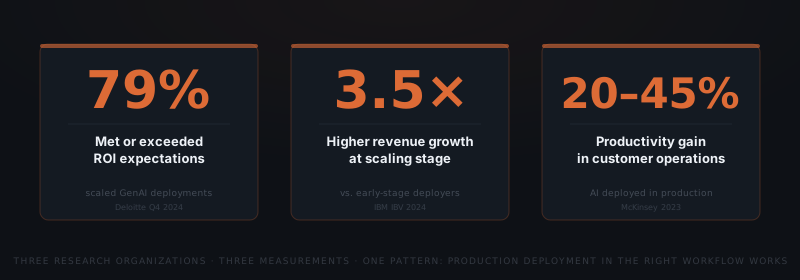
McKinsey’s August 2026 survey reports a gap between personal and organization-level results: 80% of respondents said AI improved their own productivity, while 37% attributed at least some EBIT impact to AI. Around 6% satisfied its high-performer definition: at least 5% of EBIT attributed to AI plus an impact described as significant.[1]
The research collected 1,719 responses across 97 nations between May 4 and June 8, 2026, and weighted the data by national contributions to global GDP.[1]
Those are self-reported results across company sizes. They are not an agent-specific success rate, a controlled comparison or a small-business ROI estimate. EBIT is a company profit measure; the definition also requires reported significance, so the 6% figure should not be read as “only 6% of AI projects work.”
The November 2025 edition reported 88% regular AI use in at least one business function. It also found 23% of respondents reporting agentic AI scaling in at least one function. Within each individual function, no more than 10% reported scaling agents.[2] Function-specific and organization-wide measures have different denominators.
Read the population, year and outcome before using a number. Broad AI adoption, agent deployment, personal productivity and project ROI are separate measurements.
Which workflows have the strongest potential for AI value?
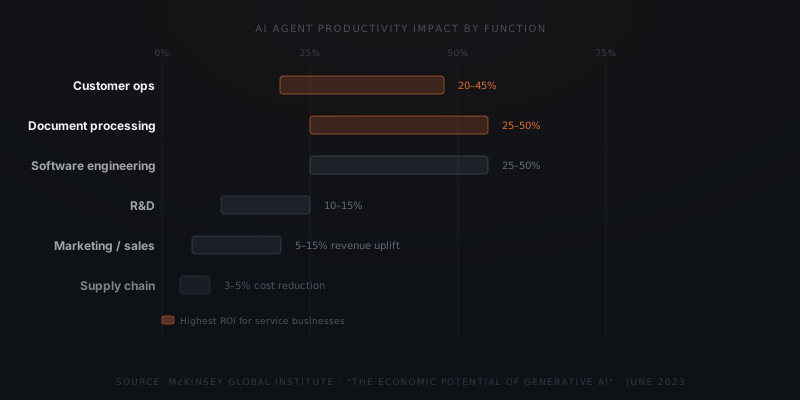
McKinsey’s June 2023 economic model examined 63 generative AI use cases. It estimated that approximately three quarters of potential use-case value lay in customer operations, marketing and sales, software engineering, and R&D.[3]
The function-level estimates describe potential productivity value relative to current spending. They do not rank measured returns from agents:
| Function | Modeled potential value | Basis |
|---|---|---|
| Customer care | 30–45%[3] | Current function costs |
| Marketing | 5–15%[3] | Marketing spending |
| Sales | 3–5%[3] | Global sales expenditures |
| Software engineering | 20–45%[3] | Current annual function spending |
| Product R&D | 10–15%[3] | Overall R&D costs |
These are historical model estimates for generative AI, broader than autonomous agents. A productivity-value estimate is not the same as that percentage of extra revenue, cash saved or faster task completion. For a document workflow, measure time from receiving the file to accepting the result, including missing information and corrections.
For your own business, use the research to choose candidates to investigate. Then check task volume, the cost of current work, available information, required quality and the consequence of an error. A client-update draft may be a useful candidate; a contractual decision may require substantially more review.
How should you measure time savings from an AI agent?
Measure the entire task. Say a report took thirty minutes before the trial. A two-minute draft followed by twenty-eight minutes of review still takes thirty minutes. Those are hypothetical timings to show the method, not a reported client result. Include corrections and exception handling in the same task.
Keep successful routine cases and failed cases in the same measurement. Include days when a connection was unavailable or the input was incomplete. Track output quality alongside time so that a faster result does not conceal lower accuracy.
Task evidence can help choose the comparison: the published 2025 Generative AI at Work study reports 15% more issues resolved per hour with assistance. That is throughput in the studied support setting, not a universal reduction in task minutes or your full operating cost.[6]
McKinsey’s early-2024 survey involved 1,363 participants and described adoption, reported value and risk practices. Use it for those survey questions; use task measurements to estimate handling time.[4]
For a service business, a useful weekly record includes completed tasks, corrected tasks, review minutes, missed cases and the time someone spent keeping the system working. Compare this with a baseline from comparable work before the agent started.
How do you calculate AI agent ROI and payback?
Calculate net benefits over a defined period, then compare them with total costs. Include implementation, operation, required software, staff review and maintenance. Count a removed subscription only when you actually stop paying for it. Count staff time as financial value only with a stated assumption about how that time is used.
Illustrative calculation: use Destatis’ published €45 average hourly labour cost for German industry and services in 2025 as a reference, not your company’s actual rate.[5]
Suppose, purely for the example, a workflow releases ten hours per month after review but needs three additional hours of maintenance. The calculation is €450 of released capacity minus €135 of maintenance effort: €315 before software bills and the initial build. The hours are chosen assumptions, not measured savings; the euro inputs derive from the cited labour-cost reference. This is capacity value, not cash received or a Yardwork price.
Replace the hourly rate, observed time and actual bills with your own records before calculating a return. The initial cost and other operating charges still have to be counted. A positive time-value subtotal alone is not a complete ROI result.
Payback occurs when cumulative net benefit covers the initial cost. A weak month, extra maintenance or a slower rollout changes that date. Forecast a cautious case as well as a favorable one.
Choose the review period to cover the task’s normal cycle and exceptions. McKinsey’s 2026 survey says operating costs constrain AI use for about 20% of respondents; that is another reason to keep ongoing charges beside benefits rather than only reporting a launch.[1]
Expand after useful results and acceptable failures are demonstrated, then measure the added workflow too. For the full calculation and measurement method, use how to calculate AI agent ROI.
What should you ask before using a benchmark in a business case?
Ask who was studied, what was measured, when the data was collected and whether the result was modeled, observed or self-reported. Check whether the work and company size resemble yours. A large-company AI survey can offer context without being a small-business agent benchmark.
Then ask what your implementation will cost to operate and review. Your decision should rest on the workflow’s measured net result, not a comparison between unrelated percentages. For the underlying concepts, see what an AI agent is and how to calculate AI agent ROI.
Frequently asked questions
What ROI do AI agents deliver on average? There is no verified universal average for an AI agent in a small business. Surveys describe different populations and different outcomes; modeled productivity potential is not measured project ROI. Calculate the return for your workflow using observed net benefits and the full implementation and operating cost.
Which business functions produce the highest AI agent ROI? McKinsey’s 2023 model identified customer operations, marketing and sales, software engineering, and R&D as major areas of potential value from generative AI. It did not measure a universal ROI ranking for deployed agents. A useful candidate in your business is a repeatable task with enough volume, accessible information and an outcome you can verify.[3]
How does AI agent ROI differ between customer operations and marketing? McKinsey modeled customer-care productivity value at 30–45% of current function costs and marketing productivity value at 5–15% of marketing spending. These are potential values, not measured returns or revenue growth rates. Compare the actual workload, quality, review effort and total costs in each proposed workflow.[3]
How does deployment scale affect AI agent ROI? Shared connections can reduce some of the work needed for a later agent, but additional agents also create operating and review costs. Survey associations between adoption depth and financial impact do not prove that adding another agent causes a fixed return. Measure each workflow and check the combined system before expanding.
Notes
- The state of AI in 2026: On the road to ROI. August 25, 2026; survey May 4–June 8, 2026 Accessed October 15, 2026.
- The state of AI in 2025. November 5, 2025; survey June 25–July 29, 2025 Accessed October 15, 2026.
- The economic potential of generative AI: The next productivity frontier. June 14, 2023 Accessed October 15, 2026.
- The state of AI in early 2024. May 30, 2024; survey February 22–March 5, 2024 Accessed October 15, 2026.
- Eine Arbeitsstunde kostete im Jahr 2025 durchschnittlich 45,00 Euro. April 29, 2026 Accessed October 15, 2026.
- Generative AI at Work. February 4, 2025 online; May 2025 issue Accessed October 15, 2026.