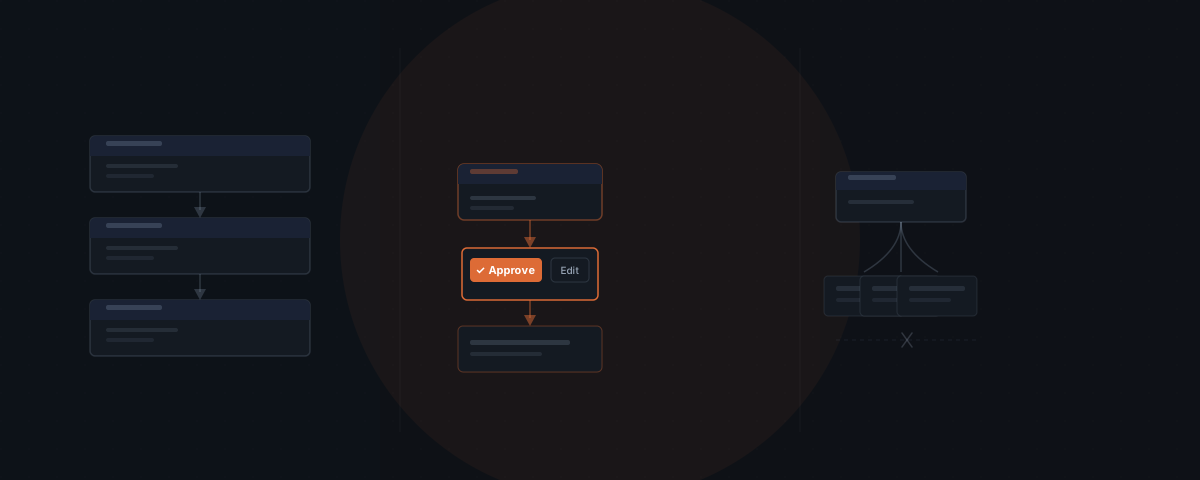
Choosing the best AI agent platform is not a features decision — it is a control infrastructure decision. Every platform embeds assumptions about when an agent can act without a human checkpoint, and those assumptions may not match how your business needs to operate. Most evaluations compare integration counts and pricing tiers. The evaluation criteria that prevent post-launch failures are not listed in those comparisons.
A founder chooses a platform because it connects to the most tools. Three months later, the agent is sending emails without a review step — because the platform's default model assumes agent autonomy, and the setting to require approval was buried in a sub-menu nobody checked during evaluation. The integration list was accurate. The control model was invisible in the comparison.
What separates an AI agent platform from automation software?
An AI agent platform deploys agents that read context, make decisions, and take actions across connected tools without being given explicit rules for every scenario. Automation software — Zapier, Make, n8n — executes predefined rules: when a trigger fires, run a defined action. An AI agent reads what it receives and decides what to do.
The functional difference has a practical consequence. Automation software is reliable when inputs are consistent and outputs are predictable. An AI agent handles the variation that automation cannot process — but introduces the possibility of judgment errors that deterministic automation does not produce. Neither is universally better. The task type determines which one fits.
72% of enterprises are now using or testing AI agents, according to Zapier's 2026 State of Agentic AI survey.[¹] Most of those organisations reached that point without a structured evaluation of the platform's control model — which is why agent-related incidents in business-critical workflows are rising alongside adoption.
What are the three categories of AI agent platform?
Most software marketed as an "AI agent platform" falls into one of three categories. Conflating them is the most common evaluation mistake.
An AI agent platform is not just a software choice — it is a control infrastructure decision. Once workflows are built on a platform's model of human oversight, switching to a different platform means rebuilding every workflow from scratch.
Purpose-built agent platforms. Platforms designed specifically to deploy AI agents with configurable human oversight. OpenClaw and Hermes are examples. Purpose-built platforms are architectured around the approval model: what the agent can do without a human, what requires a checkpoint, and how the human reviews and releases queued actions. The control model is explicit by design — not an add-on feature.
Automation platforms with AI features. Tools like Zapier Agents and Make AI that have added AI capabilities to their automation infrastructure. The AI layer can interpret content — categorising an email, extracting a field, drafting a short text — but the approval model is typically limited or absent. The underlying platform was designed for rule execution. The AI is additive, not architectural.
General-purpose LLM interfaces with integrations. Platforms that give a language model access to tools — OpenAI's GPT with Actions, Anthropic's Claude with tool use. These are flexible but do not include a structured approval layer. Every action the model takes is a model decision unless the developer builds approval logic on top of the API. Control is entirely the user's responsibility.
| Category | Control model | Handles variation | Approval layer | Best for |
|---|---|---|---|---|
| Purpose-built agent | Built-in, configurable | Yes | Native | Variable workflows requiring oversight |
| Automation + AI | Limited or absent | Partially | Add-on only | Structured tasks with AI assist |
| LLM with integrations | User-built | Yes | Manual | Custom builds where you control everything |
For how purpose-built agent platforms like OpenClaw and Hermes work technically, see what is OpenClaw and what is Hermes. For the comparison between building custom and using off-the-shelf tools, see custom vs. off-the-shelf agent platforms.
What should your control requirements determine?
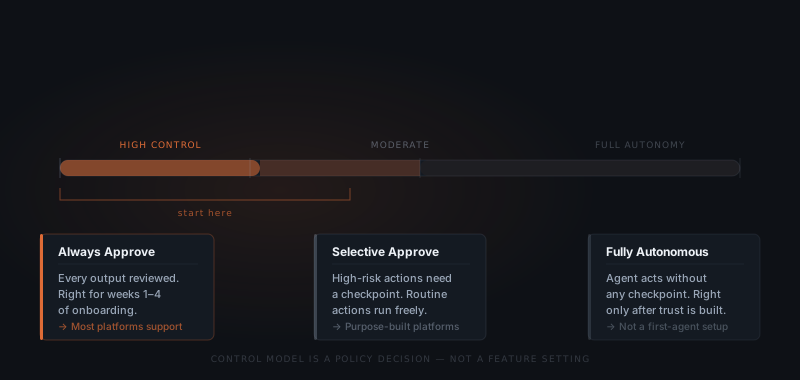
The practical question for any service business evaluating platforms is: how much of your workflow can your team tolerate an agent handling without a human checkpoint?
Every platform embeds assumptions about when an agent can act without a human. Those assumptions are a policy decision, not a feature setting.
For most businesses running their first or second agent, the answer is: very little. Early-stage implementations benefit from frequent approval checkpoints — not because the agent cannot be trusted, but because the review process is how the business understands what the agent is actually doing. A platform that makes it easy to add checkpoints is more useful at this stage than one that optimises for agent autonomy.
As an agent earns trust through a structured oversight period, the checkpoint frequency can decrease. A platform that lets you configure this progression — from high oversight to lower oversight as trust is established — is more valuable than one with a fixed autonomy model. The platform's control model should match where your business is in the trust-building process, not where a demo imagines it will eventually be.
The secondary consideration is integration depth. A platform can connect to every tool your business uses but support only a subset of actions within each tool. Before evaluating a platform, map the specific actions the agent needs to take — not just the tools it needs to access — and verify the platform supports those actions with the required permission levels.
How do you evaluate a platform before building on it?
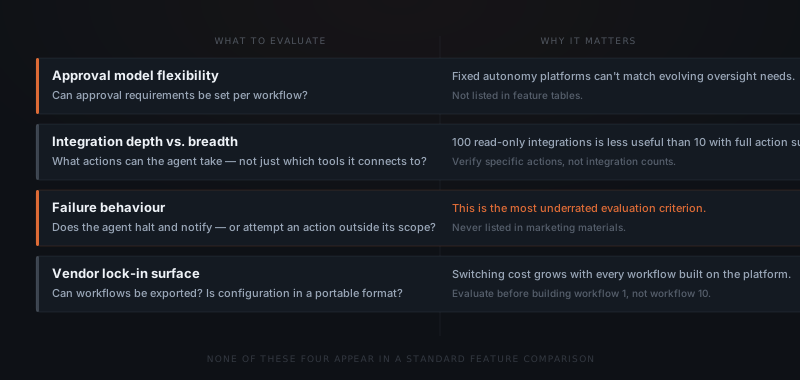
Four criteria that a standard feature comparison does not surface — and that determine whether the platform fit survives contact with real workflows.
Approval model flexibility. Can the platform configure what percentage of actions require human approval? Can approval requirements vary by workflow or action type? A platform with a fixed autonomy model will not match a business whose oversight requirements evolve over time — and most do.
Integration depth versus breadth. A platform that connects to 100 tools but supports read-only access across most of them is less useful than one that connects to 10 tools with full action support. Verify the specific actions your workflows require before comparing integration counts.
Failure behaviour. What does the platform do when an agent hits an edge case outside its defined scope? A platform that halts and notifies a human is a different control infrastructure from one that makes a best-effort attempt at an action the agent was not briefed to handle. Failure behaviour is not typically listed in feature tables — ask for it directly in any evaluation conversation.
Vendor lock-in surface area. If you build 10 workflows on a platform and then need to switch, what is the cost? Platforms with proprietary prompt formats, non-exportable configuration, and no API access for workflow portability create switching costs that grow with every workflow deployed. Assess this before building workflow one, not workflow ten.
What do AI agent platforms cost?
Platform cost varies significantly by architecture. SaaS automation platforms charge subscription fees. Purpose-built self-hosted platforms have a one-time setup cost plus infrastructure and API usage.
| Platform type | Example | Year 1 cost | Year 2+ annual cost | Notes |
|---|---|---|---|---|
| Purpose-built (self-hosted) | OpenClaw | $2,400–9,000 | $600–3,000 | Open-source, data stays on your server |
| Purpose-built (self-hosted) | Hermes | $4,000–11,000 | $840–4,560 | Open-source, self-improving |
| Automation + AI | Zapier Agents | $1,200–6,000 | Same | SaaS subscription, vendor-hosted |
| Automation + AI | Make AI | $800–4,800 | Same | SaaS subscription, vendor-hosted |
| Custom build | Bespoke | $8,000–25,000 | $1,500–6,000 | One-time build, specific to your workflow |
The cost structure is as important as the number. A SaaS platform at $400/month is predictable. A self-hosted platform with API costs that scale with task volume may cost less at low volume and more at high volume. Map your expected task volume against the pricing model before committing to a platform.
Red flags during platform evaluation
Most platform evaluations are conducted against a demo, not a production workflow. The demo is designed to succeed. These signals indicate whether the platform will work in your actual environment.
The approval layer is a setting, not architecture. If the vendor describes human oversight as "you can turn on approval mode," the approval is a configuration option an agent can be set to bypass. In a purpose-built platform, the approval layer is structural — the action is blocked at the infrastructure level, not at the model level.
The demo uses clean, predictable inputs. Ask what happens when the agent receives an input it was not designed to handle. Does it halt and notify a human? Does it make a best-effort attempt? Does it silently skip the record? Failure behaviour in edge cases is more predictive of real-world performance than demo success on ideal inputs.
Pricing is per-action. Per-action pricing means a workflow that runs more frequently than expected costs more than budgeted. Establish a ceiling and understand what triggers it before building workflows.
Workflow configuration cannot be exported. If the platform stores workflow logic in a proprietary format with no export option, every workflow you build is a switching cost that locks you in. Ask for the export format before building workflow one.
The vendor cannot explain graceful degradation. Ask: "When the agent encounters a situation outside its brief, what exactly happens?" A vendor who cannot answer specifically is describing a platform they have not stress-tested in production.
Gartner estimates that 30% of AI agent projects will be abandoned after proof of concept through 2026 — most due to people and process failures, not technology limitations.[²] McKinsey's 2024 State of AI report found that organisations with formal governance and platform selection criteria are significantly more likely to scale AI implementations successfully than those that select tools based on feature lists alone.[³]
Frequently asked questions
What is the difference between an AI agent platform and automation software like Zapier? Automation software executes predefined rules — when a trigger fires, it runs a configured action. An AI agent platform deploys agents that read context and decide what to do. Zapier is reliable for structured, predictable tasks. An AI agent platform handles variation that Zapier cannot process, but introduces the possibility of judgment errors that deterministic automation does not produce.
What should I look for in an AI agent platform for a small business? Prioritise four criteria that standard feature comparisons do not surface: approval model flexibility (can oversight be configured per workflow?), integration depth versus breadth (what actions can the agent take, not just which tools it connects to), failure behaviour (what happens when the agent hits a scope edge case?), and vendor lock-in surface area (what does switching cost once workflows are built?).
What is a purpose-built AI agent platform? A purpose-built AI agent platform is designed specifically to deploy agents with configurable human oversight built into the architecture. The approval model — what the agent can do without a human, what requires a checkpoint, how the human reviews queued actions — is native to the platform, not an add-on. OpenClaw and Hermes are purpose-built platforms. Zapier Agents and Make AI are automation platforms with AI features added.
When should a business build a custom AI agent instead of using a platform? Custom agents are worth considering when off-the-shelf platforms make assumptions about data format, approval structure, or output destination that do not match your business. Custom agents are built for one business's specific process — the integration work is what makes them custom, not the underlying model. For a full comparison, see custom vs. off-the-shelf agent platforms.
Notes
- Zapier, "State of Agentic AI Adoption Survey 2026," Zapier Inc., 2026. https://zapier.com/blog/ai-agents-survey/
- Gartner, Top Strategic Technology Trends 2024, Gartner Research. https://www.gartner.com/en/information-technology/insights/artificial-intelligence
- McKinsey & Company, "The State of AI in 2024," McKinsey Global Survey, May 2024. https://www.mckinsey.com/capabilities/quantumblack/our-insights/the-state-of-ai