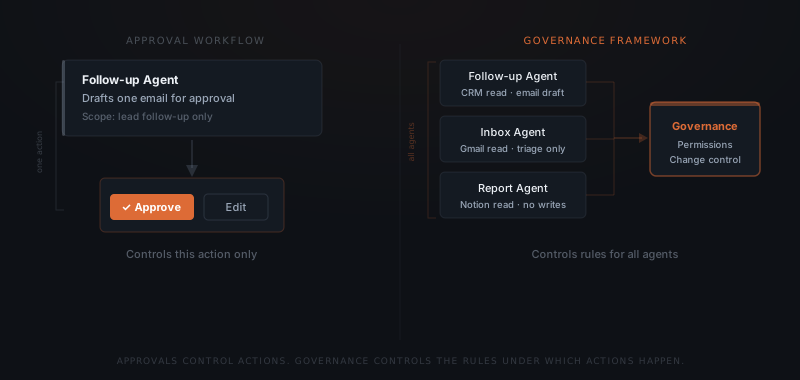
AI agent governance is the org-level framework that defines what agents are authorised to access, who can change those permissions, and what happens when an agent acts outside its scope. Approval workflows control individual agent actions. Governance controls the rules under which all agents operate. Most businesses build the first without ever thinking about the second — until they are running three agents at once.
A business runs two AI agents. The first handles lead follow-up; the second handles inbox triage. Both connect to Gmail. One afternoon, the triage agent reroutes a message that the follow-up agent was already preparing a response to. Nobody planned for the conflict. Nobody defined which agent had authority over which actions. The governance layer was never built — because until that moment, nobody needed it.
What is AI agent governance?
AI agent governance is the set of org-level decisions that define what AI agents in a business are permitted to do, who can change those permissions, and what triggers a review when an agent acts unexpectedly.
Governance is not the same as an approval workflow. An approval workflow controls individual agent actions — one email draft, one CRM update, one message queued for send. Governance controls the rules under which those workflows operate: what systems each agent can access, what categories of action require human approval, and what the escalation path is when an agent encounters an edge case outside its defined scope.
AI agent governance is not the same as an AI policy. A policy states a company's general stance on AI use. Governance is the operating framework: it sets what each agent may touch, who can revise those settings, and what triggers a review.
Governance is also distinct from an AI policy. An AI policy documents a company's principles around AI use in general — often aspirational. Governance is operational. Governance defines specific rules for specific agents and specifies who has the authority to change them. For a detailed treatment of how individual approval workflows function, see what approval workflows do in an AI agent system.
What does an AI agent governance framework actually cover?
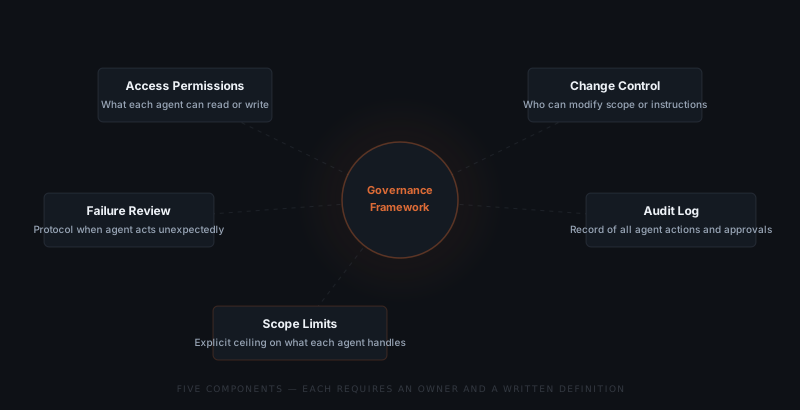
A lightweight governance framework for a service business covers five areas.
Access permissions. Each agent is authorised to read from and write to specific systems at defined access levels — scoped to what the agent actually needs. A lead-tracking agent needs CRM read access. The same agent does not need billing system access. Permissions are defined per agent, documented, and reviewed when scope changes.
Change control. One named person per agent holds the authority to modify that agent's instructions, integrations, or scope. In a 10–40 person firm, this is typically the founder or managing partner for the first agent, delegated to a senior team member as the system grows. Changes are logged with a date and a reason.
Failure review protocol. A documented procedure that answers three questions: who is notified when an agent produces an unexpected output, what information is collected during the review, and under what conditions the agent is suspended pending investigation. The protocol is written before go-live, not drafted in the aftermath of a failure.
Scope limits. Each agent has an explicitly stated ceiling on what it handles — defined as what is in scope, not only what is excluded. "This agent handles lead follow-up emails to prospects who have not responded in five days" is a scope definition. "This agent does not handle billing" is not.
Audit log. A record of what each agent did, when, and on whose approval. The format can be simple — a dated entry in Notion, a commit message, a tagged row in a project tool — but the requirement is non-negotiable. Without an audit log, failure reviews are guesswork.
The five areas summarised:
| Governance area | What it defines | Who owns it | Review trigger |
|---|---|---|---|
| Access permissions | What each agent can read or write per system | Named agent owner | When agent scope changes |
| Change control | Who can modify instructions, integrations, or scope | Founder or named delegate | Per change, logged with date and reason |
| Failure review protocol | Who is notified, what is collected, when to suspend | Named agent owner | Per unexpected output |
| Scope limits | Explicit ceiling on what each agent handles | Named agent owner | Monthly or when workflow changes |
| Audit log | Record of agent actions, changes, and approvals | Named agent owner | Monthly review cycle |
What do AI agent governance policies look like written down?
Each policy statement answers three questions: what is permitted, who holds authority, and what requires a log entry. Policies that do not answer all three are incomplete. The following are simplified examples that a 10–20 person service business can adapt directly.
Access permission policy: "The lead-follow-up agent has read access to the CRM contacts view and write access to the activity log. The agent does not have access to billing records, contract documents, or any file outside the /leads folder in Google Drive. Access to additional systems requires a change request approved by the agent owner before credentials are added."
Change control policy: "Any change to an agent's instructions, integration connections, or scope definition requires approval from the named agent owner before deployment. Changes are logged in the agent's configuration document with the date, a one-line reason, and the owner's initials. No changes go live without a log entry."
Scope definition example: "The intake agent processes new client inquiry form submissions arriving via the website contact form. The agent does not handle replies to existing email threads, support escalations, or submissions from addresses outside the approved domain list. Any input that does not match these criteria is flagged to the agent owner and not processed."
Failure trigger definition: "An output is considered unexpected when it: (a) references information outside the agent's defined data sources, (b) addresses a recipient not on the agent's approved contact list, or (c) takes an action not defined in the scope document. Unexpected outputs trigger the failure review protocol within 24 hours."
The exact wording matters less than the act of writing it down. A policy that is documented is revisable. A policy that exists only in the founder's head is invisible to anyone else in the business — and provides no protection when an agent acts outside its intended boundaries.
A complete governance document for a 10–20 person service business typically spans two to four pages, covers all five governance areas, and is shared with every team member who works with agents or has access to the systems agents connect to.
When does AI agent governance matter?
For a single-agent implementation, informal governance is usually sufficient. One agent, one reviewer, one workflow — the rules are simple enough to maintain in the agent's brief or a shared document. Most single-agent governance problems are covered by the onboarding and management frameworks.
Approvals tell one agent what it cannot do today. Governance tells all agents what they will never do.
Governance becomes a distinct requirement when a business runs more than two agents. At that threshold, three problems emerge that informal management cannot address.
Conflicting permissions. Two agents can each be authorised to access the same data source and produce conflicting outputs. Without a governance layer that defines which agent's output takes authority in a given situation, conflicts surface as production errors — not as configuration decisions.
Shared system risk. When multiple agents connect to the same tool — Gmail, a CRM, Slack — an error in one agent's scope can corrupt the data that other agents depend on. Governance defines what each agent is permitted to modify and what it is only permitted to read. Without this distinction, a write-permission error in one agent affects all agents downstream.
Change without visibility. Updating one agent's instructions may change the data or trigger conditions that a second agent depends on. Governance requires evaluating downstream effects before changes go live — not discovering them after. For the operational layer that governance underpins, see what running multiple AI agents involves.
How do you build a lightweight governance framework?
A governance framework for a 10–40 person service business does not require a compliance team or enterprise tooling. Four steps are sufficient to establish the framework before adding a second agent.
Document current permissions
Name one owner per agent
Write a failure protocol
Create a change log
KPMG's 2024 CEO Outlook found that AI governance and oversight ranked among the top concerns for business leaders planning to scale AI deployments beyond initial pilots.[1] Gartner identifies that fewer than 30% of enterprises have a formal framework governing what AI agents can access and how those permissions are changed.[2] The gap between operating agents and governing them is where most multi-agent system failures originate — see AI agent team structure for how ownership divides once a second agent joins the first, and when to let your AI agent act autonomously for how the permissions this framework documents actually get loosened over time.
Understanding what an AI agent can do is the first question. Governing what a system of agents is permitted to do is the question that follows — and it cannot be answered one agent at a time.
What is the escalation matrix, and who responds at each failure level?
The escalation matrix converts the failure protocol into a decision table: it names who is notified first at each severity level, from a low-stakes output correction up to a critical data-deletion incident. Most governance failures in small business agent deployments happen not because the business lacks a failure protocol, but because the protocol does not name who acts first — the matrix closes that gap.
| Failure type | Severity | First notified | Required action | Suspend agent? |
|---|---|---|---|---|
| Agent produces unusual output in a low-stakes workflow | Low | Agent owner | Review output, log, correct prompt if needed | No |
| Agent sends content outside its defined scope | Medium | Agent owner + founder | Review last 48 hours of output, suspend send permissions | Partial — outputs held |
| Agent accesses a system outside its permission set | High | Founder immediately | Suspend agent, run full permission audit | Yes |
| Agent sends client-facing content with a factual error | High | Agent owner + founder | Suspend agent, assess whether client notification is required | Yes |
| Agent modifies or deletes data outside its write permissions | Critical | Founder + operations lead | Suspend all agents connected to the affected system, full incident review | Yes — all affected agents |
The matrix does two things: it defines who acts, removing the delay caused by deciding who should respond during an incident; and it defines the suspension threshold, preventing a partial failure from becoming a full system problem. For a service business running two or three agents, a one-page document covering this table and the failure trigger definitions from the access policy is sufficient. It does not need to be formal — it needs to be written and shared.
Frequently asked questions
What is the difference between AI agent governance and an AI policy? An AI policy is a company's documented stance on AI use broadly — often a set of principles or guidelines for employees. AI agent governance is operational: it sets the access rules each agent runs under, names who has authority to update them, and spells out the response when an agent steps outside its scope. Policy is directional. Governance is enforceable.
When does a small business need AI agent governance? Informal governance — notes in an agent brief, one named reviewer — is usually sufficient for a single-agent implementation. Formal governance becomes necessary when a business runs more than two agents, when agents share access to the same tools or data sources, or when instructions for one agent could affect how another agent behaves.
What should an AI agent governance framework include? A lightweight framework covers five areas: access permissions (what each agent can read or write), change control (who can modify scope or instructions), a failure review protocol (what happens when an agent acts unexpectedly), scope limits (an explicit ceiling on what each agent handles), and an audit log (a record of agent actions and approvals).
What is the difference between AI agent governance and approval workflows? Approval workflows control individual agent actions — one email draft, one CRM update. An approval is a yes-or-no decision on a specific output. Governance controls the rules under which all agents in a system operate: what they can access, what triggers a review, and who has authority to change those rules. Approvals exist within the governance framework; governance defines the conditions under which approvals are required.
Notes
- KPMG International, "KPMG 2024 CEO Outlook," KPMG, 2024. https://kpmg.com/xx/en/home/insights/2024/09/kpmg-global-ceo-outlook-survey.html
- Gartner, "Top Strategic Technology Trends 2025," Gartner Research, 2024. https://www.gartner.com/en/information-technology/insights/top-technology-trends
- World Economic Forum, "Governing AI Agents," Global AI Action Alliance, 2024. https://www.weforum.org/publications/governing-ai-agents/