AI agent onboarding is the review period between deployment and trusted operation. Assign a named reviewer, a review cadence and success criteria before reducing oversight. The 30-day plan below is a starting example to adapt to the workflow’s consequences; neither a calendar deadline nor an unrelated industry failure forecast proves that the agent is ready.
The implementation is done. The agent is live. Three weeks later, the team has quietly stopped using it — not because the agent failed, but because nobody was assigned to review its outputs, nobody updated the instructions when real edge cases appeared, and nobody defined what "working correctly" was supposed to look like at day 30. Go-live was treated as the finish line. Onboarding is what should have started there.
What does onboarding an AI agent actually mean?
Onboarding an AI agent is not the same as configuring one. Configuration is the technical work before go-live: connecting tools, writing instructions, testing outputs. Onboarding is what comes after — integrating the agent into how your team operates.
Briefing is also a separate step. A brief tells the agent what to do. Onboarding tells the team how to work alongside it. Writing effective initial instructions — covered in how to brief an AI agent — is a prerequisite for onboarding, not a substitute.
Effective onboarding has three components. First: a named reviewer — one person, not a committee, whose job includes checking agent outputs on a recurring basis. Second: a defined review cadence — how often outputs are reviewed, how many, and what to look for. Third: a written success definition — workflow-specific criteria the agent must meet before the close-oversight period ends.
Without those three, go-live is the end of the project. With them, go-live is day one.
The distinction between configuration, briefing, and onboarding matters because each addresses a different failure mode. Configuration failure produces an agent that does not run. Briefing failure produces an agent that runs but produces wrong outputs on edge cases. Onboarding failure produces an agent that runs correctly for two weeks and then stops being used — because nobody was maintaining the relationship that keeps it calibrated and trusted.
A project can complete configuration and briefing while leaving onboarding unassigned. Review ownership and acceptance criteria need their own place in the launch plan.
How should you structure the first 30 days?
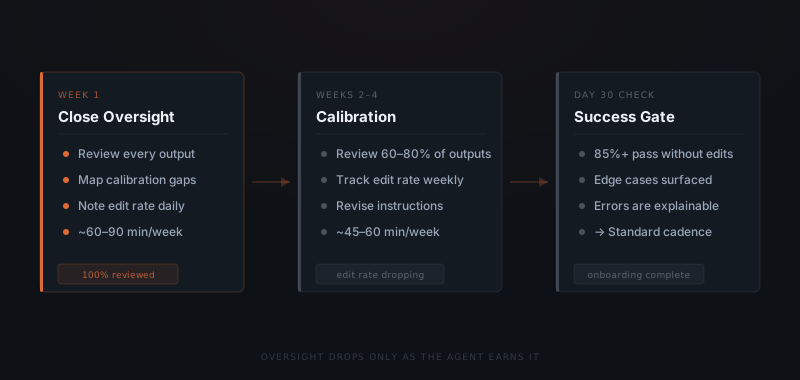
The following is an example review plan, not a measured learning curve or universal acceptance threshold. Adapt the timing, sample and oversight to the consequences of this workflow.
The first 30 days are a trust-building period. The agent operates under close review until it demonstrates its brief on real data. Oversight intensity decreases deliberately as evidence of calibration accumulates.
Onboarding is the deliberate close-oversight period between go-live and trusted operation. An agent that skips this period does not earn trust — it accumulates unreviewed errors.
Week 1: Review every output. Not to approve everything — to understand how the agent handles real inputs. Note which outputs are correct and approved as-is, which require edits before approval, and which are rejected outright. By the end of week 1, the reviewer should have a clear picture of the agent's calibration.
Weeks 2–4: Reduce to 60–80% review, focusing on categories that generated errors in week 1. Track the edit rate week over week. A declining edit rate may indicate improvement if the input mix and review standards are comparable. Investigate a flat or rising rate before reducing oversight.
Day 30: Run the success check against the benchmark written before go-live. In this example, 85% of outputs approved without edits is an illustrative quality target. Readiness also requires representative input coverage, acceptable error categories and working review rules. A blocking error can prevent reduced oversight even when the overall pass rate is high.
| Phase | Review intensity | Focus | Signal to move forward |
|---|---|---|---|
| Week 1 | 100% of all outputs | Understand how agent handles real inputs; log all error categories | Edit rate baseline established; all output types observed |
| Weeks 2–4 | 60–80%, focused on error categories | Track edit rate week over week; update instructions when patterns emerge | Edit rate declining for two consecutive weeks |
| Day 30 | Full benchmark check | Run pass rate against pre-written success criteria | Agreed quality target met; no blocking errors; representative inputs reviewed |
How do you know when the agent is ready for less oversight?
Review three signals against the requirements agreed for this workflow. No single pass rate proves readiness.
Go-live is not the finish line. It is day one of the management relationship.
Stable approval rate. Outputs meet the agreed quality target across a representative sample and review period. Set both for this workflow; a stable overall percentage does not rule out unacceptable errors.
Edge cases handled correctly. Test unfamiliar and ambiguous inputs. Confirm that the workflow handles them within its allowed scope or stops for a named reviewer, rather than assuming that the agent will recognise every exception.
Errors are explainable. The reviewer can state specifically what categories of output still need improvement and why. If errors appear random or unpredictable, the instructions need further work before oversight decreases.
When these requirements are met, use the ongoing review cadence appropriate for the task. Keep required business approvals in place, review instructions when the business changes and revisit scope decisions. The ongoing management framework is in how to manage an AI agent.
What does a success definition look like in practice?
The success definition written before go-live is not a general statement of intent — it is a specific benchmark that produces a binary result at day 30: the agent passes, or it needs an extended onboarding period.
A useful success definition covers three things:
Pass rate. The percentage of outputs approved without edits. Set the threshold for the task and the consequences of mistakes. The 85% target in the example above is not an industry standard. A pass rate alone does not show that unusual cases are correctly routed for review; test that behaviour directly.
Error category map. Which output categories are allowed to fail and which are not. An agent sending a follow-up email with a formatting error is a correctable failure. An agent routing a high-value client inquiry to the wrong queue is a different category of failure entirely. The success definition specifies which error types are acceptable at day 30 and which are blocking.
Coverage check. Which input types the agent encountered in the first 30 days and whether any input type it was designed to handle did not appear. If the agent was briefed for five input categories and only two appeared in 30 days, the pass rate means less than it would if all five were represented.
A success definition written with these three elements gives the day 30 check a clear outcome. The agent either clears the threshold on the right output categories with sufficient input coverage, or it doesn't. Without those specifics, day 30 becomes a judgment call — and judgment calls tend to go in the direction of optimism rather than accuracy.
What happens when onboarding is skipped?
In July 2024, Gartner forecast that at least 30% of generative AI projects would be abandoned after proof of concept by the end of 2025, citing data quality, risk controls, costs and unclear business value.[1] This was a prediction about generative AI projects, not a measured 2026 post-launch agent failure rate or evidence that missed onboarding caused the outcome. The practical review gaps below should be evaluated on their own.
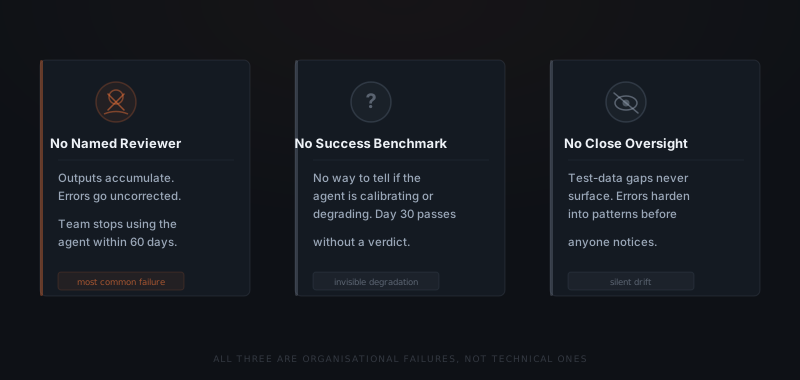
No named reviewer. The agent runs. Outputs accumulate. Errors go uncorrected because nobody owns the job of reviewing them. When the team notices quality has degraded, the agent stops being used — not because the technology failed, but because the management relationship was never established.
No success definition. At day 30, nobody can say whether the agent is performing or degrading. Without a benchmark set before go-live, a slowly failing agent looks identical to a well-calibrated one until the degradation becomes obvious. For a framework on measuring agent performance, see how to know if your AI agent is actually working.
No close oversight in week 1. Agents behave differently on real data than on test data. Close oversight in week 1 surfaces the gaps between testing and production. Skipping week 1 review means those gaps harden into patterns before anyone catches them — and correcting entrenched errors after the team has adapted to them is more disruptive than preventing them at the source.
Understanding what an AI agent is capable of is the starting point. Getting it used and trusted is what the onboarding period determines.
A clear map of which step was skipped and what it produces makes the failure mode diagnosable, not just recognisable.
| Onboarding step skipped | What the team observes | What actually happened | How to recover |
|---|---|---|---|
| No named reviewer | Quality "seems fine" — until suddenly it doesn't | Errors accumulated unreviewed for weeks before anyone noticed | Assign one reviewer; run a retrospective review of the last 30 days of outputs |
| No success benchmark | Impossible to tell if the agent is calibrating or degrading | No baseline to compare against; a failing agent looks like a working one | Define the benchmark retrospectively; run a calibration review against it |
| No close oversight in week 1 | First-month outputs approved loosely | Test-to-production gaps hardened into consistent error patterns | Run a structured review of the last 30 outputs; rewrite instructions for every identified pattern |
| No instruction update process | Agent outputs drifting from what the team expects | Instructions no longer reflect the business as it operates today | Assign instruction review responsibility; run a full brief audit |
How do you set up onboarding before go-live?
Every onboarding failure is a go-live setup failure. The reviewer, the review cadence, and the success benchmark must exist before the agent handles its first live task — not after the first problem surfaces.
Write the success definition first
Before go-live, write the specific benchmark the agent must meet at day 30: pass rate threshold, output categories covered, and which error types are acceptable versus blocking. A benchmark that does not exist before launch cannot be evaluated fairly at day 30.
Assign one named reviewer
Not a committee — one person. That person's name appears in the onboarding document before the agent goes live. If the reviewer changes during the 30 days, the handoff must include the running edit-rate log, not just a briefing from the previous reviewer.
Schedule week 1 review blocks
Put the week 1 100% review time on the calendar before go-live. Not as a reminder — as a commitment. If the calendar blocks do not exist at launch, the week 1 review defaults to "when there is time," which defaults to not happening.
Brief the team on scope
Every team member who interacts with the agent's outputs should know: what the agent handles, what it does not handle, and how to flag something that looks wrong. The brief is for the team, not just the reviewer.
Define the instruction update process
Who can update the agent's instructions, on what timeline, and how changes are logged. An instruction update made without a log becomes invisible — and invisible instruction changes are the most common source of unexplained output shifts.
Download: AI agent onboarding review (PDF)
Frequently asked questions
What does onboarding an AI agent actually involve? Onboarding is the structured period between a live deployment and trusted operation. It requires three things: a named reviewer who checks outputs on a recurring basis, a defined review cadence specifying how many outputs are reviewed and how often, and a written success definition — workflow-specific criteria the agent must meet before oversight can reduce. Without all three, go-live is effectively the end of the project.
How long does AI agent onboarding take? This article uses a thirty-day example plan. The actual onboarding period depends on the task, input variety and consequences of an error. Review closely at first, then reduce oversight only after representative outputs meet agreed requirements. A date or generic 85% pass rate is not enough to establish readiness.
What should you look for when reviewing AI agent outputs during onboarding? Track three categories for each output: approved as-is, edited before approval, or rejected outright. Record the edit rate week over week. A declining edit rate may indicate improvement if input mix and review standards are comparable. A flat or rising rate is a reason to investigate the instructions, inputs and review process. When edits are required, log the category — format error, wrong tone, missing field — so the pattern is visible, not just the count.
What happens when AI agent onboarding is skipped? Without a reviewer, success criteria and early output checks, errors can accumulate unnoticed and the team cannot assess whether the workflow is useful. Schedule the review work and assign an owner before launch.
What is a good success definition for an AI agent at day 30? Define output quality, unacceptable error types and the input cases that must have been tested. A pass-rate threshold can help for routine tasks, but it must fit the consequences: a significant mistake may block readiness regardless of the overall percentage. Use day thirty as a review milestone, not an automatic release.
Notes
- Gartner, July 29, 2024 forecast: at least 30% of generative AI projects abandoned after proof of concept by end of 2025. https://www.gartner.com/en/newsroom/press-releases/2024-07-29-gartner-predicts-30-percent-of-generative-ai-projects-will-be-abandoned-after-proof-of-concept-by-end-of-2025