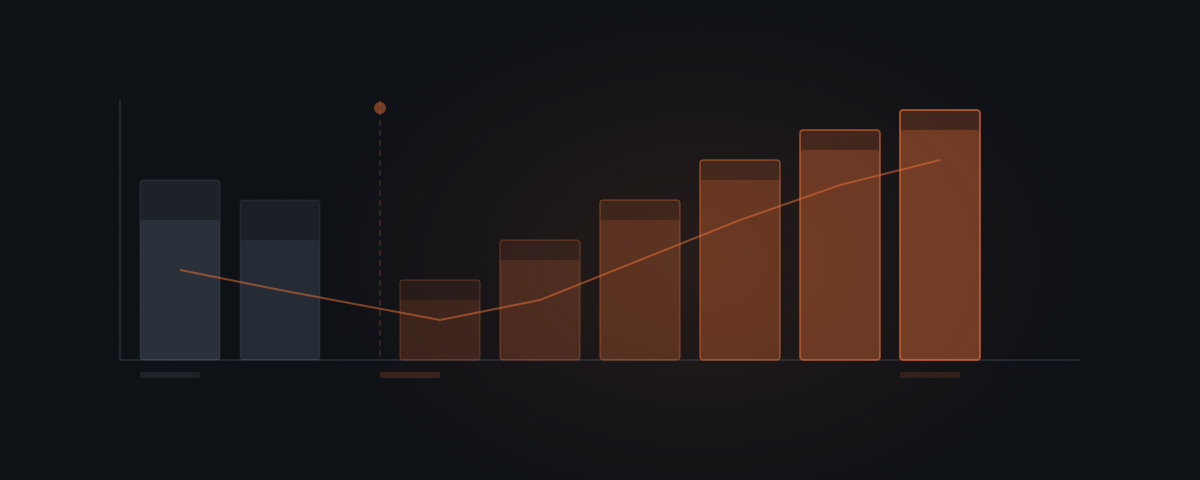
OpenClaw ROI is not measured in hours saved. The return appears in lead response speed, client retention, and invoice collection — outcomes that happen or don't, not time that gets freed up. For a founder-led business, one recovered deal at €5,000 pays for a year of service at the base tier.
What ROI from OpenClaw actually measures
Most ROI calculators for AI tools ask you to count hours. How many emails drafted per week? How many minutes saved per task? The result is a number like "7 hours saved per month" — plausible, forgettable, and wrong. That framing misses what OpenClaw is actually built to do.
The hours are real. They are not where the money is.
| What founders track | What actually drives ROI |
|---|---|
| Hours saved per week | Leads responded to within 2 hours |
| Tasks automated | Proposals that received a follow-up |
| Emails drafted | Invoices collected before 45 days |
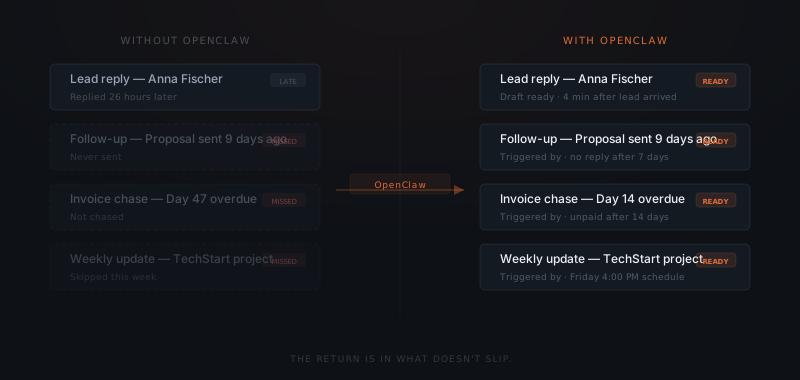
The money is in the lead that got a reply in 90 minutes instead of 26 hours. The client who received a status update before they had to ask. The invoice chased on day 31 instead of day 47. Each one either happened or it did not. The difference is not time saved — it is a deal, a relationship, or a payment.
Three places OpenClaw ROI shows up first
OpenClaw does not replace your judgment. It closes the gap between your judgment and your action. You still make every decision — the agent makes sure you make them before the window closes.
Lead follow-up is the clearest case. Reply within two hours and you are still in the conversation. Reply the next morning and it has moved on. For a €5,000 contract, one deal saved pays for months of service. OpenClaw drafts the reply the moment the trigger fires. The message is waiting in Slack for your approval before you open the thread.
Client retention is less visible but larger in aggregate. Most clients do not leave with a complaint — they drift. Fewer replies, slower responses, a feeling the agency is too busy. A weekly update that reliably arrives. A check-in that happens without prompting. In a service business, those are not nice-to-haves — they are what the client is paying for.
Invoice collection is the most direct calculation. If your invoices run 30+ days late, OpenClaw chases them on the configured day. The recovered revenue is easy to count. One recovered €3,000 invoice per quarter is €12,000 per year.
What to track in the first 30 days with OpenClaw
The ROI isn't in hours saved. It's in deals that didn't die.
You do not need a dashboard. You need three numbers.
Lead response time — From the moment an inbound lead arrives to the moment they receive a reply. Before OpenClaw: hours or days. After: minutes, because the draft is in your Slack approval channel before you have opened your inbox.
Follow-up rate — Of the proposals or check-ins that needed a follow-up this week, how many went out? Before: whatever you remembered. After: all of them. OpenClaw flags each one at the right moment and drafts the message.
Invoice aging — How old is your oldest unpaid invoice? How many days pass between issue and first chase? OpenClaw sends the reminder on the configured day, without prompting.
Measure these three before you start. Measure them at day 30. The delta is your ROI.
The OpenClaw ROI calculation
OpenClaw starts at €500 per month — €6,000 per year at the base tier.
Break-even at that cost requires roughly two €3,000 deals per year that would otherwise have slipped. That is not a high bar. It is two warm leads who got a reply fast enough to stay engaged. Two proposals that got a follow-up before the prospect went cold.
At the Growth tier (€800/month), the threshold is two €4,800 deals per year. At Scale (€1,200/month), three. In each case, the break-even assumes zero contribution from client retention or invoice recovery. Add those and you are already past it.
The retention ROI calculation
Invoice recovery and lead follow-up produce numbers that are easy to count. Client retention is harder to calculate — but for most service businesses, it is the largest return.
The average service business loses 15–25% of clients per year to gradual drift: not complaints, not crises, but the slow erosion of the relationship that happens when communication gets slower and less proactive. One retained client at €8,000 per year is €8,000 that did not need to be re-earned through new business development.
A practical way to estimate retention ROI: look at the clients who left in the past two years. How many would describe their reason as something like "we felt like a lower priority" or "the communication wasn't consistent"? That is the drift pattern. Each of those clients is a recoverable outcome that consistent, proactive communication prevents.
OpenClaw does not replace relationship management. OpenClaw ensures the minimum reliable communication layer is always present — status updates arrive on schedule, check-ins happen before the client asks, invoices are followed up without someone remembering to do it. That consistency is the operating floor below which client drift begins.
A conservative estimate: if OpenClaw prevents two client exits per year at an average account value of €5,000, the retention contribution is €10,000 annually — before counting lead recovery or invoice collection. At the base tier (€6,000/year), the system is already net-positive on retention alone.
What to do if ROI isn't showing after 30 days
The thirty-day measurement reveals whether OpenClaw is creating value. If the numbers are not moving, three causes are worth checking.
The workflow trigger was set too narrow. If the agent is only firing for leads from a single source, or follow-ups for one specific deal type, the volume of actions may be too low to create visible change in the metrics. Review the trigger conditions and confirm the agent is encountering the volume of inputs it was designed for.
The approval queue is not being processed. OpenClaw queues drafts for approval — but if the approval channel is not being checked daily, the drafts go out late or not at all. The agent can produce the right output at the right moment; it cannot force the output to be approved and sent. The first thirty days should establish the rhythm of checking the queue as a daily habit.
The baseline was not measured. Without a before number, the after number is uninterpretable. If lead response time was not measured before OpenClaw started, there is no way to know whether the 90-minute response time is an improvement or a regression. Establish the baseline on day one, even if it means pulling data from the past month manually.
The moment most founders see OpenClaw ROI
The ROI calculation is accurate. It is not usually what convinces founders.
What convinces them is the draft that appears in Slack on a Thursday morning. A follow-up to a prospect they had forgotten. The prospect has been sitting on a proposal for nine days. The draft is professional, references the original conversation, asks a simple question. You approve it in 30 seconds. The prospect replies that afternoon.
That deal does not appear in a time-saved metric. It appears in your closed-won column.
The founders who see the clearest ROI signal in the first 30 days are the ones who track what the agent caught — not what it saved.
Frequently asked questions
How is ROI from OpenClaw measured?
OpenClaw ROI does not appear in hours saved. The return shows up in lead response speed, client retention, and invoice collection — outcomes that happened or did not. A lead who received a reply in 90 minutes instead of 26 hours stayed in the conversation. A client who received a status update before asking did not drift. An invoice chased on day 31 instead of day 47 was paid.
What should you track in the first 30 days with OpenClaw?
Track three numbers: lead response time (from inbound lead arrival to reply), follow-up rate (percentage of proposals and check-ins that went out that week), and invoice aging (days between invoice issue and first chase). Measure all three before OpenClaw runs and at day 30. The delta is the ROI.
What does it cost to break even on OpenClaw?
OpenClaw starts at €500 per month — €6,000 per year at the base tier. Break-even requires roughly two €3,000 deals per year that would otherwise have slipped. That calculation assumes no contribution from client retention or invoice recovery. Add those, and the threshold is already cleared.
When do founders first see the ROI signal from OpenClaw?
The first clear signal is usually a draft that appears in Slack for a prospect the founder had forgotten. The draft references the original conversation, takes 30 seconds to approve, and the prospect replies that afternoon. That deal does not appear in a time-saved metric — it appears in the closed-won column.
How do you calculate client retention ROI from OpenClaw?
Review clients who left in the past two years. For each, was the stated or implied reason related to communication frequency or responsiveness — "we felt like a lower priority" or similar? Those are drift exits, not service failures. Multiply the number of drift exits by the average annual client value. That is the retention risk your current communication frequency carries. OpenClaw reduces that risk by ensuring the minimum consistent communication layer is always present.
What is the minimum volume of activity OpenClaw needs to produce a visible ROI signal?
At least 10–15 triggered actions per week that result in approved drafts being sent. Below that volume, the variance in outcomes makes it hard to distinguish OpenClaw's contribution from normal business fluctuation. If the configured workflows trigger fewer than 10 actions per week, either the trigger conditions are too narrow or the workflow chosen is not high-volume enough to create a clear signal within 30 days. Add a second workflow or widen the trigger conditions.
Should you measure OpenClaw ROI against a cost-per-hour calculation?
No. Cost-per-hour calculations compare OpenClaw to a hypothetical human doing the same tasks. That framing misses the actual value: the human was not doing those tasks reliably — they were being done inconsistently, late, or not at all. The relevant comparison is not "OpenClaw vs. a person doing this work" but "the business with this work reliably done vs. the business without it." The revenue impact of reliable follow-up, consistent client communication, and timely invoice chasing is the measure — not the hours saved.