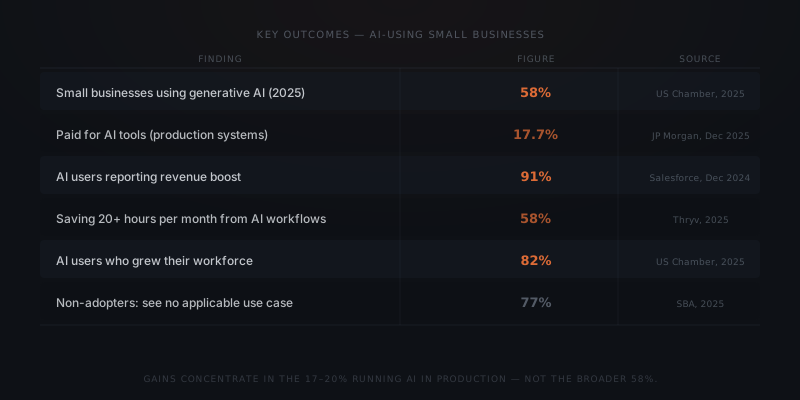
The headline says 58% of US small businesses use AI. The U.S. Census Bureau's last narrowly-defined reading of production use — before the survey question was broadened in November 2025 — put it at 8.8%, and JPMorgan Chase Institute finds close to 18% have paid for an AI tool, based on actual transaction data rather than a survey answer. This page is about the gap between the headline and the committed users: who crosses it, what separates them from the businesses that tried a tool once, and why 77% of non-adopters say no use case applies to them.
The adoption statistics look encouraging on the surface. More than half of US small businesses report using AI. The number went up 18 percentage points in a single year. What the headline does not show is the split inside that figure: a small group running AI as a core part of how they work, and a much larger group who used a free chatbot once and count as adopters. The gap between those groups is where the real story lives — and it is widening.
How many small businesses actually use AI?
The most-cited adoption statistic is the broadest: 58% of US small businesses used generative AI in 2025, up from 40% in 2024, according to the U.S. Chamber of Commerce August 2025 report.[1] That figure captures any use — a free consumer AI tool, a single session, a one-time experiment.
Production use is a different number — and the series measuring it broke in November 2025. The U.S. Census Bureau's Business Trends and Outlook Survey tracked AI use specifically in the production of goods or services — not casual or experimental use. Under that question, production use rose from 6.3% to 8.8% of small businesses (under 250 employees) between roughly February and August 2025.[2] In November 2025, Census changed the question from "using AI in producing goods or services" to "using AI in any business function" — a broader measure.[3] Readings taken after that change, including figures as high as 17–20% circulating for 2026, are answering a different question than the 6.3%→8.8% series and should not be read as a continuation of it. The last clean, narrowly-defined production reading remains 8.8%.
JPMorgan Chase Institute reaches a comparable figure from a different, and arguably more reliable, angle: tracking actual Chase Business Banking payments for AI services rather than a survey answer, it finds small-business AI adoption has grown to close to 18%.[4] Because it is based on transaction data rather than self-report, this figure did not change definition and is a steadier signal of committed, paid use than the Census series.
The numbers together describe distinct adoption stages — read the "production" row as the last verified reading, not a live 2026 figure:
| Segment | Share of small businesses | What it means |
|---|---|---|
| Headline "using AI" | 58% | Any use, including one-time or free tools |
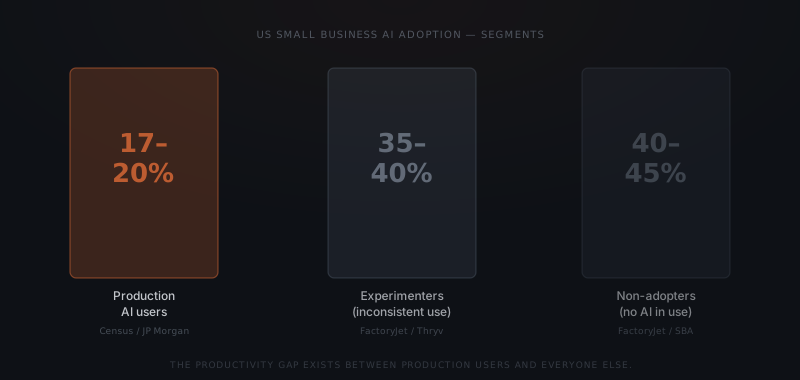
| Inconsistent / experimental | ~35–40% | Using AI occasionally, no production workflow |
| AI in production (Census, narrow definition, last reading Aug 2025) | 8.8% | The last reading before the survey question broadened in November 2025 |
| Paid for AI tools (JPMorgan Chase Institute, transaction data) | ~18% | Based on actual payment behavior, not survey self-report — the more reliable current benchmark |
The productivity and revenue outcomes reported in the data attach to the committed, paying, production-running segment — not to the full 58%. The businesses showing strong results are running agent workflows and automation in their core operations, not using a chatbot to draft social posts once a week.
The 58% adoption figure includes anyone who has tried any AI tool in any capacity. The Census Bureau's own production-specific question changed in November 2025, so a same-methodology "production" figure for small businesses is no longer available from that source — JPMorgan Chase Institute's payment-data-based figure (~18%) is the steadier benchmark for committed use. When comparing your business to adoption statistics, the relevant benchmark is committed, paying use — not the 58% headline.
What do small businesses use AI for?
Among the small businesses reporting AI use, the most common applications concentrate in communication and administrative workflows.
Data analysis for reporting and forecasting leads at 62% of AI-using businesses, followed by content and communication drafting at 58%, according to Thryv's 2025 small business AI survey.[6] Scheduling, administrative task handling, and customer inquiry responses round out the top five applications.
The pattern shows where AI is currently displacing human time most directly: the work that requires processing existing information (data, emails, documents) and producing a structured output (report, draft, response). These are the workflows where AI agents perform most reliably — and where the time cost for a small team is highest.
What AI is not commonly replacing: judgment-dependent work, client relationships, sales conversations, and operational decision-making. Small businesses report keeping these firmly with the human team.
| Application | Share of AI-using businesses | Agent type |
|---|---|---|
| Data analysis and reporting | 62% | Reporting agent |
| Content and communication drafting | 58% | Communication agent |
| Scheduling and admin | ~50% | Scheduling agent |
| Customer inquiry handling | ~45% | Support agent |
| CRM updates and follow-up | ~40% | CRM agent |
For a breakdown of which workflows to automate first in a lean service business, see which workflows to automate first.
What are AI-using businesses gaining?
The outcome data for small businesses that have moved AI into production is consistent across multiple sources.
Revenue impact. Salesforce's December 2024 SMB Trends Report found that 91% of small and medium businesses using AI report that AI boosts their revenue.[7] That figure spans businesses of varying sizes and sectors — the consistency across the full sample is striking.
Workforce impact. 82% of small businesses using AI increased their workforce over the past year, according to the U.S. Chamber of Commerce August 2025 report.[1] The frequently stated concern that AI adoption leads to hiring freezes or layoffs does not appear in the small business data — the pattern is the opposite. Businesses adding AI are adding people, likely because the operational capacity freed by automation creates space for growth.
The dollar and hour figures small businesses report after adopting AI are covered in AI agent adoption statistics, which owns the outcome data. This page stays on the production gap.
Broader productivity context. McKinsey's August 2026 survey found that 80% of respondents reported that AI had increased their own productivity. This is individual self-reporting across company sizes, not the proportion of AI-using small businesses with measured company-wide productivity gains.[8]
Why have most small businesses not adopted AI?
The SBA's 2025 research found that 77% of small business non-adopters report seeing no applicable use case for their business.[5] That is the primary barrier — not cost, not access, not technology readiness.
62% report lacking understanding of AI applications. They know AI exists. They do not know what specific problem it would solve in their business.[5]
60% report lacking in-house expertise or resources. Even businesses that can identify a use case do not have the technical capability to implement it without external help.[5]
38% cite data privacy and security concerns. Particularly in professional services, healthcare-adjacent businesses, and financial services where client data sensitivity is high.
The cost barrier is smaller than expected. Widely available AI tools start at $20 to $50 per month. API costs for a simple agent workflow typically run under $100 per month at small business volumes. The barrier is identification and implementation — not subscription fees.
This pattern explains why external implementation services exist. A business that cannot identify which workflow to automate, and lacks the technical staff to build the integration, faces a barrier that more product access does not solve. What removes the barrier is scoping — someone who can look at the existing workflows and identify the specific starting point. For a self-assessment tool, see is your business ready for AI agents.
What separates production users from experimenters?
The adoption gap isn't between large companies and small ones. It's between small businesses running AI in production and those that don't.
The small businesses running AI in production — on the last clean reading, 8.8%, and close to 18% by JPMorgan's payment-data measure — share a pattern that distinguishes them from the broader 58%. They started with one specific, well-defined workflow — not a platform adoption or a broad "let's use AI" initiative. They automated a task with clear inputs and outputs: invoice follow-up, lead routing, appointment confirmation, weekly report generation.
The experimenters — the roughly 35–40% using AI inconsistently — started with a tool rather than a workflow. They adopted ChatGPT or a similar assistant for general use and found it useful sometimes, not reliably. Their AI usage does not run automatically. It requires someone to decide to use it each time.
The difference is structural. A production AI workflow runs without a human deciding to invoke it. A reactive AI tool requires a human to remember to use it, which means its use is inconsistent and its time savings are intermittent.
The businesses moving from the experimental group to the production group are not making technology choices — they are making process choices. They are identifying the specific, repeatable tasks that run consistently enough to automate and building the workflow around them. The technology execution follows from that decision, not the other way around.
What does the adoption data predict for 2026 and 2027?
The Census Bureau's own production-specific series cannot answer this anymore. It showed a real 2.5-percentage-point rise (6.3% to 8.8%) over six months in early-to-mid 2025 — but the survey question changed in November 2025, so no same-methodology reading exists past that point to extrapolate from. Projecting the old growth rate forward onto figures measured under the new, broader question would repeat the exact comparability error this page corrects; that projection has been removed.
JPMorgan Chase Institute's payment-data trend is the steadier forward signal, precisely because it does not depend on a survey question that can be reworded: adoption measured by actual AI-service payments has grown from roughly 5% in late 2022 to close to 18% by the end of 2025.[4] That is a real multi-year trend on a single, stable definition — paying for AI, not describing oneself as using it.
The US Chamber of Commerce found that 73% of small businesses using AI report improved competitiveness compared to larger competitors.[1] As paid, committed AI use continues to grow among small businesses, the competitive advantage shifts from "using AI at all" to "having better-configured, more integrated agent systems than your peers." The early-adopter advantage lasts until adoption levels out — which the data suggests is still some way off.
For businesses currently evaluating whether to start with agents, the relevant question is not whether AI will be important for small businesses — the outcome data answers that definitively. The relevant question is which workflow to start with. See before you hire: what to have in place for AI implementation for a pre-implementation checklist.
Frequently asked questions
What percentage of small businesses use AI in 2025? 58% of US small businesses used generative AI in 2025, up from 40% in 2024, according to the U.S. Chamber of Commerce August 2025 report. The headline adoption figure overstates production usage: the U.S. Census Bureau's last reading under its narrow 'producing goods or services' question found 8.8% (August 2025) — the survey then broadened its question in November 2025 to 'any business function,' so later readings are not directly comparable. JPMorgan Chase Institute, using actual payment data rather than a survey question, finds close to 18% of small businesses have paid for AI tools.
What do small businesses use AI for? The most common applications among small businesses using AI are data analysis for reporting and forecasting (62%), content and communication drafting (58%), and scheduling and administrative tasks. Most usage is concentrated in communication and administrative workflows rather than core operations. Businesses that have moved AI into production operations — where it runs as part of daily workflow rather than on request — report the strongest productivity and revenue outcomes.
What productivity gains do small businesses report from AI? Among small businesses using AI, 58% report saving 20 or more hours per month from AI-assisted workflows, according to Thryv's 2025 small business survey. Two-thirds report saving $500 to $2,000 per month. Among businesses with the most active AI adoption, 91% report that AI boosts their revenue, according to Salesforce's December 2024 SMB Trends Report.
Why haven't more small businesses adopted AI? The SBA's 2025 research found that 77% of small business non-adopters see no applicable use case for their business, and 60% report lacking in-house expertise or resources. The most common barrier is not cost or access — it is the inability to identify which specific workflow to start with. Businesses that adopt AI successfully typically start with one clearly defined, repeatable workflow rather than attempting a broad implementation.
Notes
- U.S. Chamber of Commerce. (August 2025). "Empowering Small Business: The Impact of Technology on U.S. Small Business." U.S. Chamber of Commerce Technology Engagement Center. https://www.uschamber.com/technology/empowering-small-business-the-impact-of-technology-on-u-s-small-business — source for: 58% using generative AI in 2025 (up from 40% in 2024); 82% of AI users grew workforce; 73% report improved competitiveness.
- U.S. Census Bureau, Business Trends and Outlook Survey (BTOS). https://www.census.gov/programs-surveys/btos.html — source for: 6.3% (roughly February 2025) and 8.8% (August 2025) of small businesses (under 250 employees) using AI specifically "in producing goods or services." These two historical figures were originally reported in this post via a secondary aggregator (FactoryJet) and were not independently re-verified against the original Census press release in this revision; they are not contradicted by anything found, only not re-checked to the primary release.
- U.S. Census Bureau, "Large Firms With at Least 20 Employees Biggest AI Users," published 26 May 2026, covering BTOS data 14 December 2025 – 3 May 2026. https://www.census.gov/library/stories/2026/05/ai-use-businesses.html — verified directly 2026-09-01. Source for: the BTOS survey question changed in November 2025 from asking whether a business used AI "in producing goods or services" to asking whether it used AI "in any business function." No production-specific figure is published by Census after this change; readings taken under the new wording are not comparable to the 6.3%/8.8% series in Note 2.
- JPMorgan Chase Institute, "Small Business in the Age of AI," updated 28 May 2026. https://www.jpmorganchase.com/institute/all-topics/business-growth-and-entrepreneurship/small-business-in-the-age-of-ai — verified directly 2026-09-01: adoption (measured by actual Chase Business Banking payments for AI services) grew from roughly 5% in late 2022 to close to 18% by the end of 2025. The precise "17.7%" figure previously stated in this post was not independently re-confirmed to that decimal on direct fetch; "close to 18%" is used here as the verified approximation.
- SBA Office of Advocacy, "Research Spotlight: AI in Business — Small Firms Closing In," by Robert Press (Regulatory Economist), published 24 September 2025. https://advocacy.sba.gov/wp-content/uploads/2025/09/Research-Spotlight-AI-in-Business-Small-Firms-Closing-In_-092425.pdf — source for: 77% of non-adopting small businesses see no applicable use case, independently corroborated by the Small Business & Entrepreneurship Council's own October 2025 survey finding the same figure. The direct PDF returned a 403 on fetch; the 77% figure rests on two independent sources. The 60% (lacking in-house expertise) and 62% (lacking understanding of AI applications) figures in this post could not be independently confirmed as originating from this specific SBA report in this research pass — they are not shown wrong, only unverified to this primary.
- Thryv, press release, 17 July 2025. https://www.thryv.com/news/ai-adoption-among-small-businesses-surges-41-in-2025-creating-new-era-of-growth-and-efficiency/ — verified directly 2026-09-01: survey of 540 US small-business decision-makers, fielded May 2025; 58% report saving 20+ hours monthly; 66% report saving $500–$2,000 monthly. The 62%-for-data-analysis application-share figure elsewhere on this page was not independently re-confirmed against this specific release in this pass.
- Salesforce, SMB Trends Report, December 2024. https://www.salesforce.com/news/stories/smbs-ai-trends-2025/ — verified via direct business-press quotation (smallbiztrends.com, businesstoday.in) 2026-09-01: 91% of SMBs using AI report it boosts revenue; survey of 3,350 respondents at businesses of 200 employees or fewer — larger and more established than the 5–50 employee range this site typically addresses.
- McKinsey & Company. “The state of AI in 2026: On the road to ROI,” August 25, 2026. https://www.mckinsey.com/capabilities/quantumblack/our-insights/the-state-of-ai — checked October 13, 2026; source for respondents’ own productivity, not an SMB-specific estimate.