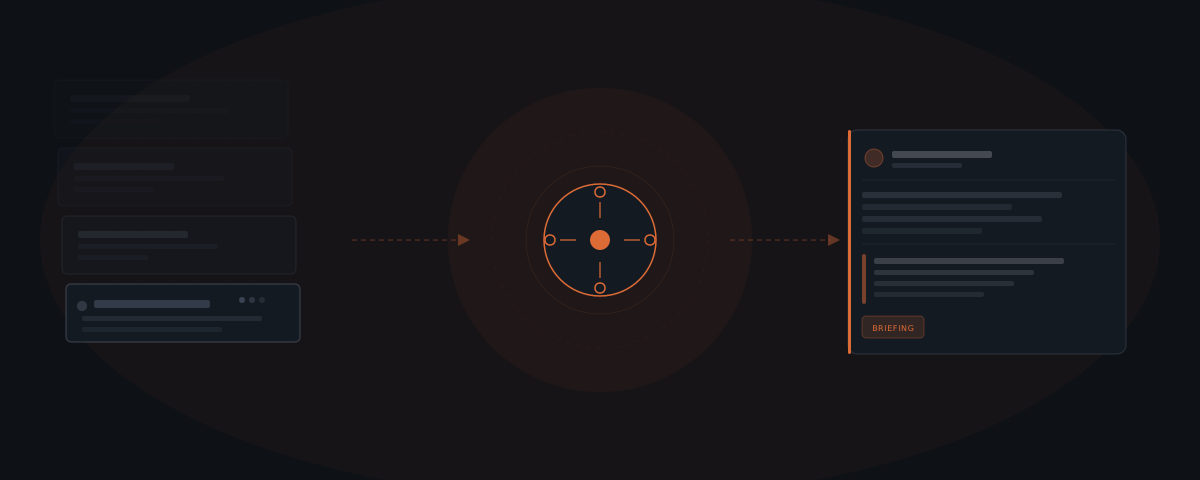
AI agents for PR agencies automate the intelligence-gathering layer — daily media monitoring, coverage compilation, executive briefings, and media list management. Only 12% of PR professionals currently use AI agents, with 28% unaware of the technology altogether. The agent handles the scan, summarize, and compile work; client strategy, relationships, and pitching stay with the team.
Every PR account starts Monday the same way: scanning for weekend coverage, pulling yesterday's mentions, building the weekly clips report. On a 10-person agency running 12 client accounts, that is a significant part of the first hour of every working day — before a single strategic conversation has happened. An AI agent handles that scanning layer — see what an AI agent is for how that differs from a chatbot or a fixed automation. The agent monitors coverage across sources, summarizes what matters, and puts the briefing in front of the human. The team reads the intelligence. The agent gathered it.
Where PR agencies lose the most billable hours
The intelligence-gathering layer — monitoring, compiling, reporting — is the largest non-billable time sink in most PR agencies.
A boutique PR agency with 5 to 20 staff running 8 to 15 client accounts typically allocates significant daily time to tasks that produce information rather than impact. Daily media monitoring for each active client: scanning news outlets, trade publications, social platforms, and competitor channels. Coverage compilation for weekly client calls: pulling clips, categorizing by sentiment and tier, assembling the report. Media list maintenance: researching journalists, updating beats, removing bounced contacts, adding new reporters on relevant topics.
None of this is advisory work. All of it is necessary. And all of it runs before the account team can begin the conversations, pitching, and relationship work that clients actually pay for.
Only 12% of PR professionals currently use AI agents, and 28% have never heard of them, according to a Muck Rack survey of more than 500 PR professionals.[¹] That figure reveals both the gap and the opportunity. The agencies adopting agent workflows now are doing the intelligence layer in a fraction of the time — not because they cut corners, but because the gathering and compiling work that occupied hours is now running automatically.
Eighty percent of communications professionals believe AI will be a transformative force for the industry, according to testing by the FINN Agency across 16 AI tools.[²] The transformation is not in the strategic work. It is in the operational layer that precedes every strategic conversation.
| Task | Average time per client per week | Can agent handle it |
|---|---|---|
| Daily media monitoring | 2–4 hours | Yes |
| Coverage compilation and clipping | 1–2 hours | Yes |
| Weekly client report draft | 1–2 hours | Agent drafts, human reviews |
| Media list maintenance | 1–2 hours | Yes |
| Executive briefing preparation | 30–60 minutes | Agent drafts, human reviews |
| Pitch writing and strategy | 3–5 hours | No |
| Media relationship management | Ongoing | No |
| Crisis response | Variable | No |
For an agency running 10 accounts, the agent-addressable tasks represent 5 to 10 hours per account per week — work that currently falls on the team. See AI agent for reporting for a closer look at how the compilation and drafting step works.
What AI agents handle in a PR workflow
An AI agent for a PR agency handles four core operational tasks: media monitoring, coverage compilation, media list management, and pitch follow-up.
Media monitoring. The agent scans configured sources — news outlets, trade publications, blogs, social feeds — for client mentions, topic keywords, and competitor coverage. The agent runs this continuously, not once in the morning. When significant coverage appears, the agent flags it immediately. The account team receives a daily summary of what matters; overnight and weekend coverage does not wait for Monday morning.
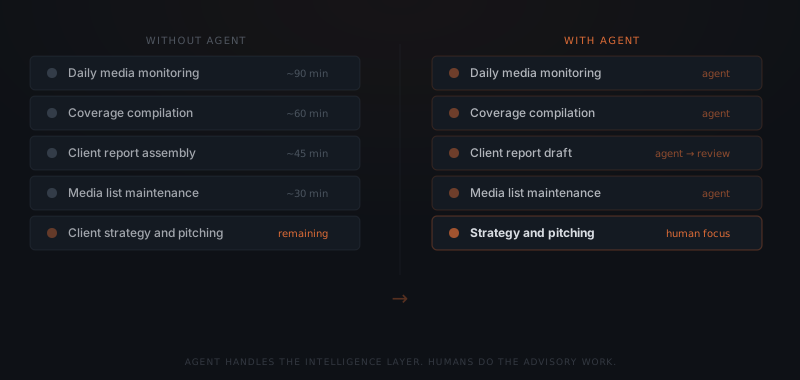
Coverage compilation. When the weekly client report is due, the agent assembles the coverage from the week: pulls the clips, tags them by outlet tier and sentiment, calculates the reach, and drafts the summary section. The account manager reviews the draft, adjusts framing where needed, and sends. What previously took 90 minutes of assembly takes 15 minutes of review.
Media list management. Media lists degrade. Journalists change beats, move publications, go freelance, or stop covering relevant topics. The agent monitors contact activity and flags contacts who have not published relevant content in 90 days, identifies newly active journalists covering target topics, and cleans bounce errors from campaign logs. The list stays current without the team manually researching every contact.
Pitch follow-up. When a pitch goes out, the agent sends a follow-up at the configured interval — 48 or 72 hours — if there has been no response. The follow-up is drafted from the account team's template, not generated independently. The agent does not pitch. The agent ensures pitches are not forgotten.
Why client-facing output always passes through human review
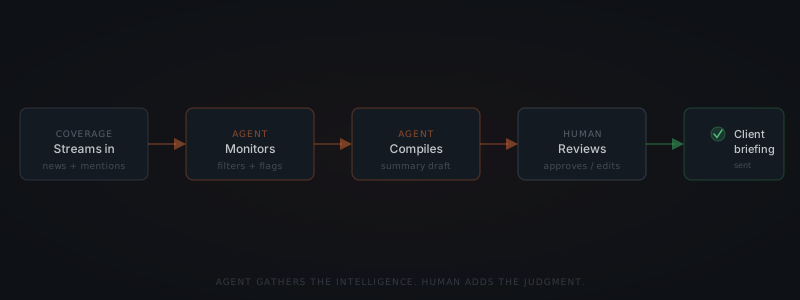
The agent does not send anything directly to clients. Coverage summaries, report drafts, and executive briefings are placed in a review queue. The account team reviews, adjusts framing, and approves before any output reaches the client.
In PR, everything that goes to a client represents the agency. A coverage summary with the wrong tone, a sentiment tag that missed the nuance of a negative story, an executive briefing that omitted the most important development — any of these erode client trust. The agent does not have the client relationship context to make those judgment calls.
The approval step is built into the workflow, not optional. The account manager reviews the agent's coverage compilation and adjusts any framing that needs a human eye. The review takes 10 to 15 minutes instead of the 90 minutes of assembly the work previously required.
Muck Rack's Media List Agent found a 10% average lift in email open rates for beta customers — not because the agent was writing better pitches, but because the agent kept the list clean and matched pitches to the journalists actually covering relevant topics.[¹] The outcome improvement came from better intelligence, not from replacing the pitch writer.
What agents cannot do in a PR agency
AI agents in a PR context handle the operational layer. They cannot handle the work that differentiates an agency.
Pitching. Writing a pitch that a journalist opens requires understanding their specific beat, the timing relative to their editorial cycle, the angle that makes this story newsworthy today, and the relationship history with that contact. That is the core skill of PR. The agent gathers intelligence that makes the pitch sharper — the journalist's recent coverage, the publication's current editorial focus — but the pitch stays with the human team.
Media relationships. Relationships with journalists are built over years of reliable, relevant outreach. They depend on the account team knowing what each contact cares about, responding quickly when journalists call for comment, and not burning contacts with irrelevant pitches. The agent supports this by keeping lists accurate. It does not maintain the relationship.
Crisis communication. When a client faces a reputational issue — a negative story breaking, a social media incident, a product recall — the response requires judgment, speed, and direct communication with media contacts under pressure. The agent can flag early signals in monitoring. Crisis response stays with the most experienced people in the room.
Campaign strategy. Deciding which outlets to target, which narrative angle serves the client's goals, which timing maximizes impact — these are strategic choices that require understanding the client's business, their competitive landscape, and the media environment. The agent does not do strategy.
For a framework on which tasks are ready for an agent versus which require human judgment, see how to know if a business process is ready to hand to an AI agent.
How to set up an agent for a PR agency
Map the monitoring sources per account
For each active client, identify the sources that matter: relevant news outlets, trade publications, competitor channels, and keyword feeds. This becomes the monitoring configuration. Most accounts need 10 to 20 source configurations. Start with the sources the team already checks manually every morning.
Connect your media tools
The agent integrates with the tools already in use — Muck Rack, Cision, Mention, or Google Alerts as the monitoring layer; Gmail or Outlook for outreach and follow-up; Google Drive or Notion for report storage. Most integrations are live within a few days.
Build coverage compilation templates
For each client, build the coverage report template: the sections included, how coverage is categorized (tier, sentiment, reach), and what the summary section format looks like. The agent compiles against this template. The account team reviews and edits rather than building from scratch.
Configure follow-up sequences
For active pitch campaigns, configure the follow-up timing and the follow-up message template. The agent sends at the configured interval to contacts who have not responded. Every follow-up is from the account team's template — not independently generated.
Run one account for two weeks before scaling
Deploy the agent on a single active account for two full weeks before expanding. Review the coverage compilations and briefing drafts daily. Adjust the source configuration, filtering rules, and report templates based on what needs refinement before adding more accounts.
A PR agency implementing monitoring, coverage compilation, and follow-up automation typically goes from scoping to first live output in two to three weeks. For the broader implementation framework, see what a real AI agent implementation involves.
What early adoption means in a market at 12%
The agency doesn't need a faster team. It needs the team doing less gathering and more advising.
Only 12% of PR professionals use AI agents today. That figure — from a Muck Rack survey of over 500 PR pros — means 88% of the industry is still doing the intelligence layer by hand.[¹] For an agency that adopts agent workflows now, that gap is a competitive advantage with a window.
When the monitoring, compilation, and media list maintenance runs automatically, the account team's day looks different. Mornings that started with an hour of monitoring and clipping now start with a briefing that was assembled while the team slept. The first conversation of the day is the strategy conversation, not the assembly conversation.
Across small businesses more broadly, 58% used AI in some capacity in 2025 — up from 40% in 2024, according to the U.S. Chamber of Commerce.[³] In PR specifically, adoption sits at 12%. That gap is not a reflection of the technology's fitness for the work — the tasks that agents handle well (monitoring, compiling, maintaining lists) are among the most rules-based, repeatable work in agency life. The gap is a reflection of how recently the technology became practical for the workflows.
The agencies that act now are not buying an advantage that will last forever. Adoption will normalize as the tools become more accessible. But the operational efficiency — and the client relationship time that comes from reclaiming the intelligence layer — starts accumulating immediately.
Frequently asked questions
What can an AI agent do for a PR agency? An AI agent for a PR agency handles media monitoring across news outlets and social platforms, daily coverage compilation, executive briefing drafts, media list cleaning and maintenance, and pitch follow-up sequences. The agent gathers and organizes the intelligence layer. Strategy, pitching, client relationships, and crisis response stay with the human team.
How do AI agents help with media monitoring in PR? A media monitoring agent scans configured news sources, trade publications, and social platforms for client mentions, competitor coverage, and relevant topic signals. The agent filters noise, summarizes what matters, and places a daily briefing in front of the account team. The team reads the intelligence instead of spending the first hour of the day assembling it.
Can an AI agent write pitches for a PR agency? An AI agent does not write pitches. Pitching requires understanding a journalist's specific beat, the timing of their editorial calendar, the relationship context with that contact, and the narrative angle that makes a story worth their attention. The agent can gather intelligence that makes the pitch sharper — the journalist's recent coverage, the publication's current focus areas — but the pitch itself stays with the account team.
How many PR agencies currently use AI agents? A Muck Rack survey of more than 500 PR professionals found that only 12% currently use AI agents in their work, and 28% have not heard of AI agents at all. That leaves the majority of the industry in an early exploration phase or unexposed entirely.
Notes
- Muck Rack. (2025). "AI agents for PR pros: What they are and how to use them." Muck Rack Blog. https://muckrack.com/blog/ai-agents-for-pr-pros — source for: 12% of PR professionals use AI agents; 28% unaware; Muck Rack Media List Agent 10% average lift in open rates and clicks.
- FINN Agency. (2025). "AI in marketing and PR: we tested 16 tools for you." FINN Agency Blog. https://www.finn.agency/ai-in-marketing-and-pr-we-tested-16-tools-for-you — source for: 80% of communication professionals believe AI will be transformative for the industry.
- U.S. Chamber of Commerce. (August 2025). "Empowering Small Business: The Impact of Technology on U.S. Small Business." U.S. Chamber of Commerce Technology Engagement Center. https://www.uschamber.com/technology/empowering-small-business-the-impact-of-technology-on-u-s-small-business — source for: 58% of small businesses used generative AI in 2025, up from 40% in 2024.