AI agent adoption is not evenly distributed across industries. NVIDIA's State of AI 2026 names financial services, telecommunications, and retail/CPG as the sectors with the strongest adoption and ROI — telecom alone reported 48% deploying or assessing agents. By function, PwC found customer support (49%) and operations (47%) lead. These leaders share one structural trait: a high proportion of high-volume, structured, repeatable work. The laggards are behind because their workflows are less structured, not because agents don't fit them.
The industries where AI agent adoption is fastest share a structural characteristic that has nothing to do with their size, their budget, or their tech sophistication. Professional services firms, marketing agencies, recruiting companies, and financial advisory firms all share the same ratio problem. A high proportion of senior staff time goes to structured, repeatable tasks that do not require senior judgment. Those tasks are where AI agents produce measurable, consistent returns — and those are the tasks concentrated in the industries leading the adoption curve.
Understanding which industries have moved and why is useful for two reasons. It tells you what your competitors are likely doing. And it tells you whether the absence of agent deployment in your industry represents a timing opportunity or a structural constraint.
What the industry adoption data shows
The clearest 2026 sector signal comes from NVIDIA's State of AI 2026, which names financial services, telecommunications, and retail/CPG as the industries with the strongest combined AI adoption and ROI.[⁸] Telecommunications led all sectors in agentic adoption, with 48% of companies deploying or assessing AI agents and 99% reporting improved employee productivity. Retail and CPG followed at 47% deploying or assessing agents, with 37% cutting costs by more than 10%. The common thread is structural: these sectors run high volumes of repeatable, rule-based work — transaction processing, service provisioning, order management — that agents act on reliably. For the full 2026 sector-by-sector return data, see AI ROI by industry in 2026.
PwC's 2025 AI Agent Survey asked 308 US business executives about which functions had the highest AI agent deployment rates.[¹] The two functions leading deployment were customer support (49%) and operations (47%).
Those are not industry categories — they are function categories. But they point directly to the industries where those functions are most concentrated:
- Professional services firms: client communication is a primary operational function
- Marketing and PR agencies: multi-client coordination at volume
- Recruiting and staffing firms: candidate intake and status updates are the dominant workflow
- Financial advisory and accounting: client document collection, compliance reporting
- Ecommerce and retail: customer inquiry volume at scale
McKinsey's State of AI 2024 confirms the pattern at the industry level. High-tech, financial services, and professional services organizations consistently report higher rates of both AI adoption and value creation than organizations in other industries.[²] The ranking has held across McKinsey's annual surveys for three consecutive years.
The industries leading AI agent adoption share one structural characteristic: a high proportion of the most expensive staff time goes to structured, repeatable coordination tasks — follow-up, document collection, status updates, intake processing. These tasks are where agents produce consistent, measurable returns.
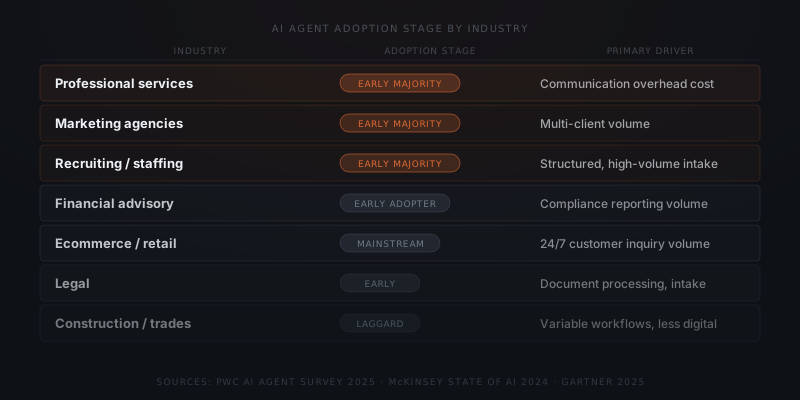
| Industry | Adoption stage | Primary agent use cases | Primary driver |
|---|---|---|---|
| Professional services | Early majority | Client communication, document coordination, status updates | Senior time cost on low-judgment tasks |
| Marketing agencies | Early majority | Campaign reporting, brief follow-up, client coordination | Multi-client volume across accounts |
| Recruiting / staffing | Early majority | Candidate intake, interview scheduling, pipeline updates | Process-heavy workflows at consistent volume |
| Financial advisory | Early adopter | Client onboarding, compliance reporting, renewal reminders | Compliance volume and audit trail requirements |
| Ecommerce / retail | Mainstream | Customer support, order status, return coordination | 24/7 inquiry volume across channels |
| Real estate | Early majority | Lead follow-up, showing coordination, CRM updates | Response-time competitive pressure |
| Legal | Early stage | Document review, intake processing, scheduling | Document volume and intake standardization |
| Construction / trades | Laggard | Scheduling, supplier coordination, quoting | Irregular workflows, lower digital baseline |
Professional services and marketing agencies: the highest-volume case
Professional services firms and marketing agencies lead AI agent adoption for the same reason. Their most expensive resource — senior professional time — spends a disproportionate share of its hours on communication coordination. That work does not require senior judgment.
A partner at a consulting firm billing at $350 per hour spends 2–4 hours per day on email, status updates, document follow-up, and scheduling. At that rate, 3 hours per day of coordination overhead costs $1,050. Over a year, that is more than $260,000 in senior time spent on admin instead of billable work.
An agency account director managing 6–8 clients faces a similar ratio. These tasks consume 40–60% of their week:
- Status reports
- Brief follow-up
- Reporting summaries
- Client email
Each has a structured format and a defined recipient — exactly the profile that AI agents handle reliably.
McKinsey's 2023 analysis found customer operations — which maps directly to client communication and coordination for these firms — delivers 20–45% productivity improvement with AI deployed in production.[³] For professional services and agencies, that range translates to 1–2 hours per day of senior time recovered per person.
The most rigorous benchmark for professional services AI is the Dell'Acqua et al. field experiment (Harvard Business School / Wharton, 2023). In that study, 758 BCG consultants completed defined tasks 25.1% faster — with 40% higher quality output.[⁴] Both improvements held across the full sample. For service businesses, that matters — quality of client deliverables counts as much as the time spent producing them.
Recruiting and staffing: the highest workflow fit
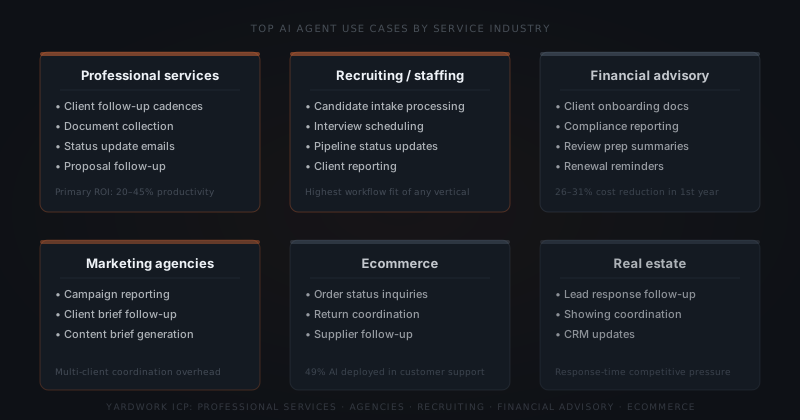
Recruiting and staffing firms have the most structurally well-fitted workflows for AI agent deployment of any service industry. Four workflows drive that fit:
- Candidate intake processing
- Interview scheduling
- Pipeline status updates to clients
- CRM data entry
All four are high-volume, structured, and repeatable — the profile that produces returns at the top of the McKinsey productivity range.
Bullhorn's 2024 GRID staffing industry research found that 56% of staffing firms had adopted AI for candidate matching and initial screening — the highest adoption rate for a single technology function in the industry's history.[⁵] The adoption rate is explained by workflow fit: candidate intake has a defined input (a resume and a job specification) and a defined output (a qualified/not qualified classification with a reason). That task structure is exactly what current AI handles reliably.
The downstream workflows — interview scheduling, status updates to hiring managers, pipeline reporting to clients — are equally well-suited. A recruiting firm handling 50 active roles at a time sends hundreds of status-update messages per week. Each one follows a template: candidate name, current stage, next step, expected timeline. An agent drafts these from CRM data. The recruiter reviews and sends.
The compounding benefit for recruiting firms runs in three directions. Faster candidate response improves conversion — candidates accept offers from firms that communicate quickly. Faster client updates build trust — clients renew with agencies that keep them informed. Reduced CRM admin means recruiters spend more time on calls and placements.
Financial advisory and accounting: compliance as catalyst
Financial advisory and accounting firms are early adopters rather than early majority — slightly behind professional services overall. The reason they lag is also the argument for moving: regulation-driven document volume.
A registered investment advisor managing 100 client relationships produces thousands of compliance-related documents per year:
- KYC updates
- Annual review summaries
- Fee disclosures
- Account statements
- Rebalancing notifications
Each is templated, each requires client-specific data, each follows a regulatory format. Agents handle this reliably — because the agent does not skip a required field under deadline pressure.
Gartner's 2025 research on agentic AI in finance and accounting found that early adopters in that category reported 26–31% cost reductions in the first year of deployment.[⁶] The cost reduction came primarily from accuracy, not labor displacement. Consistent execution eliminated the rework costs that manual processes produce under volume pressure.
For the same reason, accounting firms benefit from AI agent deployment in document collection workflows. A tax preparation firm runs the same intake process for every client before the April deadline:
- Document request
- Confirmation of receipt
- Reminder on missing items
- Deadline warning
An agent handles the full sequence — not just the clients the staff had time to follow up with.
Ecommerce and retail: 24/7 coverage at scale
Ecommerce adoption is labeled "mainstream" in the adoption data — a higher proportion of organizations than in professional services, but a more commoditized use case. Customer inquiry handling is the primary application: order status, return processing, shipping questions, product queries.
The ecommerce use case is mature enough to have benchmark data from multiple sources. Salesforce's State of Service 2024 found AI-assisted customer service cut cost per contact by 24% and improved satisfaction scores by 19%.[⁷] Both figures reflect the same mechanism. An agent handles the structured, high-frequency inquiries — order status, return status — that previously consumed human time. Human agents then handle the variable, judgment-intensive cases that require them.
The structural difference between ecommerce and professional services for AI agent deployment is the inquiry type. Ecommerce inquiry volume is high-frequency and low-judgment per inquiry — order status, where is my package, how do I return this. Professional services coordination is lower-frequency but higher-value per interaction — client status updates, document collection, proposal follow-up. Both fit the agent profile, but the business case calculation differs: ecommerce measures cost-per-contact, professional services measures senior time recovered.
The industries leading adoption aren't more tech-savvy — they have more structured coordination overhead to eliminate.
Why some industries are slower to adopt
Construction, government, education, and healthcare administration are lagging industries. AI agents can produce value in those contexts — but fewer of their high-volume tasks meet the structural criteria for reliable deployment.
Variable workflow inputs. A construction firm's project coordination involves quotes, change orders, subcontractor availability, and site conditions — all of which vary enough between jobs that no template applies reliably. An agent handling this workflow needs enough context to handle the variation, and the cost of errors (a wrong material order, a missed subcontractor schedule) is higher than in professional services coordination.
Lower digital baseline. Many construction, trades, and small retail businesses operate with minimal CRM or project management tooling. AI agents require integrations with existing systems. If those systems don't exist or aren't maintained, the agent has nothing to pull data from.
Regulatory and professional constraints. Healthcare and legal are slower not because of workflow structure but because of professional accountability requirements. A diagnosis or a legal opinion requires documented professional judgment. Agents can assist with preparation and documentation. But professional liability limits how much of the decision chain can be automated without explicit human sign-off.
These constraints are not permanent. Construction and trades firms that adopt basic CRM tooling before agent deployment create the integration layer agents need. Healthcare administrative workflows (scheduling, patient intake, insurance authorization) are better suited to agents than clinical workflows — and they are beginning to move. The adoption curve is delayed, not absent.
The SMB window in each industry
The adoption curve data describes the industry average — the proportion of businesses in each sector that have moved past pilot. Within each industry, the gap between early movers and laggards is growing each quarter.
McKinsey's State of AI 2024 found the highest-value organizations were those that deployed AI across multiple functions — not those with the largest budgets or the most technical staff.[²] The IBM IBV compounding pattern applies: each additional agent shares the integration infrastructure of the previous one. That reduces marginal deployment cost while multiplying combined output.
For a service business in professional services, recruiting, or agency work, the window for first-mover advantage within the SMB segment is still open in 2026 — but narrowing. More than half of organizations in each of these industries have moved to some form of AI deployment. The question is no longer whether to deploy. It is which workflows to automate first — and how to stay ahead of the efficiency gap.
For a decision framework on which workflow to automate first for maximum competitive impact, see which workflows to automate first.
Frequently asked questions
Which industries have the highest AI agent adoption rates? PwC's 2025 AI Agent Survey found customer support (49%) and operations (47%) have the highest deployment rates — functions concentrated in professional services, marketing agencies, recruiting firms, and financial advisory. McKinsey's State of AI 2024 identifies high-tech, financial services, and professional services as the highest-adoption industries.
Why are some industries adopting AI agents faster than others? Industries adopting AI agents fastest share a specific workflow profile: high volume of structured, repeatable tasks with clear inputs and measurable outputs. Professional services firms and agencies handle high volumes of client communication, document coordination, and reporting — all of which fit this profile closely. Industries with more variable, judgment-intensive workflows adopt more slowly because fewer of their high-volume tasks meet the structural criteria for reliable agent deployment.
What AI agents are recruiting firms using? Recruiting and staffing agencies use AI agents primarily for candidate intake processing, interview scheduling, pipeline status updates to clients, and CRM data entry. Bullhorn's 2024 staffing research found 56% of staffing firms had adopted AI for candidate matching and initial screening — the highest adoption rate for a single technology function in the industry's history.
What is the AI agent adoption gap between industries? McKinsey's State of AI 2024 found high-tech, financial services, and professional services organizations consistently report higher rates of both adoption and value creation from AI compared to other industries. Construction, education, and government remain the lowest-adoption sectors. The adoption gap is widening — early-majority industries are deploying their second and third agents while laggard industries are still evaluating the first.
Notes
- PwC, "AI Agent Survey," PwC US, 2025.
- McKinsey & Company, "The State of AI in 2024: GenAI Adoption Spikes and Starts to Generate Value," McKinsey Global Survey, 2024.
- McKinsey & Company, "The economic potential of generative AI: The next productivity frontier," McKinsey Global Institute, June 2023.
- Fabrizio Dell'Acqua et al., "Navigating the Jagged Technological Frontier," Harvard Business School Working Paper, 2023.
- Bullhorn, "GRID 2024 Staffing Industry Trends," Bullhorn Research, 2024.
- Gartner, "Agentic AI in Finance and Accounting: Early Adopter Performance Data," Gartner Research, 2025.
- Salesforce, "State of Service, 6th Edition," Salesforce Research, 2024.
- NVIDIA, "State of AI 2026," NVIDIA, 2026.