
AI agent ROI statistics in 2026 show returns concentrated in a minority of deployments. PwC's 2026 CEO Survey found 56% of CEOs saw no measurable return from AI in the past 12 months, while 12% reported both higher revenue and lower costs. NVIDIA's State of AI 2026 found 88% of companies saw some revenue gain — but only 30% above 10%. Workflow fit and pre-defined success criteria, not the tool, explain most of the variance.
56% of CEOs saw no return from AI in the past 12 months. Twelve percent saw both higher revenue and lower costs.[⁸] That split, from PwC's 2026 CEO Survey, is the honest starting point for reading any AI agent ROI statistic in 2026. The range of outcomes is enormous — and where a business lands is not random.
NVIDIA's State of AI 2026 shows the same pattern from the revenue side: 88% of companies reported that AI increased revenue, but only 30% saw gains above 10%.[⁹] Nearly everyone records a directional effect. A minority records an effect large enough to change the business. The variance is not explained by which model or vendor a company chose — it is explained by workflow fit and whether success was defined before deployment began.
The deeper research explains why the top of that range is so much higher than the average. McKinsey's estimate of 20–45% productivity improvement for customer operations describes what AI produces when deployed against well-fitted workflows with defined success criteria — not average outcomes across all deployments.[¹] Understanding the difference between the range and the average determines whether AI agent ROI statistics are useful planning inputs, or just headline numbers that look good in a business case. For the underlying definition this data assumes, see what an AI agent is.
What the 2026 ROI data adds
The 2026 research reframes AI ROI from a technology question into a structural one. Four 2026 sources establish the current picture.
PwC 2026 CEO Survey found 56% of CEOs reported neither higher revenue nor lower costs from AI over the prior 12 months, and 12% reported both.[⁸] High performers were two to three times more likely to have extensively embedded AI across operations — not to have bought a different tool.
NVIDIA State of AI 2026 found 88% of companies saw revenue gains from AI and 87% saw cost reductions, but only about 30% and 25% respectively cleared the 10% threshold.[⁹] Financial services, telecommunications, and retail/CPG led on returns.
Accenture 2026 found companies with AI-led processes grew revenue 2.5× faster than peers, and organizations with the highest operations maturity were 3.3× more likely to succeed at scaling high-value AI use cases.[¹⁰]
IBM's 2026 CEO study, surveying 2,000 CEOs across 33 geographies, found only 25% of the workforce regularly using AI despite broad deployment — access was distributed, but the workflow redesign that makes access productive was not.[¹¹]
| Source (2026) | Headline finding | What it measures |
|---|---|---|
| PwC 2026 CEO Survey | 56% no return / 12% both | Self-reported financial return, last 12 months |
| NVIDIA State of AI 2026 | 88% revenue up, 30% above 10% | Revenue and cost impact by threshold |
| Accenture 2026 | 2.5× faster revenue growth | AI-led vs. assist-only processes |
| IBM 2026 CEO Study | 25% of workforce using AI regularly | Adoption depth vs. access |
The consistent 2026 finding: returns concentrate in companies that rebuilt workflows around agents. For the sector-by-sector breakdown, see AI ROI by industry in 2026. For the wider agentic picture, see agentic AI statistics 2026.
What the major AI agent ROI studies actually measure
Five research organizations publish AI ROI data with enough methodology detail to be worth citing in a business case. Each measures a different layer of the same deployment pattern.
McKinsey Global Institute, "The economic potential of generative AI" (2023) analyzed 63 AI use cases across industries and modeled the productivity and cost impact of deploying AI across specific business functions. The analysis maps which activities within each function are candidates for AI automation, estimates the proportion of time spent on those activities, and projects the impact assuming deployment succeeds against the right task types.[¹] McKinsey's function-level figures represent modeled potential in well-suited deployments — not averages across all implementations.
IBM Institute for Business Value (2024) surveys enterprise organizations on AI outcomes and segments them by deployment maturity: beginners (proof-of-concept), developers (limited production), scalers (AI running across multiple functions), and transformers (AI integrated into core business processes).[²] IBM IBV's revenue growth differential of 3.5× compares scalers to beginners — it measures the compounding effect of deploying AI across multiple workflows, not the return from a single implementation.
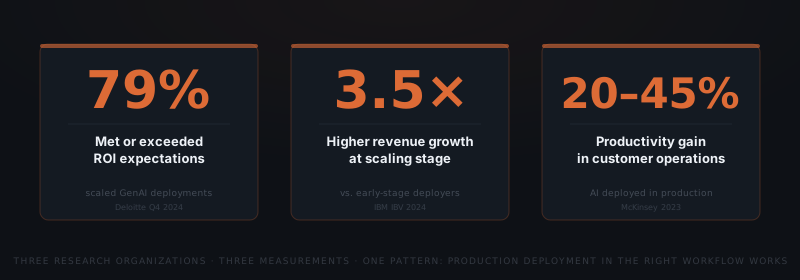
Deloitte "State of Generative AI in the Enterprise" (Q4 2024) surveys organizations on ROI realization. The Q4 2024 edition found that 79% of organizations that had fully scaled at least one GenAI implementation met or exceeded their ROI expectations.[³] Organizations that only ran pilots reported meaningful ROI at substantially lower rates — consistent with the IBM maturity data.
PwC AI Agent Survey (2025) covers 308 US business executives with active AI agent deployments. Among active deployers, 57% report cost savings, 66% report productivity gains, and 55% report faster decision-making.[⁴] These figures represent active deployers — not the full population of organizations that attempted deployment.
Dell'Acqua et al., Harvard Business School/Wharton (2023) ran a controlled experiment with 758 BCG consultants.[⁵] The most methodologically rigorous benchmark for professional services AI — a randomized study, not a survey. Result: 25.1% faster task completion with 40% higher quality output. This is a task-level figure from a controlled environment, not a full-workflow ROI number.
McKinsey's function-level productivity figures describe outcomes when AI is deployed against well-fitted workflows with defined success criteria — not averages across all implementations. IBM IBV's revenue growth differential describes organizations that scaled past a single deployment, not those running one pilot.
| Source | Study | What it measures | Year |
|---|---|---|---|
| McKinsey Global Institute | Economic potential of generative AI | Modeled productivity impact by function and use case | 2023 |
| IBM Institute for Business Value | CEO's Guide to Generative AI | ROI by deployment maturity stage | 2024 |
| Deloitte | State of Generative AI in the Enterprise | ROI realization rates, enterprise survey | Q4 2024 |
| PwC | AI Agent Survey | Self-reported outcomes, 308 US executives | 2025 |
| Dell'Acqua et al. (HBS/Wharton) | Field experiment | Task-level productivity in knowledge work | 2023 |
AI agent ROI by business function
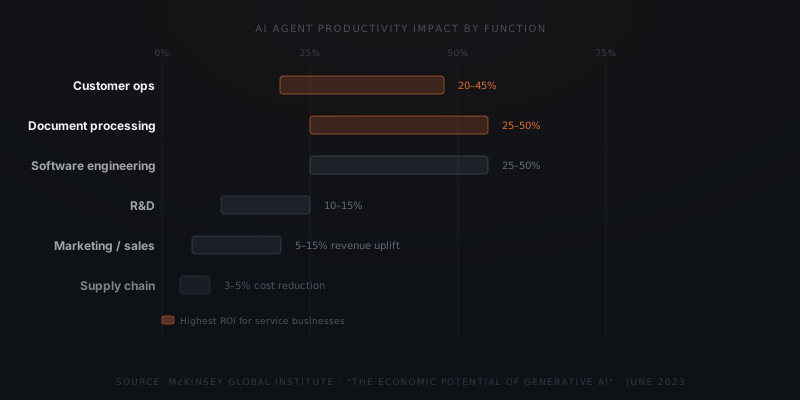
McKinsey's function-level analysis remains the most granular breakdown of AI ROI by business area in published research. The analysis covers six major functions and provides ranges that reflect deployment quality — well-fitted, production deployments at the upper end, looser deployments at the lower.
Customer operations: 20–45% productivity improvement. Customer operations is the highest-ROI function in McKinsey's analysis because it has the most concentrated version of the characteristics that produce high AI returns: high task volume, structured inputs, measurable output, repeated pattern.[¹] For service businesses where client communication is a significant proportion of senior staff time, this function maps directly to the highest-volume workflows — follow-up, inquiry response, document collection, status updates.
Document and content processing: 25–50% time reduction. Document processing — intake, extraction, generation, review — has the same structural characteristics. Inputs are structured (forms, records, contracts). Outputs are defined (a summarized document, a drafted response, a populated CRM record). Agents perform these tasks at comparable accuracy to humans for the high-frequency, low-judgment subset — which is where most of the volume sits.
Software engineering: 25–50% coding task time reduction. GitHub Copilot research found developers complete coding tasks 55% faster with AI assistance — sitting at the top of McKinsey's modeled range.[⁶] Software engineering was among the first professionally benchmarked domains for AI assistance, which is why the figures are precise. The task structure is well-defined: fixed inputs, defined outputs, clear correctness criteria.
Marketing and sales: 5–15% revenue uplift. Marketing and sales AI delivers smaller productivity percentages but is measured differently — revenue impact rather than task completion speed. A 5–15% revenue uplift from faster lead response, more consistent follow-up, and better personalization is a different return category than productivity gains in operations. For a business generating $1M per year, a 10% revenue uplift is $100,000.
R&D and product development: 10–15% productivity improvement. Drug discovery, materials research, and engineering are the primary use cases. The percentage is lower than customer operations because AI assists a narrower slice of a more judgment-intensive workflow — and because the measurable output (a compound, a material spec) is harder to attribute to a single tool.
Supply chain management: 3–5% inventory cost reduction. Supply chain AI impact is measured in inventory cost terms. Lower percentage, different metric — reflecting the primary cost category in that function.
What IBM IBV found about deployment scale
IBM IBV's 2024 research identified a threshold effect that single-workflow benchmarks miss. Organizations classified as "scalers" — deploying AI across three or more integrated business functions — showed 3.5× higher revenue growth and 5.4× higher profitability improvement compared to organizations at the "beginner" stage.[²]
The compounding effect has a structural explanation. An agent handling client follow-up uses the CRM and email system. An agent handling document collection uses the same CRM. An agent handling status updates uses the same data. Each agent deployed against the same integration infrastructure inherits the connections built for previous agents. The marginal cost of the third agent is lower than the marginal cost of the first — while the combined output grows disproportionately.
IBM IBV's maturity stages, with the revenue growth profile at each:
| Stage | Definition | Revenue growth vs. beginner |
|---|---|---|
| Beginner | Proof-of-concept, limited testing | Baseline |
| Developer | 1–2 production deployments, narrow scope | 1.5–2× baseline |
| Scaler | AI running across 3+ integrated functions | 3.5× baseline |
| Transformer | AI embedded in core business model | Distinct category |
For service businesses, the practical equivalent of IBM's "scaler" stage is three workflow agents running against a shared integration layer: client communication, document coordination, and reporting or lead management. At that scope, the combined time recovery and efficiency gain is large enough to appear in revenue figures — not because the agents generate revenue directly, but because they redirect senior professional time from coordination overhead to billable work.
For a decision framework on how to sequence multiple deployments and build toward that scope, see running multiple AI agents.
Organizations scaling AI across three functions see 3.5× higher revenue growth than those running a single pilot.
Deloitte's enterprise survey: who realizes ROI and why
Deloitte's Q4 2024 "State of Generative AI in the Enterprise" survey identified a consistent pattern in which organizations realize ROI and which do not.[³]
Organizations that had fully deployed at least one GenAI system — past pilot, running in production against live data — reported meeting or exceeding ROI expectations at a rate of 79%. Organizations still at the pilot or exploration stage reported meaningful ROI at substantially lower rates.
The finding aligns with IBM IBV's maturity data and explains the wide variance in self-reported AI ROI across the industry. The variance is not primarily explained by which tool was used, which vendor was engaged, or how large the organization was. Deployment stage explains the gap. Organizations that committed to production — real data, real integrations, active workflows — realized ROI at high rates. Organizations that ran controlled tests did not.
Deloitte's secondary finding: organizations that defined measurable ROI criteria before implementation began were significantly more likely to report positive results than those that defined criteria after. This is consistent with a measurement problem, not a performance problem. An agent performing correctly against undefined success criteria looks identical to one that is underperforming — both generate activity, neither generates a verifiable result.
Why AI agent ROI spans a factor of 10
AI agent ROI figures from research range from near-zero (pilots that never reached production) to 5–10× returns (multi-workflow deployments with pre-defined success criteria). Two variables explain most of the spread.
Workflow fit. The McKinsey function-level data describes a specific structural profile for high-ROI deployments: high task volume, structured and repeatable inputs, a measurable output, and low requirement for contextual judgment on each individual task. Customer operations and document processing fit this profile closely. Advisory work, strategic analysis, and client relationship management fit it poorly. Deploying an agent against a poorly-fitted workflow produces real but substantially smaller gains — typically in the 5–15% range that represents the lower end of McKinsey's customer operations figure.
For the framework on identifying which workflows in your business are structurally suited for agent deployment, see which workflows to automate first.
Pre-defined success criteria. Deloitte's finding — that organizations with pre-defined ROI criteria are significantly more likely to report positive results — is a measurement effect and a management effect combined. Measurement: an agent running correctly against undefined success criteria cannot be distinguished from one that is degrading. Management: organizations that define success criteria before deployment make different build decisions — they scope tighter, instrument more, and review outcomes earlier. The agent built when success criteria are defined from day one is a better-scoped agent than the one built without them.
For a framework on defining measurable success criteria before go-live, see how to know if your AI agent is working.
How long AI agent ROI takes to appear
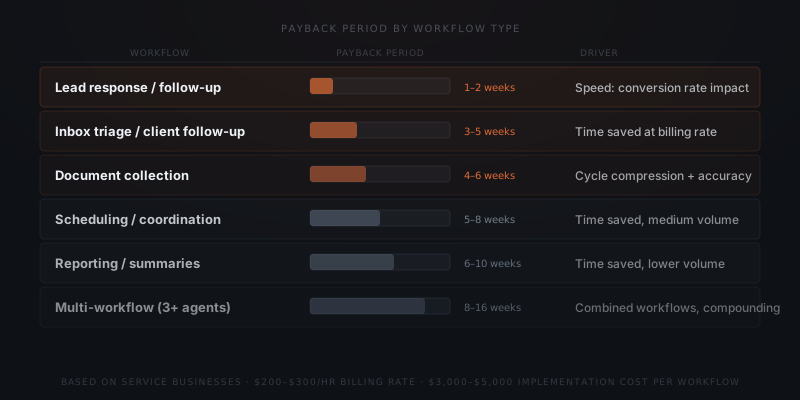
The magnitude figures above say nothing about timing. Payback varies by a factor of eight depending on which workflow is automated first, and the fastest returns come from speed-sensitive workflows where a single recovered deal exceeds the implementation cost.
| Workflow type | Typical payback | Primary return category | Volume threshold |
|---|---|---|---|
| Lead response / follow-up | 1–2 weeks | Speed: conversion rate impact | 10+ inquiries/month |
| Inbox triage / client follow-up | 3–5 weeks | Time: billable rate × hours | 20+ emails/day |
| Document collection | 4–6 weeks | Time + accuracy: cycle compression | 10+ active matters |
| Scheduling / coordination | 5–8 weeks | Time: coordination overhead | 30+ scheduling events/week |
| Reporting / summaries | 6–10 weeks | Time: lower volume | 5+ reports/week |
| Multi-workflow (3+ agents) | 8–16 weeks | Combined categories, compounding | Multiple workflows combined |
Lead response sits at the fastest end because the return is speed-driven rather than time-driven. Harvard Business Review's analysis of 15,000 sales leads found that responding within five minutes is 100× more likely to result in a conversion than responding after thirty minutes.[¹²] For a business where a single engagement is worth $10,000–$50,000, a lead response agent can recoup a $3,500 implementation from one retained client in its first week. Bain's 2026 agentic AI benchmark puts the cross-industry median payback at 4.2 months across fourteen industries — 4.1 months for customer service, 6.7 for marketing operations, 9.3 for engineering.[¹³]
The 90-day breakpoint. Gartner's 2025 agentic AI research found that implementations surviving 90 days in production — without significant modification or abandonment — produce stable, measurable returns at a high rate, while implementations that fail most commonly do so before that mark.[¹⁴] The pattern has a structural cause. In weeks 4–8 the agent handles the core cases the workflow was scoped around. Between weeks 6–12 the edge cases surface: inputs outside the original scope, seasonal patterns the testing period missed, integration behaviors that only appear at volume. Organizations that defined scope boundaries and a maintenance owner before launch absorb these systematically; those that did not face a widening gap between what the agent was scoped to do and what the workflow actually demands.
Ninety days is not a payback target. It is the point at which the signal is unambiguous either way — high-volume workflows confirm ROI in weeks 4–8, complex multi-integration implementations closer to weeks 10–14, but by 90 days every well-scoped implementation has produced enough data to decide what comes next.
How much time AI agents actually save
The most-cited productivity studies arrive at different numbers because they measure different things. Each is correct within its scope, and the differences matter when building a business case.
| Study | Scope | Time saving found |
|---|---|---|
| Glean Work AI Index 2026 | 6,000 digital workers, US/UK/Australia, self-reported | 11 hrs/week saved, 6.4 hrs/week botsitting |
| Microsoft Work Trend Index 2024 | 31,000 workers — email, content, search | 1.22 hours/day average |
| Dell'Acqua et al. (HBS), 2023 | 758 BCG consultants — defined tasks | 25.1% faster completion |
| McKinsey State of AI 2024 | 1,363 organizations — routine tasks | 20–40% time reduction |
| GitHub / Microsoft, 2022 | 95 software developers — coding tasks | 55% faster task completion |
The Glean figure deserves the closest reading, because it reports both sides of the ledger: workers saved roughly 11 hours a week through automation while spending 6.4 hours a week maintaining and correcting AI output, and only 13% said their organization performed significantly better as a result.[¹⁵] Both numbers are self-reported, with the usual recall and social-desirability caveats. The gap between individual time saved and organizational performance is the single most important caveat in this literature — savings captured at the desk frequently do not reach the business.
Broken down by function, for service businesses of 5–40 people running communication-heavy workflows:
| Business function | Weekly time saved per person |
|---|---|
| Client follow-up | 3–7 hours |
| Document coordination | 2–5 hours |
| Lead qualification | 2–4 hours |
| Status updates | 1–3 hours |
| Billing and invoicing | 1–3 hours |
| Scheduling coordination | 1–2 hours |
These per-function ranges are informed estimates rather than direct measurements: none of the studies above measured these six service-business functions individually. They apply general findings about task-level AI assistance to specific functions, and should be read as planning inputs rather than benchmarks. The highest-leverage functions are consistently those with the most coordination overhead per task — client follow-up and document coordination are predominantly coordination rather than execution, which is the part an agent removes almost entirely.
How to use these statistics in a business case
The five research sources provide different inputs to a business case depending on what the case needs to establish.
For projecting impact on a specific workflow: Use McKinsey's function-level figures. If the target workflow is customer operations (follow-up, inquiry response, status updates), the applicable productivity improvement range is 20–45%. If document processing, use 25–50% time reduction. If marketing or sales (lead response, nurture sequences), apply the 5–15% revenue uplift to current inbound revenue.
For building a multi-workflow business case: Use IBM IBV's scale data. The 3.5× revenue growth differential describes the compounding effect of deploying across three or more integrated workflows. The figure is relevant for organizations planning a sequence of two or more agent implementations over 12–18 months.
For assessing whether production deployment is worth the move from piloting: Use the Deloitte finding. The data shows 79% of organizations that committed to production met or exceeded ROI expectations. The risk of production deployment is lower than the continued cost of remaining in pilot mode — where meaningful ROI realization rates are substantially lower.
For defining success metrics: Use PwC's deployment outcomes as the benchmark. Among active deployers, 57% report cost savings and 66% report productivity gains. An implementation plan without a mechanism to measure whether it lands in either category needs one before the build begins.
For the full ROI calculation methodology — adding speed returns, accuracy returns, and time-saved calculations into a single year-1 ROI figure — see how to measure AI agent ROI for a service business.
Frequently asked questions
What ROI do AI agents deliver on average? AI agents that reach production deliver an average 171% ROI, with U.S. service businesses averaging 192%, according to compiled 2026 industry analyses — a blended figure across many deployment types and use cases, not a single controlled study, with individual deployments ranging roughly 80% to 300%+ by use case. This average masks a wide distribution — organizations deploying against well-fitted workflows with pre-defined success criteria sit significantly above the average. The McKinsey and IBM IBV data both confirm that production deployment in the right workflow category produces returns well above that mean.
Which business functions produce the highest AI agent ROI? McKinsey's 2023 analysis of 63 AI use cases found customer operations delivers the highest consistent return — 20–45% productivity improvement with AI in production. Document and content processing delivers 25–50% time reduction. Both share high volume, structured inputs, measurable output, and low per-task judgment requirement.
How does AI agent ROI differ between customer operations and marketing? Customer operations delivers 20–45% productivity gains — the highest of any major function by percentage in McKinsey's analysis. Marketing and sales delivers 5–15% revenue uplift, measured differently as revenue impact. For service businesses, customer operations (client communication, follow-up, document collection) is typically the higher-return function because it has a higher proportion of structured, repeatable tasks.
How does deployment scale affect AI agent ROI? IBM IBV's 2024 research found organizations deploying AI across three or more integrated functions achieve 3.5× higher revenue growth than organizations at the early deployment stage. The compounding effect comes from shared integration infrastructure: each additional workflow agent shares the system connections built for previous agents, reducing marginal build cost while multiplying combined output.
Notes
- McKinsey & Company, "The economic potential of generative AI: The next productivity frontier," McKinsey Global Institute, June 2023.
- IBM Institute for Business Value, "CEO's guide to generative AI: Scale or stall," IBM IBV, 2024.
- Deloitte, "State of Generative AI in the Enterprise Q4 2024," Deloitte Insights, 2024.
- PwC, "AI Agent Survey," PwC US, 2025.
- Fabrizio Dell'Acqua et al., "Navigating the Jagged Technological Frontier," Harvard Business School Working Paper, 2023.
- GitHub, "Research: Quantifying GitHub Copilot's Impact on Developer Productivity and Happiness," GitHub Research, September 2022.
- Master of Code, "AI ROI: Why Only 5% of Enterprises See Real Returns in 2026," Master of Code Research, 2026.
- PwC, "2026 CEO Survey," reported in Forbes, "56% Of CEOs See Zero ROI From AI—Here's What The 12% Who Profit Do Differently," January 28, 2026. PwC's underlying CEO Survey covers 4,454 CEOs across 95 countries — a global sample, not US-specific, and weighted toward larger organizations with a CEO position distinct from the small-business owners this site's readers typically are.
- NVIDIA, "State of AI 2026," NVIDIA, 2026. Survey of 3,200+ respondents across industries and regions (North America, EMEA, APAC) drawn from NVIDIA's own opted-in audience of people already investing in or curious about AI — a self-selected group likely skewed toward more AI-engaged organizations than the general business population.
- Accenture, "Making reinvention real with gen AI," Accenture, 2026.
- IBM Institute for Business Value, "2026 CEO Study," IBM, 2026.
- James Oldroyd, Kristina McElheran, David Elkington, "The Short Life of Online Sales Leads," Harvard Business Review, March 2011.
- Bain & Company, "Agentic AI Benchmark," 2026 — median payback 4.2 months across 14 industries; 4.1 months customer service, 6.7 marketing operations, 9.3 engineering.
- Gartner, cited in "39 Agentic AI Statistics Every GTM Leader Should Know in 2026," Landbase, 2026.
- Glean, "Work AI Index 2026," Glean Work AI Institute, 2026. Survey of 6,000 full-time digital workers across the US, UK, and Australia, fielded December 2025–January 2026. Self-reported data on hours saved and hours spent "botsitting."
- Microsoft, "2024 Work Trend Index: AI at Work Is Here. Now Comes the Hard Part," Microsoft Research, May 2024.
- McKinsey & Company, "The State of AI in 2024: GenAI Adoption Spikes and Starts to Generate Value," McKinsey Global Survey, 2024.