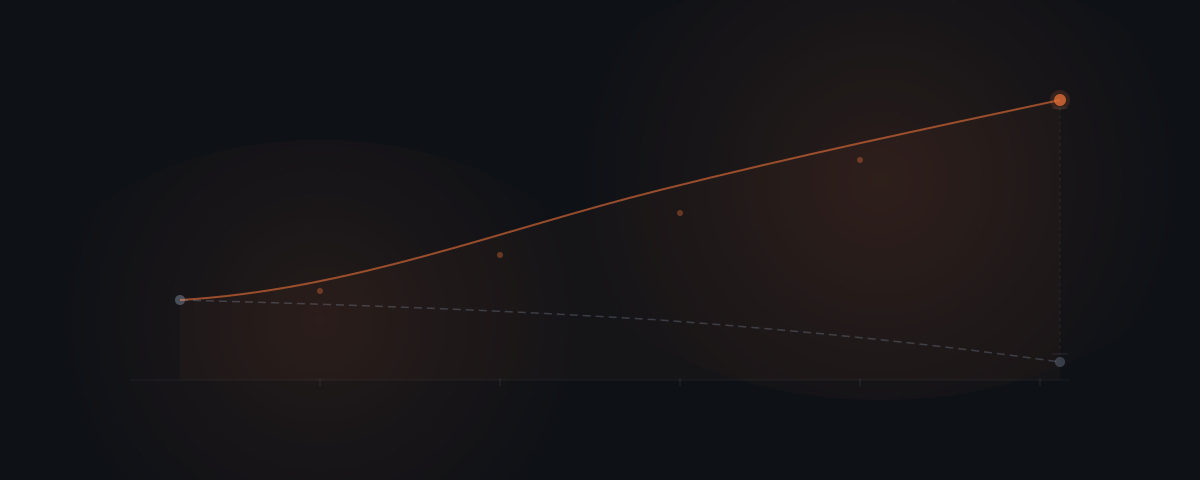
The cost of not adopting AI is real and measurable, though most founders never calculate it. In 2026, 74% of AI's economic value is captured by just 20% of organizations — the gap between adopters and non-adopters is widening, not stable. Small business owners investing in AI are nearly twice as likely to report year-over-year revenue growth, and businesses on manual workflows lose 20–30% of revenue to operational inefficiency. Every quarter of waiting compounds the disadvantage.
Most founders treating AI adoption as an optional upgrade are running a hidden quarterly loss. The calculation they run compares visible implementation cost against speculative benefit. The calculation they don't run compares their manual workflow cost against the growing efficiency of AI-enabled competitors doing the same volume with fewer hours.
Both calculations are real. Only one of them includes the cost of waiting.
The revenue gap between AI adopters and non-adopters
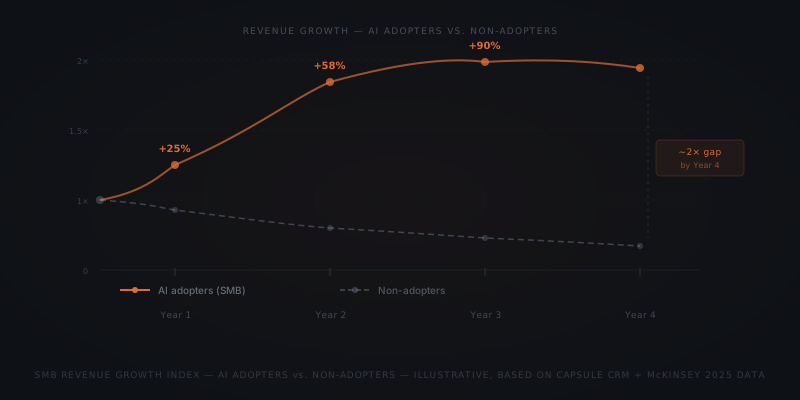
The data on what AI adoption does to revenue growth is consistent across 2025 and 2026 research.
The starkest 2026 figure is about concentration: 74% of AI's economic value is captured by just 20% of organizations.[⁹] A small group is pulling ahead on turning AI into measurable financial results, while the rest stay stuck at isolated use cases or early experimentation. NVIDIA's State of AI 2026 shows the same split — 88% of companies reported AI increased revenue, but only 30% saw gains above 10%.[¹⁰] The gap does not close on its own.
Small business owners investing in AI are nearly twice as likely to report year-over-year revenue growth compared to those not investing.[¹] That figure comes from research across SMB cohorts — not enterprise — making it directly applicable to service businesses under 50 employees. The investment threshold triggering the difference is not large-scale infrastructure. It is consistent AI use across one or two high-volume workflows.
91% of SMBs using AI report revenue increases.[²] 66% of SMBs report saving between $500 and $2,000 per month from AI-assisted workflows.[²] At the lower end, $500 per month is $6,000 per year — from a single workflow implementation that typically costs less than that to build.
McKinsey's 2025 State of AI found that 88% of organizations now use AI in some form. Only 6% achieve significant impact — defined as AI contributing more than 5% of EBIT.[³] The 6% are the businesses compounding their advantage quarterly. The 94% are getting tool-level efficiency from workflow-level deployments — and the 6% gap is growing.
Small businesses using or exploring AI reached 76% of the market in 2025, per a Reimagine Main Street/NSBA/PayPal survey.[⁴] Non-adoption is no longer a majority position. It is a deliberate choice to operate differently from three-quarters of the market.
| Metric | Figure | Source |
|---|---|---|
| SMB owners investing in AI more likely to report YoY growth | nearly 2× | Capsule CRM / multiple sources, 2025 |
| SMBs using AI reporting revenue increases | 91% | Capsule CRM, 2025 |
| SMBs saving $500–$2,000/month from AI workflows | 66% | Capsule CRM, 2025 |
| Organizations with significant AI impact (5%+ EBIT) | 6% | McKinsey State of AI, 2025 |
| Small businesses using or exploring AI | 76% | NSBA / Reimagine Main Street, 2025 |
| SMB AI usage YoY increase | +41% | Capsule CRM, 2024–2025 |
The operational cost of running manual workflows
Revenue growth gap is the second-order cost. The first-order cost is operational: manual workflows consume time that could be recovered and redirected.
McKinsey's research found that 57% of US work hours are automatable with current technology. Managers spend more than 8 hours per week on manual data tasks alone.[⁵] For a service business with a founding team of two or three people, 8 hours per person per week is a significant fraction of available capacity.
Formstack found average savings of 17 hours per week when automation replaces process steps — rather than assisting humans doing those steps.[⁶] At $50/hr, 17 hours per week is $850/week, or $44,200 per year — from automating the highest-volume repeatable workflows in one business.
The comparison founders should be running is not "AI implementation cost vs. AI benefit." It is "manual workflow cost vs. automated workflow cost." The first comparison treats AI as an expense. The second treats it as infrastructure — which is what it is for the businesses capturing the revenue growth numbers above.
Businesses operating manual workflows also carry error correction costs that rarely appear on a P&L. Incorrect invoices, missed follow-ups, CRM data errors, scheduling conflicts — these produce rework, client friction, and lost deals. None of it gets attributed to "not having an AI agent" in any accounting system — even though, as covered in what an AI agent is, this is exactly the class of repeatable, rule-based work an agent is built to absorb.
How the competitive advantage compounds over time
AI adoption creates compounding advantages in three areas: speed, capacity, and iteration rate.
Speed affects deal outcomes directly. A service business with AI-managed lead follow-up can respond to inquiries in minutes rather than hours. HBR research found that a 5-minute response to a lead is 100× more likely to qualify than a 30-minute response.[⁷] Manual workflows structurally cannot sustain 5-minute response at volume. AI-managed workflows do this by default.
Capacity means AI-enabled businesses handle more work per person. A recruiter managing outreach manually can sustain a fixed volume per week. A recruiter whose agent handles outreach, follow-up, and CRM logging can handle materially more — or redirect the recovered hours to higher-value work. The capacity difference compounds: the AI-enabled recruiter completes more placements per quarter, funds more growth, and can afford to invest in the next workflow.
Iteration rate is the compounding factor most businesses underestimate. An AI-enabled competitor running data across its CRM, email, and project management tools has visibility into what is and isn't working. They can iterate the workflow. A manual operation running the same process for three years has intuition, not data. The gap between data-driven iteration and intuition-based iteration widens each quarter.
Waiting to adopt AI is not a neutral position. It is a decision to fall behind at an accelerating rate.
McKinsey found that companies implementing AI agents are nearly three times as likely to report fundamentally redesigning their workflows. That workflow redesign is among the strongest contributors to meaningful business impact.[³] The businesses doing the redesigning now are building process infrastructure. The businesses waiting are not.
What founders miscalculate when they defer
Non-adoption decisions typically compare the wrong numbers.
Founders compare implementation cost (visible, immediate, certain) against the benefit of adoption (estimated, future, uncertain). That comparison almost always favors waiting — because any uncertain future benefit discounts heavily against a certain present cost.
The calculation missing from that comparison: the cost of the current state. Manual workflows have a current cost — in hours, in error rates, in slower response speeds, in deals lost to faster competitors. That current cost is real, recurring, and often larger than the implementation cost. It just does not appear as a line item.
The correct comparison:
| Manual workflow cost | Automated workflow cost | |
|---|---|---|
| Weekly hours on eligible steps | 17 hrs × $50/hr = $850/week | Under 2 hrs oversight = under $100/week |
| Annual operational cost | $44,200 | under $5,200 |
| Year 1 revenue growth differential | baseline | +25% likelihood gap vs. non-adopters |
| Implementation cost (one-time) | — | $3,000–$8,000 typical |
At that framing, the question is not "can we afford to implement?" It is "how much longer can we afford not to?"
When the break-even point makes non-adoption the more expensive choice
For a service business with 5–20 employees running 40+ hours of agent-eligible work per week, the break-even on a typical implementation is reached within 4–8 weeks. That is from operational efficiency alone, before the revenue growth differential appears.
A standard workflow implementation covering the three highest-volume processes — client follow-up, scheduling, and status reporting — typically costs $3,000–$8,000. It returns $6,000–$12,000 per year in recovered time at $50/hour, plus the revenue differential from faster response and better follow-through.[⁸]
Every quarter of delay means one more quarter of manual workflow costs, one more quarter of competitor advantage compounding, and one more quarter of savings not collected. The implementation cost does not get lower with time. The opportunity cost does get higher. For the fuller numbers behind that case, see AI agent ROI, by the numbers and AI agent vs. hiring: the cost math.
For service businesses with written, documented processes, implementation timelines run 2–4 weeks from scoping to live agent. The prerequisite is process documentation — which is itself valuable independent of automation. See what AI agent implementation actually costs for a small business and which workflows to automate first for the scoping framework.
Frequently asked questions
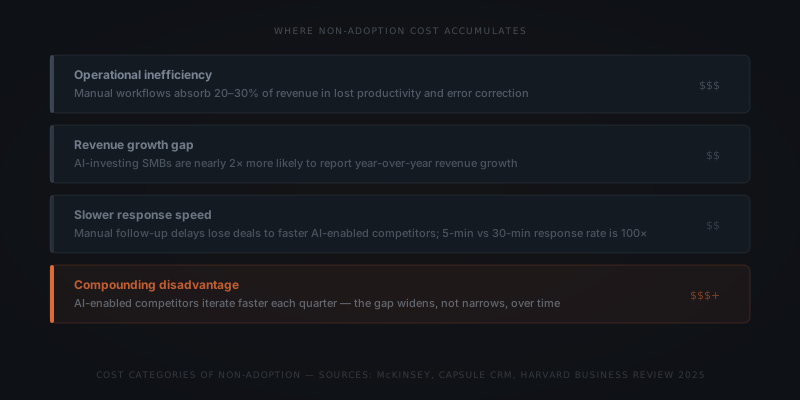
What is the cost of not adopting AI for a small business? Small businesses not adopting AI face three measurable cost categories: operational inefficiency (manual workflows absorb 20–30% of revenue in lost productivity), revenue growth gap (AI-investing SMBs are nearly twice as likely to report year-over-year growth), and compounding competitive disadvantage (AI-enabled competitors iterate faster each quarter). The total cost grows each quarter non-adoption continues.
Are small businesses that use AI growing faster than those that don't? Yes. Small business owners investing in AI are nearly twice as likely to report year-over-year revenue growth. 91% of SMBs using AI report revenue increases, and 66% report saving $500–$2,000 per month from AI-assisted workflows. The gap between adopters and non-adopters is widening as AI-enabled businesses compound their efficiency gains.
How do I calculate the cost of not adopting AI for my business? Map your highest-volume repeatable workflows and count the hours spent on steps an AI agent could handle. Multiply those hours by your effective hourly cost. Add the revenue growth gap differential. Add response speed cost from lost deals. That total is your quarterly non-adoption cost — and it compounds each quarter.
Is it risky to adopt AI agents before competitors do? The risk runs in both directions. Early adoption carries implementation risk — the agent may need iteration. Non-adoption carries competitive risk — the gap between your efficiency and a competitor's compounds over time. For service businesses with high-volume repeatable workflows, the implementation risk is typically lower than it appears: well-defined tasks have high agent reliability and short payback periods.
Notes
- Capsule CRM, "Small Business AI Adoption Statistics." https://capsulecrm.com/blog/small-business-ai-adoption-statistics/
- Capsule CRM, "Small Business AI Adoption Statistics." https://capsulecrm.com/blog/small-business-ai-adoption-statistics/
- McKinsey, "The State of AI in 2025: Agents, Innovation, and Transformation," November 2025. https://www.mckinsey.com/capabilities/quantumblack/our-insights/the-state-of-ai
- Reimagine Main Street / NSBA / PayPal, "Small Business AI Survey," June 2025.
- McKinsey Global Institute, "Agents, robots, and us," November 2025. https://www.mckinsey.com/mgi/our-research/agents-robots-and-us-skill-partnerships-in-the-age-of-ai
- Formstack, "Workflow Automation Statistics You Need to Know." https://www.formstack.com/blog/workflow-automation-statistics
- Harvard Business Review, "The Short Life of Online Sales Leads." https://hbr.org/2011/03/the-short-life-of-online-sales
- YardWork implementation data, 2025–2026 client range.
- Enterprise AI value-concentration analyses, 2026 (74% of AI's economic value captured by roughly 20% of organizations).
- NVIDIA, "State of AI 2026," NVIDIA, 2026.