Multiple AI agents without defined ownership rules fail silently. An agent team is structured by trigger ownership — which agent responds to which event — and write authority — which agent can modify which data field. Both must be defined before the second agent deploys. Skip them and the failures surface after conflicting records are already in the CRM.
Three weeks into running a second agent, a recruiting firm found candidates tagged "sourced" on the contact record and "uncontacted" on the pipeline view — on the same day, for the same person. Both agents had run correctly. The CRM held two versions of the truth.
That is what happens when agents share infrastructure without defined ownership. The structure of an AI agent team is not a function map — it is a trigger assignment and write authority map. Both must be defined before the second agent deploys.
What separates an agent team from a collection of agents?
Multiple AI agents sharing the same environment without ownership rules is not a team — it is a collection of agents waiting to conflict. A team has defined ownership. A collection has defined tasks.
The distinction matters because tasks overlap at the infrastructure level even when they do not appear to overlap at the workflow level. An intake agent and a follow-up agent seem to do entirely different jobs. Both watch the CRM. Both write to contact records. Without defined ownership, both can act on the same record at the same time — producing contradictory outputs with no error, no alert, and no indication that either agent did anything wrong.
McKinsey's November 2025 survey found that 23% of respondents reported scaling an agentic AI system in at least one business function. Within any individual function, no more than 10% reported scaling agents.[1] These are different measures; neither establishes coordination failure as the main cause of limited scaling. For a team adding another agent, ownership rules, shared records and the handoff between agents are practical things to test.
Which two decisions define every agent's role?
An agent's role is not a job description. It is a trigger assignment and a write restriction — which events activate it, and which data fields it is allowed to modify. Everything outside those definitions is outside its scope.
Every agent in a multi-agent system has two defining characteristics: which triggers it responds to, and which data fields it is allowed to write.
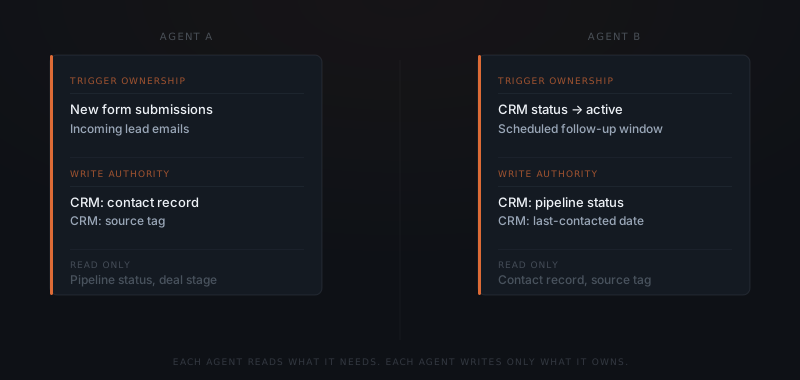
Trigger ownership answers: what events activate this agent? An inbox message, a new CRM entry, a form submission, a scheduled time — each trigger belongs to exactly one agent. If two agents could theoretically respond to the same trigger, a routing rule decides which one does. The rule is not "both agents check the trigger and the first one to run wins." The rule is "only one agent is authorized to respond to this event."
Write authority answers: which data fields can this agent modify? An agent can read any field it needs to do its job. An agent can only write to the fields explicitly assigned to it. If an agent needs to update a field owned by another agent, it creates a task for that agent rather than writing directly.
These two decisions — trigger ownership and write authority — are the role definition for every agent in the system. They are set before deployment, written down, and enforced.
What does a structured agent team look like in practice?
The trigger ownership and write authority model becomes concrete when applied to a real setup. The table below shows a standard 3-agent configuration for a founder-led service business — intake, follow-up, and reporting — with each agent's full role definition.
| Agent | Trigger ownership | Write authority | Read access | Escalation trigger |
|---|---|---|---|---|
| Intake agent | New form submission, new CRM contact created | Contact record, lead qualification fields, initial status | Template library, calendar availability | Input doesn't match any defined contact pattern |
| Follow-up agent | CRM status changes to "contacted," scheduled cadence events | Outreach activity log, follow-up status field | Contact record, lead status (read-only), pipeline view | Lead reply outside defined response template types |
| Reporting agent | Scheduled time trigger (daily or weekly) | Report output destination (email, Notion, Slack) | Full CRM read access, activity log, pipeline | Data gap that prevents report generation |
Three things to note in this structure. First, the intake agent and follow-up agent never write to each other's fields — the intake agent owns the contact record, the follow-up agent owns the activity log. Second, the reporting agent only reads; it has no write authority except to its own output destination. Third, all three have distinct triggers — no two agents respond to the same event.
Common agent roles in service businesses. The three agents above cover the most frequent configuration. The intake agent is typically deployed first — it handles the highest-volume structured work and produces visible output fast. The follow-up agent is second — it depends on the intake agent's contact records being clean and reliably structured. The reporting agent is usually third — it adds the visibility layer once the first two are stable and the data they produce is trustworthy.
A fourth agent type that appears at higher volumes: a routing agent whose only job is to read incoming events and dispatch them to the right downstream agent. The routing agent owns no triggers itself — it sits in front of the trigger layer and enforces the "one trigger, one agent" rule at scale, which becomes manual maintenance at four or more agents.
Where does escalation go when no agent can decide?
The team structure problem isn't how many agents you run. It's which one owns what.
Every agent will eventually receive an input it was not designed to handle. A message that does not match any defined trigger. A contact record in an unexpected state. An edge case that falls between the defined scopes of two agents.
Without a defined escalation path, that input either goes unprocessed — logged as an exception with no action taken — or the agent guesses and produces output that was not reviewed before it was sent.
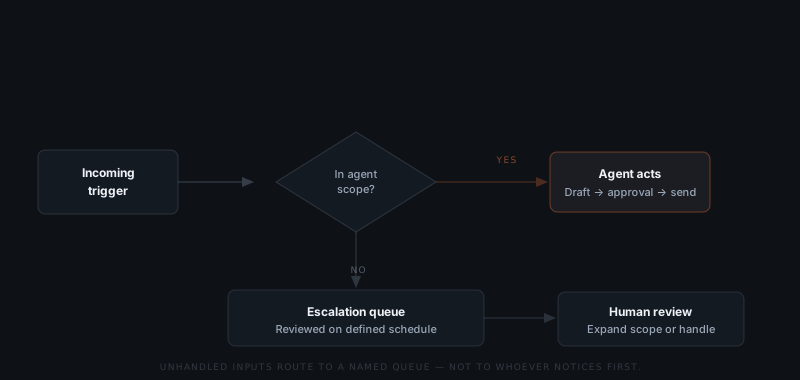
The escalation path is simple: every unhandled input routes to a named queue that a human reviews on a defined schedule. The queue is not a failure log. The queue is a decision inbox. Each item in it needs one of three responses: the agent's scope expands to cover it, the agent's scope stays the same and the human handles this case, or the input is classified as out of scope entirely.
The review schedule matters. A queue checked weekly finds edge cases after they have accumulated. A queue checked daily finds them before they compound. For most service businesses running one or two agents, a daily five-minute review of unhandled inputs is sufficient.
When is the structure ready to expand?
Adding a second agent before the first one is stable solves the wrong problem. If the first agent is producing inconsistent outputs, adding a second agent to compensate amplifies those problems rather than resolving them.
The readiness signals for expanding to a second agent are specific: the first agent has run for at least four weeks without requiring manual intervention on its core workflow; its trigger ownership and write authority are documented, not just assumed; the escalation queue is reviewed on a defined schedule by a named person.
When those three conditions are true, the first agent's structure is stable enough to share infrastructure safely. The second agent's role is then defined the same way: which triggers does it own, which data fields can it write, and where does it escalate. The process is identical — it applies to the second agent and every agent after that.
The scaling path from one agent to three follows a predictable sequence:
| Stage | Agents active | New infrastructure added | Gate to next stage |
|---|---|---|---|
| Stage 1 | 1 (intake or follow-up) | Trigger ownership doc, write authority doc, escalation queue with named reviewer | First agent stable 4+ weeks, no manual intervention on core workflow |
| Stage 2 | 2 (intake + follow-up) | Trigger routing rule, shared audit log, cross-agent read permissions defined | Both agents stable, escalation queue reviewed daily, no coordination failures in 2 weeks |
| Stage 3 | 3 (+ reporting or specialist workflow) | Cross-agent data dependency audit | Both prior agents stable, all ownership docs current |
| Stage 4+ | 4 or more | Formal governance document, named governance owner | Only after Stage 3 is stable — see AI agent governance |
The gate between each stage is deliberate. A business skipping Stage 2's audit log requirement and routing rule will build a coordination problem into Stage 3 that grows with every agent added. The infrastructure cost of each gate is low — a shared Notion page, a routing rule, a daily queue review. The cost of skipping it is the coordination failures that end deployments.
Gartner's June 2025 forecast said that over 40% of agentic AI projects would be canceled by the end of 2027 because of escalating costs, unclear business value or inadequate risk controls.[2] It did not identify coordination failures as the primary cause or measure completed cancellations. Check the value, permissions and operating cost of the next agent before extending the system.
For the full treatment of what goes wrong when multiple agents share infrastructure without ownership rules — and how to trace failures after the fact — see running multiple agents at once. For guidance on scaling beyond two agents, see how to scale an AI agent system.
What documentation is required before the second agent launches?
For a service business currently running one agent and planning to add a second, four documents are required before the second agent goes live. These are not governance artifacts for large teams — they are the minimum viable coordination layer for two agents sharing a CRM and an inbox.
Trigger ownership map. A list of every event both agents could theoretically respond to — inbound messages, CRM status changes, scheduled times, form submissions — with one agent assigned to each. If any event is unassigned, assign it before the second agent launches. If two agents could both respond to the same event, create a routing rule before the second agent launches.
Write authority map. A list of every data field both agents write to, with one agent assigned as the writer for each. If the same field appears in both agents' configurations, pick one writer before the second agent launches. The other agent can read the field but not write to it.
Shared audit log format. A defined structure for how both agents log their actions — entity acted on, action taken, timestamp, outcome. Both agents use the same format so that failure tracing is a lookup, not a reconstruction.
Escalation queue owner. A named person who reviews unhandled inputs on a defined schedule. The queue is not optional — every multi-agent system produces inputs that fall between agent scopes. Without a named owner and a review schedule, those inputs accumulate unprocessed.
One shared document covering these four items is the coordination layer for a two-agent system. It does not need to be long. It needs to exist before the second agent runs.
Frequently asked questions
What is AI agent team structure? AI agent team structure is the set of defined ownership rules that govern how multiple agents share the same environment. It specifies which triggers each agent responds to (trigger ownership) and which data fields each agent is allowed to write (write authority). Without these definitions, agents sharing the same CRM or inbox will eventually conflict.
How do you define roles for AI agents in a multi-agent system? Assign each agent two properties before deployment: which events activate it (trigger ownership) and which data fields it can modify (write authority). An agent can read any field it needs, but can only write to explicitly assigned fields. If an agent needs to update a field owned by another agent, it creates a task for that agent rather than writing directly.
When should you add a second AI agent? When the first agent has run for at least four weeks without requiring manual intervention on its core workflow, its trigger ownership and write authority are documented, and the escalation queue is reviewed on a defined schedule. Adding a second agent before those conditions are met introduces coordination complexity on top of unresolved first-agent problems.
What is an escalation path in a multi-agent system? An escalation path is the routing rule for inputs that fall outside every agent's defined scope. Every unhandled input routes to a named queue reviewed by a human on a defined schedule. Each item results in one of three decisions: the agent's scope expands to cover it, the human handles the case directly, or the input is classified as out of scope.
What are the minimum documents needed before launching a second agent? Four documents are required: a trigger ownership map (one agent assigned to each possible trigger), a write authority map (one agent assigned as writer for each data field), a shared audit log format (how both agents log their actions), and a named escalation queue owner with a defined review schedule.