Scaling an AI agent system means defining which agent owns which trigger and data source. Most multi-agent systems break not because the technology fails, but because two agents share the same trigger without an ownership rule — and each runs when the other should. Building the coordination layer is the actual work. The agents are the output.
Three agents, three workflows, three owners — and nobody can explain why the CRM shows the same contact with three different statuses by Friday. Not too many agents. Not a technology failure. No decision about which agent owns which data. Every business running more than one AI agent hits this wall: the second agent inherits all the ambiguity the first one glossed over. Scaling an agent system is a design job before it is a configuration job.
What does scaling an AI agent system actually require?
Scaling an AI agent system requires one thing that deploying a first agent does not: a routing layer. A routing layer is a set of explicit rules about which agent owns which trigger, reads from which data source, and writes to which output. Without those rules, two agents in the same business environment will eventually share a trigger or a data source — and what happens next is not a technical question. It is a question nobody answered.
The failure mode is invisible. A single AI agent fails noisily: wrong outputs, visible errors, the agent stops running. Two agents with unresolved shared ownership fail quietly. One agent writes to a CRM field. The second overwrites it with stale data. Both report success. The record is wrong. Neither agent flagged an error. The owner finds out when a client calls.
Gartner named agentic AI the top strategic technology trend for 2025 and forecasts that by 2028, 33% of enterprise software applications will include agentic AI.[1] The scaling challenge is organisational, not technical. Scaling is not adding agents. Scaling is building the layer that makes agents usable together.
A routing layer does not require bespoke infrastructure. For most B2B service businesses, it is a written ownership document: which agent owns which trigger, which agent has write access to which CRM field, and where each agent's output goes. That document — kept current, reviewed quarterly, and checked before every new agent goes live — is the routing layer. The technology does not care whether the rules are sophisticated or whether they are implemented in a specialised tool. It only cares whether they exist and whether someone is responsible for maintaining them.
How does unresolved ownership break a multi-agent system?
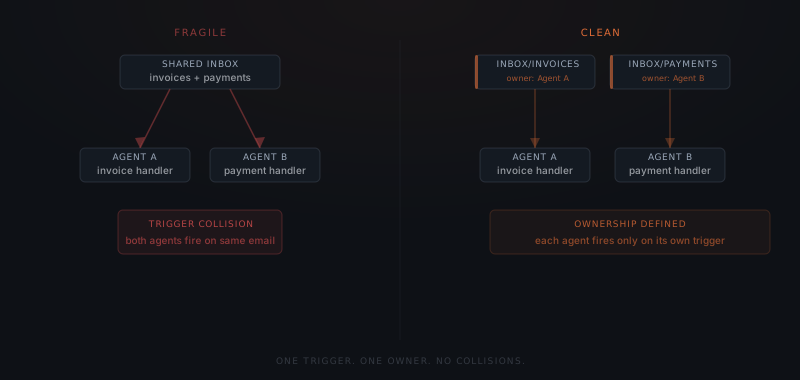
The most common multi-agent failure is trigger collision. Agent A watches a shared inbox for invoice emails. Agent B watches the same inbox for payment emails. A supplier sends "re: invoice payment due." Both agents trigger. Both draft a response. One sends immediately. The second sits in the approval queue — and when the owner approves it ten minutes later, the supplier receives a contradictory second reply.
The second failure is data ownership conflict. Agent A updates a contact record after a call. Agent B pulls contact records every morning to generate outreach drafts. If the timing overlaps, Agent B reads yesterday's version of the record and drafts outreach based on stale data. Both agents report success. The outreach goes to a client whose situation changed the night before.
Both failures share the same root: no decision about who owns the trigger and who owns the data. These decisions feel premature when the first agent is new. By the time the second agent arrives, they are already overdue.
What decisions define a scalable agent architecture?
Before adding a second agent, three ownership decisions need to be explicit — written down, not assumed.
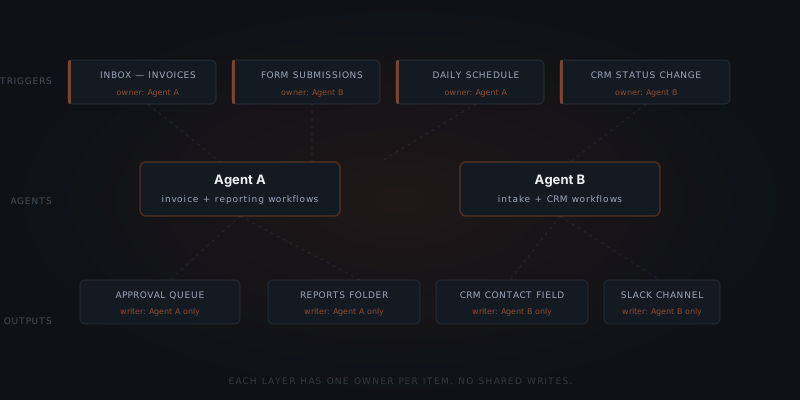
Trigger ownership. Each trigger belongs to one agent. No two agents listen to the same trigger. If a trigger needs to activate more than one workflow, it fires a dispatch queue that routes to each downstream agent in sequence. One trigger, one owner.
Data ownership. Each data field has a defined write owner. Agent A owns write access to "contact status" in the CRM. Agent B reads that field but never writes to it. When Agent B needs to flag a status change, it creates a task for Agent A rather than writing directly. One field, one writer.
Output routing. Each agent's output reaches a destination no other agent writes to simultaneously. If two agents produce output for the same Slack channel or approval queue, a routing layer sequences them. Conflicts are prevented by design.
These decisions look like overhead for a 10-person business. They are not optional for a 10-person business running three agents. Document them before deployment — not after the first conflict appears.
The table below maps each ownership type to its rule and a concrete example from a B2B services environment.
| Ownership type | Rule | Example |
|---|---|---|
| Trigger ownership | Each trigger assigned to exactly one agent | Invoice emails → Agent A only; payment emails → Agent B only |
| Data field ownership | One agent holds write access; all others read only | "Contact status" in CRM → Agent A writes; Agent B reads only |
| Output destination | Each agent writes to a separate output or they are sequenced | Agent A → CRM follow-up queue; Agent B → Slack #billing only |
| Exception routing | Undefined situations route to one named person | All agent exceptions → ops coordinator, with a 24-hour resolution SLA |
These four rules are not a complete architecture — they are the minimum required before a second agent goes live. More complex systems will need additional rules, but a system without these four will generate conflicts before any further design decisions matter.
How do you sequence agent rollouts without creating fragility?
The sequencing rule is one sentence: never add a second agent until the first has run stably for four consecutive weeks.
Four weeks is the minimum window for real edge cases to surface — email patterns that did not appear in testing, client types the agent was not briefed on, integration behaviour that differs between days of the week. A four-week stable run confirms the first agent's ownership rules have been tested. Adding a second agent into a tested environment is a manageable design problem. Adding it into an untested one creates two simultaneous calibration challenges with overlapping failure modes.
Before deploying the second agent, write the three ownership decisions explicitly: this agent owns these triggers, reads from these sources, writes to these outputs. Check every item against the first agent's ownership. Any overlap — shared trigger, shared data field, shared output destination — is a conflict that needs resolving before deployment, not after.
Confirm the first agent has run stably for four weeks
Stable means: consistent output quality, no unresolved trigger conflicts, and approval rate above 85% without edits. If those conditions are not met, the first agent is not ready to share an environment.
Write the second agent's trigger map
List every trigger the second agent will listen to. Check each one against the first agent's trigger list. Any shared trigger needs a dispatch queue before either agent is configured.
Write the second agent's data ownership map
List every data field the second agent will write to. For each field, confirm one of two things: no other agent writes to it, or the write sequence is explicitly defined and enforced.
Define the output routing
Specify where the second agent's output goes. If any output destination overlaps with the first agent's, route them through a sequencing layer before deployment.
Document the escalation path
When the second agent encounters a situation outside its defined scope, specify who receives the escalation and on what timeline. Two agents sharing the same escalation owner without a priority rule creates a queue that defaults to nobody.
Adding a second agent is a design decision, not a configuration task.
For guidance on managing individual agents before scaling the system, see how to manage an AI agent. For a practical framework on which workflows to sequence next, see which workflows to automate first.
What a multi-agent system looks like at each stage
Every multi-agent system passes through the same four stages regardless of business size. The coordination requirements at each stage are predictable — and the risks that appear when a stage is skipped are also predictable.
| Stage | Agent count | Coordination requirement | Primary risk |
|---|---|---|---|
| Single agent | 1 | Minimal — no cross-agent conflict possible | Agent drift without a named owner; outputs degrade silently |
| Small system | 2–3 | High — ownership decisions become mandatory at deployment | Trigger collision; CRM data overwrites with both agents reporting success |
| Operating system | 4–6 | Routing layer required; written ownership documentation for all shared resources | Silent failures compound across agents; single error hard to trace |
| Full implementation | 7+ | Dedicated coordination review cadence; change management for ownership updates | Scope creep across multiple agents simultaneously; new agents inherit unresolved conflicts |
Most B2B service businesses operate in the small system stage — two or three agents handling follow-up, invoicing, and reporting. The coordination requirements at this stage are manageable: four ownership rules, written down, reviewed quarterly. The businesses that skip the documentation end up in an operating system with small-system governance — which is where the silent failures appear.
The most common mistakes when scaling agent systems
The failure modes in multi-agent systems cluster into five patterns. All five are preventable at the design stage. None are preventable at the debugging stage.
Adding a second agent before the first has stabilised. The first agent's edge cases are still surfacing. The second agent inherits an environment that is still being calibrated. Two simultaneous calibration problems with overlapping triggers produce failures neither agent alone would generate.
Assuming shared data sources won't conflict. "They're both reading from the same CRM, but writing to different fields" is not a safe assumption until the field-level write ownership is documented and verified. Two agents writing to adjacent fields in the same record will produce a conflict eventually.
Setting ownership verbally instead of in writing. A verbal agreement about trigger ownership does not survive a team change or a platform update. The rule that is written down is the one that gets checked when something goes wrong. The rule that is remembered is the one that quietly breaks.
Scaling by workflow category instead of ownership clarity. A business might add Agent B to handle invoicing because invoicing is a new workflow category — without checking whether Agent B's data reads overlap with Agent A's CRM writes. Categories are not a substitute for ownership decisions.
Building agents in parallel rather than in sequence. Two agents built simultaneously never complete a stable four-week run independently before sharing an environment. The coordination design gets deferred because both agents are still in calibration. By the time both are live, the deferred design decisions have already caused the first conflict.
| Mistake | When it breaks | How to prevent it |
|---|---|---|
| Adding agent 2 before agent 1 is stable | Immediately after deployment | Require 4-week stable run before adding any second agent |
| Undocumented shared data source | First write conflict; both agents report success | Document field-level write ownership before agent 2 is configured |
| Verbal ownership agreements | After a team change or platform update | Write every ownership rule; no verbal agreements count |
| Category-based scaling without ownership check | When workflows overlap unexpectedly | Check new agent's trigger and data map against all existing agents before deployment |
| Parallel agent builds | Coordination design deferred until both are live | Build and stabilise sequentially; never run parallel agent calibration |
This post covers the growth-stage decision — whether and when to add a second agent, and the ownership rules that keep the architecture from becoming fragile as it grows. If an agent is already misbehaving and you need to trace why, see running multiple agents without conflicts for the diagnosis playbook. For a worked example of what a stable three-agent setup looks like end to end, see AI agent team structure.
Frequently asked questions
What does scaling an AI agent system mean? Scaling an AI agent system means adding agents to handle more workflows while building the coordination layer that prevents them from interfering with each other. Scaling is not adding agents. It is defining the trigger ownership, data ownership, and output routing rules that make multiple agents usable together without silent conflicts.
How do you prevent two AI agents from interfering with each other? Assign every trigger to a single agent — no two agents listen to the same trigger. Assign write ownership of every data field to one agent — others can read, not write. Route outputs to separate destinations, or sequence them through a dispatch queue if they share one. Document these rules before the second agent goes live.
How long should you wait before adding a second AI agent? Wait until the first agent has run stably for at least four consecutive weeks. Stable means: consistent output quality, no unresolved trigger conflicts, and an owner approval rate above 85% without edits. If those conditions are not met, the first agent is not ready to share an environment with a second.
What is the most common failure mode when scaling AI agents? Trigger collision — two agents listening to the same event and both responding when only one should. The second most common is data ownership conflict — one agent overwrites a field the other just updated, and both report success. Both failures are invisible until a downstream consequence surfaces them.
Notes
- Gartner, "Top 10 Strategic Technology Trends for 2025," Gartner Research, October 2024. https://www.gartner.com/en/articles/top-10-strategic-technology-trends-for-2025