Running multiple AI agents in the same environment creates problems that deploying one agent never revealed. Trigger collisions happen when two agents respond to the same event. Data conflicts happen when one agent overwrites what another just wrote. Both failures are silent — each agent reports success. Preventing them requires defining which agent owns which trigger and data field before the second agent goes live.
The intake agent and the follow-up agent were both running. Both approved. Both generating output at the right times. Three weeks in, a prospect complained about receiving contradictory emails — one inviting them to book a call, a second sent 40 minutes later with different phrasing, from what appeared to be the same business. Neither agent had failed. Each did exactly what it was configured to do. Nobody had defined which one owned the prospect inbox.
What changes when two agents share the same environment
A single AI agent operates in isolation. It owns its trigger, reads its inputs, and writes to its output. Failures are self-contained: when an agent misconfigures or produces bad output, the problem starts and ends with that agent.
Two agents in the same environment share infrastructure — the same CRM, the same inbox, the same Slack workspace, sometimes the same approval queue. Shared infrastructure means one agent's actions can affect the other's inputs, outputs, or triggers without either agent being aware of the other.
The failures that result are different in kind from single-agent failures. A single agent fails noisily: bad output, missed triggers, visible errors. Multi-agent interference fails silently. Both agents run. Both produce output. Both report success. The problem surfaces later as contradictory data, duplicate responses, or a downstream task built on a corrupted input.
Gartner recorded a 1,445% surge in multi-agent system enquiries between Q1 2024 and Q2 2025 — and simultaneously identified multi-agent orchestration as one of the primary governance gaps in enterprise AI deployments.[1] Most of the businesses running these systems are encountering the coordination problem after go-live, not before.
The three interference types that only appear in multi-agent setups
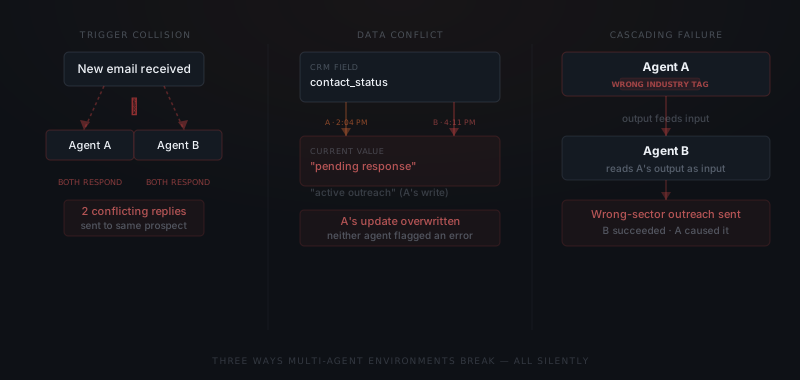
Trigger collision is the most common. Two agents watch the same inbox or channel for different event types. A prospect sends a message that qualifies as both an intake trigger for Agent A and a follow-up trigger for Agent B. Both agents activate. Both draft responses. If both outputs are approved, the prospect receives two replies with different content from the same business.
Data conflict is subtler. Agent A processes a contact record and updates the status field to "active outreach." Agent B runs its daily sync two hours later, reads the record, and overwrites the status field with "pending response" based on older data. Agent A's update is gone. Neither agent flagged anything. The record reflects the last write — which is not the most recent action.
Cascading failure is the hardest to trace. Agent A processes incoming requests and creates draft records in the CRM. Agent B reads those draft records and generates follow-up actions. When Agent A tags a contact with the wrong industry, Agent B inherits that error and generates outreach that references the wrong sector. Agent B's output looks wrong, but Agent A caused it. Without tracing backward through both agents' logs, the source is invisible.
Gartner's June 2025 forecast said that over 40% of agentic AI projects would be canceled by the end of 2027 because of escalating costs, unclear business value or inadequate risk controls.[2] It did not identify coordination failures as the primary cause or measure completed cancellations. Check the value, permissions and operating cost of the next agent before extending the system.
What multi-agent failures look like when they surface
The three interference types describe the mechanism. The failure modes below describe what they look like when they surface — sometimes days after the underlying cause occurred.
Silent double-send. Two agents both fire on the same incoming lead because neither has exclusive trigger ownership. Both drafts are approved in separate queues, by separate reviewers who each see one item. The prospect receives two emails from the same business, 35 minutes apart, with different phrasing and a different CTA. Neither reviewer noticed because each saw only their own queue.
Status overwrite loop. Agent A processes a new contact and updates the CRM status to "active outreach." Agent B runs a daily sync four hours later, reads the record, and resets the status to "pending response" based on its own logic. Agent A's next scheduled run reads "pending response" as uncontacted and generates a new first-contact message. The contact receives an introductory email two weeks after already being in a sequence.
Upstream error amplified downstream. Agent A classifies an inbound lead by industry. Agent B reads the industry tag and uses it for personalisation in outreach. Agent A misclassifies 15% of leads in one batch. Agent B sends 23 outreach messages referencing the wrong industry. The source was one bad classification. The downstream effect was 23 wrong messages — all of which looked correct at the point they were sent.
Orphaned escalation. Agent A flags a contact for human review and creates an escalation task. Agent B encounters the same contact, finds a separate condition resolved, and marks the contact as "handled." Agent A's escalation task remains open but is disconnected from the contact's actual state. Nobody follows up because the contact record says "handled." The escalation sits unresolved until someone notices it manually.
All four failure modes share one root cause: neither agent knew what the other was doing. The coordination rules in the next section address each directly — before they appear in production.
How to trace a failure to its source in a multi-agent system
When output looks wrong in a multi-agent environment, start with the approval timestamps.
Every agent action that required approval has a timestamp. Pull the approval log for the relevant time window and look for two agents touching the same record, contact, or trigger window. A collision shows up as two approvals close together for the same entity.
If no collision appears in the approval log, trace backward from the wrong output to its input. Agent B produced the wrong follow-up — what did Agent B read as its input? Pull Agent B's input record. If the input record was wrong, find when it was last written and which agent wrote it. That is the source.
Every agent in a multi-agent system needs its own approval log with the entity it acted on recorded for each action. Without that log, tracing a failure across agents becomes a forensic exercise instead of a five-minute lookup.
McKinsey's November 2025 survey found that 23% of respondents reported scaling an agentic AI system in at least one business function. Within any individual function, no more than 10% reported scaling agents.[3] These are different measures; neither establishes coordination failure as the main cause of limited scaling. For a team adding another agent, ownership rules, shared records and the handoff between agents are practical things to test.
Coordination rules that prevent most interference
Three rules prevent the majority of multi-agent failures before they occur.
One trigger, one agent. No two agents listen to the same channel, inbox, or event source without a routing rule that pre-assigns which agent handles which message type. If both agents need to act on incoming messages from the same source, a routing layer reads each message first and dispatches it to the correct agent. One source, one decision point, one owner.
One writer per data field. Every CRM field, status column, and structured data destination has exactly one agent authorised to write to it. Other agents can read those fields but not overwrite them. If a second agent needs to flag a change to a field it does not own, it creates a task for the owning agent rather than writing directly.
No agent reads another agent's unverified output. Before an agent's output becomes another agent's input, a review step or an explicit verification check sits between them. Cascading failures require an unverified output to flow downstream — the review step breaks the chain.
The three rules and when each applies:
| Coordination pattern | Problem it prevents | How to implement | When it's required |
|---|---|---|---|
| Exclusive trigger ownership | Trigger collision | Routing layer reads each event and dispatches to one assigned agent | Two or more agents monitoring the same inbox, channel, or event source |
| Single field writer | Data conflict | Each CRM field has one authorised writer; all other agents are read-only for that field | Two or more agents writing to the same record or data destination |
| Verified handoff | Cascading failure | Review step or validation check between Agent A's output and Agent B's input | Any workflow where one agent's output feeds another agent's input |
| Shared audit log | Slow failure tracing | Each agent logs entity acted on, action taken, and timestamp in a shared readable format | Any multi-agent environment — non-negotiable from day one |
| Non-overlapping schedules | Resource contention | Stagger agents running heavy data syncs or bulk API calls | When agents compete for the same API rate limit or database lock |
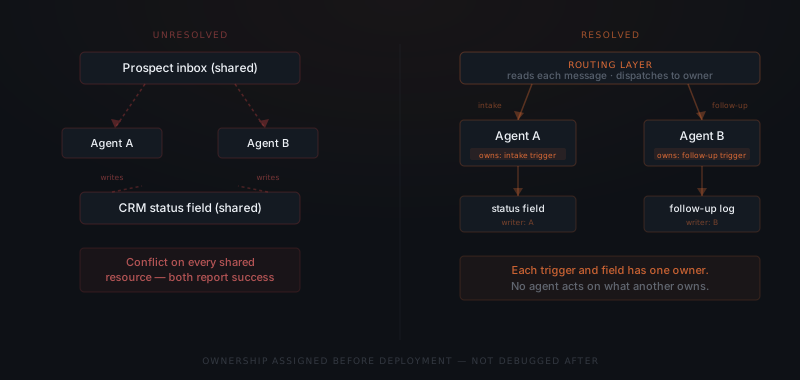
Both agents reported success. The CRM was wrong. That is the multi-agent problem nobody briefs you on.
For the full architecture — trigger assignments, data field ownership, and output routing — see how to scale an AI agent system. For guidance on managing individual agent quality over time, see AI agent maintenance.
The cost of running two agents versus one
Running a second agent does not cost twice as much as the first. Shared infrastructure — the CRM integration, calendar connection, email OAuth — carries over. The second agent builds on what the first already established.
| Cost component | First agent | Second agent | Notes |
|---|---|---|---|
| Implementation | $3,000–$7,000 | $2,000–$4,500 | Lower because integrations are already live |
| Coordination infrastructure (routing layer, audit log) | — | $500–$1,500 | One-time cost, covers all future agents in the same environment |
| API operating costs (year 1) | $100–$400 | $80–$300 | Per agent; scales with task volume |
| Total year 1 | $3,100–$7,400 | $2,580–$6,300 | Per agent, after first agent is live |
| Year 2+ operating | $100–$400/yr | $80–$300/yr | Per agent |
The coordination infrastructure cost — the routing layer and shared audit log — is paid once. A business running three agents does not pay it three times.
The combined annual operating cost for two agents at typical service business task volumes — 80–150 tasks per week combined — runs $180–$700. At that level, the cost per task is $0.02–$0.14. Manual processing of the same tasks at $25/hr runs $8–$12 per task. The economic case for the second agent follows the same logic as the first — the setup cost amortizes quickly at any meaningful task volume.
The one cost that scales with agent count is oversight time: reviewing outputs, adjusting instructions, handling exceptions. A second agent in a well-governed system adds 1–2 hours of oversight per week. A second agent in a system without clear ownership rules adds however many hours are needed to investigate the silent failures that appear instead. The coordination infrastructure is not overhead — it is what keeps the oversight cost predictable.
This post focuses on diagnosing and tracing conflicts once agents are already running together. For the growth-stage decision of whether and when to add a second agent in the first place, see how to scale an AI agent system. For a worked example of a stable multi-agent setup, see AI agent team structure.
Frequently asked questions
What is a trigger collision in a multi-agent system? A trigger collision occurs when two agents both activate in response to the same event — an incoming email, a new form submission, or a channel message — because both were configured to watch the same source. Both produce output for the same event. If both outputs are approved, the recipient receives two separate responses from the same business. Preventing trigger collisions requires assigning each trigger to exactly one agent before deployment.
How do you find out which agent caused a failure in a multi-agent environment? Start with the approval log timestamps. Pull every agent action within the relevant time window and look for two agents touching the same record, contact, or trigger window. If no collision appears, trace backward from the wrong output to its input source — find which agent last wrote the input record, and that is the source. Most multi-agent failures trace to a shared trigger or a shared data write.
Can two AI agents share the same CRM without causing data conflicts? Yes, if write ownership is defined for each data field. Each field needs one assigned writer — other agents can read those fields but not write to them. Without defined write ownership, any agent with CRM access can overwrite any field at any time, and data conflicts become inevitable. The rule needs to be written down, not assumed.
What makes multi-agent failures different from single-agent failures? Single-agent failures are visible — bad output, missed triggers, errors that surface immediately. Multi-agent failures are silent. Each agent executes its instructions correctly and reports success. The problem appears downstream as contradictory data, duplicate client responses, or a follow-up built on an input that was already wrong when the second agent read it.
What coordination rules prevent most multi-agent interference? Three rules prevent most failures: one trigger assigned to one agent (no two agents monitor the same source without a routing layer); one writer per data field (all other agents are read-only); and no agent reads another agent's unverified output without a review or validation step between them. A shared audit log across all agents is also non-negotiable — without it, tracing failures becomes a forensic exercise.