
Comparing AI agent cost to hiring cost requires the fully-loaded cost of both, not just the salary line. A 2026 MIT analysis found AI automation is economically viable in only about 23% of roles — for the remaining 77%, humans remain cheaper. A full-time employee at $50,000 salary costs $62,500–$70,000 loaded; an AI agent has a fixed setup cost plus a variable operating cost tied to task volume. The comparison only resolves correctly when framed per task — and only for structured, high-volume work.
Without proper usage controls, an AI agent can cost more to operate than an equivalent part-time hire — a caveat CIO Magazine documented in enterprise AI deployments, where unbounded agent usage drove monthly API costs above a part-time coordinator salary.[1] In 2026 that caveat hardened into a headline. MIT researchers put the economically-viable share of roles for AI automation at roughly 23%; the remaining 77% still favor a human hire.[6] Nvidia's applied-deep-learning lead put it bluntly to Axios: 'the cost of compute is far beyond the costs of the employees.'[7] The agent-versus-hire comparison breaks when framed as a total budget question. The right frame is cost per task — and at that level the answer depends on volume and task type.
What does a hire actually cost, including the full employer stack?
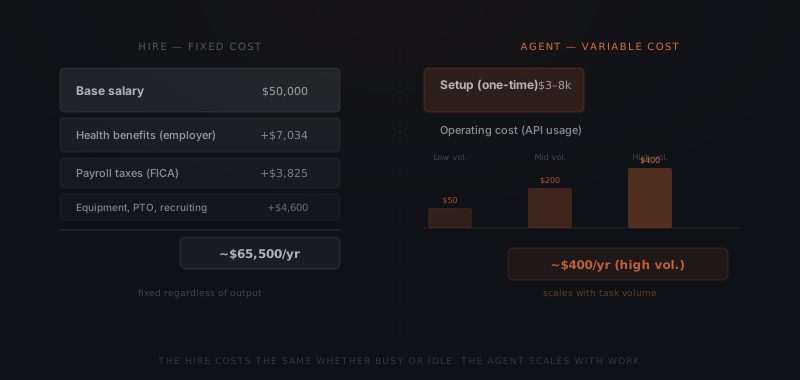
The salary line understates true hiring cost. SHRM's research on total cost of employment found that employers pay approximately 1.25–1.40x base salary when employer-side payroll taxes, health benefits, paid time off, and employer overhead are included.[2]
For a US administrative or operations hire at $50,000 base salary:
| Cost component | Annual amount |
|---|---|
| Base salary | $50,000 |
| Employer FICA (Social Security + Medicare) | $3,825 |
| Health benefits (employer share, avg.) | $7,034 |
| Paid time off (10 days, avg. accrual cost) | $1,923 |
| Recruitment and onboarding (amortized) | $1,500 |
| Equipment and software | $1,200 |
| Total employer cost | ~$65,500 |
The Bureau of Labor Statistics Employer Costs for Employee Compensation (ECEC) survey found that employer costs for civilian workers averaged $46.14 per hour in December 2024, with wages and salaries representing 70.6% of total compensation and benefits representing 29.4%.[3] For a $50,000 salary, that benefits ratio adds approximately $20,770 in employer-side costs — higher than the SHRM estimate once all categories are included.
A part-time hire at 20 hours per week carries proportionally lower fixed costs but often a higher hourly rate. Part-time workers in administrative roles average $22–28/hour in the US, which at 20 hours per week over 50 working weeks comes to $22,000–$28,000 annually — before any employer-side costs.
What does an AI agent actually cost to set up and run?
An AI agent has two distinct cost components. The setup cost is a fixed one-time expense. The operating cost is variable, tied directly to task volume.
Setup cost. Building and configuring a purpose-built agent workflow involves defining the process, writing and testing the prompts, connecting integrations, and handling the edge cases that appear in the first weeks. For a standard service business workflow — lead follow-up, renewal sequences, inbox triage — setup typically runs $3,000–$8,000 when done by an implementation service, or 40–80 hours of internal time when built in-house.[4]
Operating cost. The operating cost of an AI agent is primarily API usage, and it is the smallest, most predictable line in the budget. On published pricing for the current Claude lineup — $1.00–$2.00 per million input tokens and $5.00–$10.00 per million output tokens across Haiku 4.5 and Sonnet 5 — a standard email draft (roughly 300–500 tokens generated, plus a similar amount of input context) costs a fraction of a cent, in the range of $0.002–$0.006.[8] At 100 email drafts per week, annual API cost lands around $10–$30 — not the $100–$400 a blended-rate guess would suggest.
| Cost component | Amount | Notes |
|---|---|---|
| Setup — implementation service | $3,000–$8,000 | One-time |
| Setup — internal build | 40–80 hours | One-time |
| API usage — low volume (under 20 tasks/week) | ~$50–100/yr | Ongoing |
| API usage — high volume (100+ tasks/week) | ~$100–400/yr | Ongoing |
| Total cost — year 1 | $3,100–$8,400 | Setup + first year usage |
| Total cost — year 2+ | $100–400/yr | After setup amortizes |
The caveat the CIO analysis raises is accurate: an agent configured without usage limits can process inputs at a rate no human would match — checking inboxes every two minutes, processing every notification, running summarisation on every document — and the costs compound quickly.[1] Proper configuration includes rate limits, trigger conditions, and scope boundaries that prevent unbounded usage.
When does the agent win, and when does the hire win?
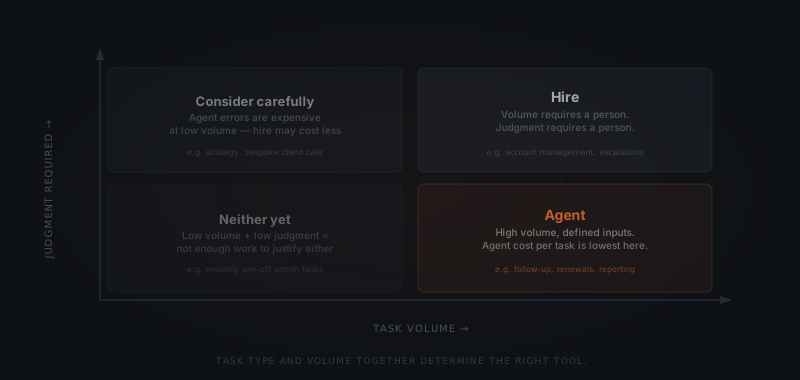
Task volume determines whether an agent is cheaper than a hire. Task type determines whether an agent can do the work at all. Both conditions must be evaluated before the comparison makes sense.
The break-even calculation depends on two variables: task volume and judgment requirement.
Task volume. At low task volumes — fewer than 20–30 defined tasks per week — the agent setup cost does not amortize well against the work being done. A hire covering two or three roles across ad hoc needs is often cheaper to maintain. At high task volumes — 50+ defined tasks per week of the same type — the agent operating cost per task becomes substantially lower than the equivalent human processing time.
Judgment requirement. The task type determines whether an agent can do the work at all. Defined, repeatable tasks with structured inputs — lead follow-up, renewal reminders, document requests, invoice generation — are well-suited to agent handling. Variable, judgment-dependent tasks — client escalations, strategic decisions, relationship-sensitive communications — require human assessment. A hire covering variable work cannot be replaced by an agent, regardless of cost.
Those two variables sort into a consistent task split across service businesses. The table below reflects the pattern behind the recruiting, agency, and consultancy examples used later in this post.
| Agent task | Hire task |
|---|---|
| Lead follow-up sequences | Client escalations |
| Renewal and invoice reminders | Relationship management |
| Status update drafts | Novel situation handling |
| CRM and pipeline data entry | New workflow scoping |
| Report generation | Vendor and partner communication |
| Onboarding confirmations | Judgment calls on exceptions |
The left column is where an agent wins on cost once volume clears the break-even threshold below. The right column is where cost comparison stops applying — a hire can't be priced out of relationship work an agent structurally cannot do.
The test for which column a task belongs in: write down the trigger, the steps, the decision points, and the output. If that written process would let a new hire run it correctly on day one without asking questions, the task is ready for an AI agent to run it. If it still needs judgment calls the process can't anticipate, it belongs in the hire column — at least until those judgment patterns get documented well enough to close the gap.
Stanford HAI's 2024 AI Index found that AI automation cost per task has declined by more than 99.7% since 2017 — the cost of running a standardized text processing task dropped from approximately $20 in 2017 to less than $0.06 in 2024.[5] That decline changes the cost-per-task calculus decisively for high-volume, structured work. It does not change the judgment-requirement calculus.
The break-even point by task volume, using a $4,000 average setup cost and a $25/hr equivalent for a human processing the same tasks at 20 minutes each:
| Weekly task volume | Break-even vs. equivalent hire | Annual savings from year 2 |
|---|---|---|
| Under 20 tasks/week | 10–14 months | $4,000–$8,000 |
| 20–50 tasks/week | 4–8 months | $8,000–$22,000 |
| 50–100 tasks/week | 2–4 months | $22,000–$43,000 |
| 100+ tasks/week | Under 2 months | $43,000+ |
Assumptions: $4,000 setup, $0.01/task API cost, 20 minutes per task at $25/hr equivalent.
The hire costs the same whether the work is easy or hard. The agent costs proportionally to volume.
For an analytical framework on which tasks are ready for an agent, see how to know if a business process is ready to hand to an AI agent.
Which total cost question do most businesses get wrong?
Most businesses frame the decision as: "Can an agent do this instead of a person?" The correct frame is: "What is the cost per completed task, and what is the task type?"
A hire processing 20 lead follow-up emails per week at $65,500 annual cost ($31.50/hr, 30 min per email batch) costs approximately $16.25 per email batch. An agent processing the same 20 emails per week at $0.01/task costs approximately $0.20 per week in API costs, with the setup cost amortizing to near-zero within the first year.
The hire also handles the variable work alongside the structured work — the client calls, the escalations, the ad hoc requests. The agent handles only the structured work. Most businesses need both, deployed in the right sequence.
The businesses that over-invest in agents do so by automating variable work that requires judgment and then spending significant time managing errors and edge cases. The businesses that under-invest ignore the compounding value of removing structured tasks from their team's load entirely — freeing senior attention for the variable, high-value work that cannot be delegated.
How does the comparison play out in a real service business?
Abstract cost tables do not answer whether an agent makes sense for a specific workflow. The numbers below use realistic task volumes and setup costs for three common founder-led service businesses.
Agency — lead follow-up and proposal reminders. A six-person digital agency sends 40–60 follow-ups per week across eight client accounts. An account manager currently handles this in 6–8 hours per week. At a $35 blended rate, that is $10,900–$14,600 in annual attention cost — from someone whose time is worth more on client strategy than email composition. Agent setup: $3,500–$5,000. Year 2 operating cost: $150–$250/year. Break-even: month 4. Year 2 savings: $10,600–$14,350.
HR consultancy — candidate intake and scheduling. An eight-person consultancy processes 60–80 candidate submissions per week: parsing intake forms, scheduling screening calls, sending confirmation emails. A part-time admin handling intake runs $24,000–$32,000 per year. Agent setup: $4,500–$6,000. Year 2 operating cost: $200–$350/year. Break-even: month 3. Year 2 savings: $23,650–$31,650.
Recruiting firm — pipeline status updates. Fifty to eighty candidates in active pipelines at any time, each requiring weekly status updates, interview confirmations, and disposition notices. Manual effort: 10–15 hours per week. At a $30 coordinator rate, that is $15,600–$23,400 per year. Agent setup: $5,000–$7,000. Year 2 operating cost: $250–$400/year. Break-even: month 4–5. Year 2 savings: $15,200–$23,000.
In all three cases, year 2 represents a step-change in economics. The setup cost does not recur. The task volume the agent handles does not decrease. The person who was processing that work redirects attention to higher-judgment tasks that cannot be delegated.
Can you run an agent and a hire together?
None of the three businesses above eliminated a role after implementation. That pattern holds broadly: the first agent implementation changes what a hire's cost buys, not whether the hire is needed.
Take the recruiting firm above. Before the agent, its coordinator spent 10–15 hours a week on status updates, interview confirmations, and disposition notices — the top rows of the task-split table. After implementation, those hours shifted to escalations the agent routed to her and to client relationships generating unusual volume. Her salary cost didn't change. What it bought did.
The hybrid model holds up when the work split is deliberate. It breaks down when an agent gets added but the hire keeps doing the same tasks alongside it — reviewing everything the agent produced costs nearly as much time as producing it manually.
Three practices keep the split from collapsing back into double work:
Remove the task from the hire's list, not just from their daily grind. A task the agent now runs shouldn't stay on the coordinator's responsibilities as a check. Reviewing flagged exceptions is a different task from redoing the whole batch.
Route escalations to a named person, not the founder by default. An agent that hits its scope boundary should hand off to whoever owns the relationship work — set at implementation, not discovered mid-exception.
Turn the hire's judgment calls into the next agent's scope. A pattern the hire resolves the same way three times out of five is a candidate for the next implementation's defined-task list. Documenting those patterns is how a business discovers which workflows are ready to implement as agents, not just which ones cost less.
When does the agent cost model fail?
Three failure modes flip the break-even analysis and make an agent more expensive than a hire.
Automating judgment-dependent tasks. An agent handling client escalations, complaint responses, or strategic recommendations produces outputs requiring correction on 30–50% of cases. Each correction cycle takes longer than the original task would have. The judgment requirement disqualifies the task regardless of volume — the setup cost does not recover.
Operating without usage limits. An agent configured to check inboxes every two minutes and process every inbound notification runs continuously. Without scope boundaries — defined triggers, rate limits, task-type filters — a mid-tier model generates $800–$1,200 in unnecessary annual API cost with no corresponding workflow benefit. CIO Magazine's analysis documented enterprise deployments where unbounded configurations added $3,000–$8,000 per year above projections.[1]
Under-defined task scope. A workflow defined as "handle customer questions" rather than "respond to order status inquiries matching these four templates" produces outputs requiring human review on 60–70% of cases. Volume does not fix a scope problem — it amplifies it. The agent creates work rather than removing it.
All three failure modes share a root cause: treating the agent as a general-purpose hire rather than a narrowly-scoped task processor. The cost analysis above assumes the task is well-defined, the scope is bounded, and usage limits are configured. Remove any of those conditions and the break-even calculations do not hold.
Should you build the agent or hire first?
The cost math above assumes a process worth costing already exists. When it doesn't, the decision isn't about cost yet — it's about which gap is creating the most friction right now.
| Primary constraint | Right first move | Cost logic |
|---|---|---|
| High task volume, process already defined | Implement the agent first | Setup amortizes inside the first year — see the break-even table above |
| Founder can't step away, process undocumented | Hire first | An undocumented process can't be scoped into an accurate setup estimate |
| High volume and an undocumented process | Hire first, document in parallel | A hire who documents while working turns the next setup cost into a fixed-scope quote instead of a guess |
| New workflow with no history to reference | Hire first | Agents need a written process to run; a hire creates the first version of it |
| A repeating pattern the founder already handles manually | Implement the agent | The founder's manual handling is the documentation; scoping extracts it directly |
The businesses in the examples above already had the process defined — that's why the break-even numbers hold, and why implementation takes 2–4 weeks rather than longer. For what that build actually involves, see how to build a custom agent. A business without that documentation isn't choosing between an agent and a hire yet. It's choosing whether to hire someone who will eventually produce the process an agent can run.
Frequently asked questions
How much does an AI agent cost compared to hiring an employee? A full-time US employee at $50,000 salary costs approximately $62,500–$70,000 annually when employer taxes, benefits, and overhead are included. An AI agent has a one-time setup cost of $3,000–$8,000 and an operating cost tied to task volume — typically $100–$400 per year for a standard service business workflow. The comparison only works on a per-task basis, and only for tasks that are structured and high-volume enough to justify the setup.
When does an AI agent cost more than hiring someone? MIT's 2026 analysis puts the economically viable share of roles for AI automation at about 23% — the other 77% stay cheaper with a human. Three things push an agent's cost above an equivalent hire: task volume too low to amortize setup, work that needs judgment the agent lacks so errors turn into rework, or no usage cap, which lets API spend climb. CIO Magazine documented enterprise cases where unbounded agent configurations exceeded part-time hire costs within months.
What is the break-even point for an AI agent vs. a hire? Break-even depends on task volume, task type, and setup cost. For a standard service business workflow — lead follow-up, renewal sequences, inbox triage — the agent typically breaks even against a part-time hire within 4–8 months. At 50+ identical tasks per week, the agent is significantly cheaper per task than any human processing rate. Below 20 tasks per week of the same type, the economics are less clear.
Should a small business hire or use an AI agent for admin work? The right answer depends on whether the work is structured or variable. Structured, repeatable tasks at sufficient volume — following up with leads, sending renewal reminders, generating reports — are better handled by an agent. Variable work requiring judgment — client escalations, strategy decisions, relationship management — needs a hire. Most small businesses need both. The correct sequence is to deploy agents on the structured layer first, which frees a hire (current or future) to focus on the work that actually requires them.
Notes
- CIO Magazine/TechTarget, "Without controls, an AI agent can cost more than an employee," CIO, 2024.
- SHRM, "How to Calculate Total Compensation," Society for Human Resource Management, 2024.
- Bureau of Labor Statistics, "Employer Costs for Employee Compensation — December 2024," BLS, March 2025.
- Retool, "The State of AI 2024," Retool, 2024.
- Stanford Human-Centered AI Institute, "AI Index Report 2024," Stanford HAI, April 2024.
- MIT analysis of AI automation economics, 2026 (AI automation economically viable in roughly 23% of roles; humans remain cheaper for the remaining 77%), reported in Futurism and Fortune, 2026.
- Bryan Catanzaro (NVIDIA), quoted in Axios, "AI can cost more than human workers now," April 2026.
- Anthropic model pricing (Claude Haiku 4.5, Sonnet 5), published pricing verified August 2026, per what an AI agent implementation costs in Europe.