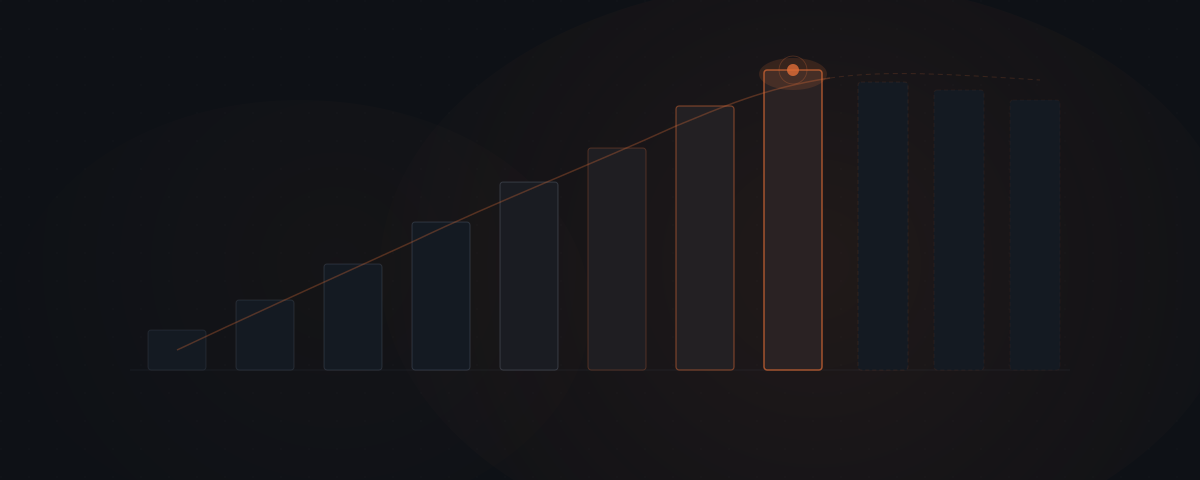
Worldwide AI spending is forecast to reach $2.59 trillion in 2026, up 47% year over year and roughly 41% of all IT spending, according to Gartner. Spending on AI models and agents alone more than doubled, to about $32.6 billion. Yet enterprise GenAI in production stood at $37 billion, and only 16% of enterprises reached true agent deployment. The spending curve is accelerating; the production gap is the story behind the numbers.
$2.59 trillion. That is Gartner's forecast for worldwide AI spending in 2026 — a 47% increase year over year, and roughly 41% of all global IT spending.[¹] Spending on AI models and agents specifically more than doubled, to about $32.6 billion, up from $15.5 billion in 2025.[¹] The investment curve is not flattening. It is steepening.
The headline figures require context. Not all AI spending is the same. The $2.59 trillion covers the full stack — chips, data centers, model training, services — while the $37 billion enterprises spent running GenAI in production measures a different, much narrower layer.[³] Understanding the difference tells you where AI investment is concentrated and what the production deployment gap actually means.
What does the $2.59 trillion AI spending figure cover?
Gartner forecasts worldwide AI spending at $2.59 trillion for 2026, a 47% year-over-year increase.[¹] This figure covers the full AI investment stack:
- Hardware (servers, GPUs, specialized AI chips)
- Software (AI platforms, models, APIs)
- Professional services (implementation, consulting, training)
- Infrastructure (data centers, networking, cloud capacity)
The $1.5 trillion is a supply-side figure. It measures global investment in AI capability: the infrastructure layer, foundation model training runs, and enterprise software integrations.
Gartner's forecast for spending on AI models and AI agents specifically reached about $32.6 billion in 2026 — more than double the $15.5 billion spent in 2025.[¹] This is a narrower measure than the total: the software layer enterprises license to run models and agents, distinct from the infrastructure beneath them.
The Menlo Ventures figure of $37 billion measures something more specific: GenAI applications in production. Tools and workflows actually running in enterprise operations — not in pilots or evaluation.[³]
| Figure | Source | What it measures |
|---|---|---|
| $2.59 trillion | Gartner 2026 | Total global AI spending (hardware + software + services + infrastructure) |
| $32.6 billion | Gartner 2026 | Worldwide spending on AI models and AI agents |
| $37 billion | Menlo Ventures 2025 | Enterprise GenAI applications in production |
| $12.5 billion | Menlo Ventures 2025 | Foundation model API access (subset of the $37B) |
The gap between total AI spending and the $37 billion enterprises run in production is the important one. It reflects how much goes to infrastructure, model training, and capability not yet in operational use. The $37 billion is the running tab — what enterprises are paying to run AI in their workflows today.
The $2.59 trillion and the $37 billion measure different things. Total AI spending covers the full infrastructure buildout — chips, data centers, model training. Enterprise GenAI applications measure what businesses are actually running in production. Both are accurate. Neither describes the other.
Where did the $37 billion in enterprise GenAI go?
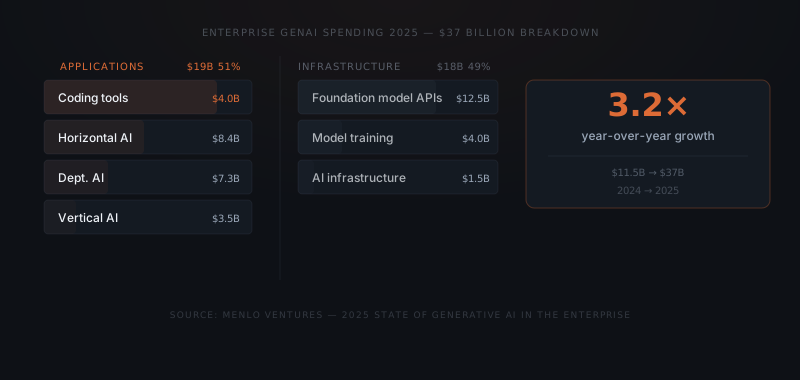
The $37 billion breaks into two roughly equal halves: applications ($19 billion, 51%) and infrastructure ($18 billion, 49%).[³]
Applications layer — $19 billion. Enterprise GenAI application spending covers tools teams use in daily work. The largest category is coding tools at $4 billion — reflecting how broadly developer productivity tooling has spread. Horizontal AI (tools that span multiple functions) accounts for $8.4 billion. Departmental AI (function-specific tools for marketing, HR, or customer success) accounts for $7.3 billion. Vertical AI (industry-specific tools) accounts for $3.5 billion, led by healthcare at $1.5 billion.
Infrastructure layer — $18 billion. Foundation model API access dominates at $12.5 billion. This is the cost of calling Claude, GPT-4o, Gemini, and other models through API endpoints. Model training infrastructure accounts for $4 billion. AI-specific infrastructure for $1.5 billion.
The applications-to-infrastructure ratio — roughly 51/49 — reveals where enterprise investment is at in 2025. The infrastructure layer is still consuming nearly half the total. As foundation model costs continue to fall and access commoditizes, more of the spending will shift toward applications. The current balance reflects a market still building the plumbing.
The Menlo Ventures data reveals one key shift: 76% of enterprise AI use cases are now purchased rather than built. That is up from 53% in 2024.[³] The direction of travel is toward buying implementation rather than building it. In 2024, nearly half of enterprises were building AI internally. In 2025, three-quarters are buying it. Implementation partner selection has become more consequential than technology selection.
How did model market share shift in a single year?
The enterprise model landscape moved significantly in 2025. Anthropic holds 40% of enterprise GenAI market share, up from 24% in 2024. OpenAI holds 27%, down from 50% in 2023. Google holds 21%, up from 7% in 2023.[³]
The shift from OpenAI dominance to a multi-model enterprise environment happened in roughly 18 months. In coding — the largest single application subcategory at $4 billion — Anthropic's share reaches 54%. OpenAI holds 21% in that category.
Foundation model API access is $12.5 billion — 34% of all enterprise GenAI spending. That entire category goes directly to model inference. That share is expected to compress as competition increases and per-token costs continue to fall. In 2024, foundation model API costs fell approximately 10x from 2023 levels. The infrastructure cost drop is what enabled the $37 billion application market to emerge.
For the broader context on where AI is being deployed across industries, see which industries use AI agents.
What does the budget-to-production conversion data show?
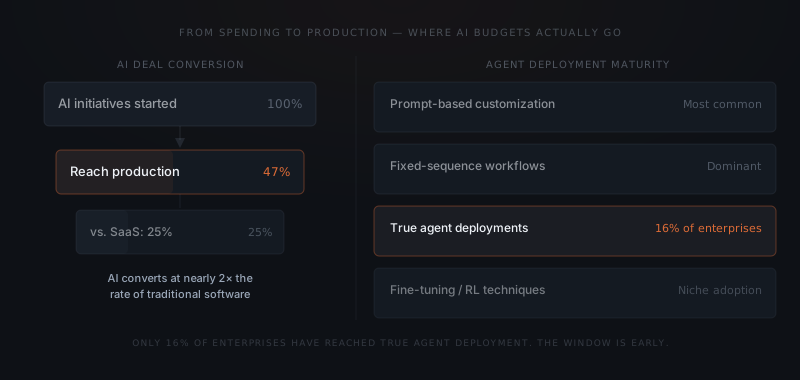
AI deployments reach production at 47% — nearly twice the 25% conversion rate of traditional SaaS implementations, according to Menlo Ventures.[³] The higher rate reflects AI's adaptability. Businesses configure the AI to their workflow — not the other way around.
But the production conversion data does not tell the whole deployment picture.
Within the organizations that have reached production, most deployments are fixed-sequence workflows or prompt-based customization rather than true agent systems. True agent deployments — where the system takes multi-step autonomous actions across tools — exist in only 16% of enterprises.[³] Startups are ahead: 27% of startups have reached true agent deployment versus 16% of enterprises.
The production deployment gap is the most strategically significant number in the 2025 spending data. $37 billion in enterprise GenAI spending, and only 16% of enterprises have deployed agents in production. The investment is flowing. The operational deployment is early.
Enterprise GenAI spend grew 3.2x in a single year. The floor is rising, not the ceiling.
The product-led growth dynamic amplifies the adoption picture. Menlo Ventures found that 27% of AI application spend occurs through product-led growth — individuals adopting tools without centralized IT procurement. That is 4x the rate of traditional software.[³] Shadow adoption — AI tools in use that IT has not inventoried — may represent 40% of total enterprise AI usage. The reported figures likely undercount actual deployment.
What does the spending curve mean for a business deciding now?
The $1.5 trillion headline and the $37 billion production figure tell a specific story about timing.
Infrastructure investment is accelerating and costs are dropping simultaneously. Foundation model API costs fell 10x between 2023 and 2024. The per-unit cost of running AI workflows continues to fall as model providers compete on price. This dynamic — high and rising investment, falling per-unit cost — characterizes a technology moving from early adoption to mainstream.
For a service business evaluating whether to implement AI agents now or in 12 months, the data suggests a few things — with the caveat that the production-conversion and agent-deployment figures above come from Menlo Ventures' survey of 495 US enterprise decision-makers, not from a small-business sample. The direction of the trend (rising investment, falling per-unit cost, early-stage agent adoption even among well-resourced enterprises) is the transferable signal; the specific percentages are not a benchmark to hit. The cost of waiting is not standing still. Other firms in the same market are implementing. Only 16% of enterprises have true agents deployed. That gap will close. That gap will close. The businesses that build now are accumulating institutional knowledge — what works, where the edge cases are, how to extend the system. That knowledge is not transferable from watching the market.
The ROI window for early implementation concentrates in the next 12–18 months, when agent deployment is still differentiated. See AI agent ROI statistics for the research on what businesses are actually measuring from production deployments.
For a practical first step, see what is an AI agent for a grounded overview of what these systems actually do before evaluating whether the investment timing makes sense for your business.
Frequently asked questions
How much is spent on AI globally in 2026? Gartner's 2026 forecast puts worldwide AI spending at $2.59 trillion — a 47% jump year over year, representing roughly 41% of all IT spending. Spending on AI models and agents specifically reached about $32.6 billion, more than double the $15.5 billion spent in 2025. Enterprise GenAI applications in production stood at $37 billion (Menlo Ventures) — the operational layer businesses actually run, distinct from the full infrastructure buildout.
What percentage of AI spending reaches production? AI deployments convert to production at 47%, nearly twice the 25% rate for traditional SaaS. However, only 16% of enterprises have reached true agent deployments. Most production AI use is prompt-based customization or fixed-sequence workflows. The conversion advantage is real; the agent deployment gap is also real.
How is enterprise AI spending allocated? Enterprise GenAI spending of $37 billion splits roughly evenly between applications (51%, $19 billion) and infrastructure (49%, $18 billion). Within infrastructure, foundation model API access dominates at $12.5 billion. Within applications, horizontal AI at $8.4 billion and coding tools at $4 billion are the largest categories.
Which AI models have the largest enterprise market share? Anthropic holds 40% of enterprise GenAI market share in 2025 — up from 24% in 2024. OpenAI holds 27% (down from 50% in 2023). Google holds 21% (up from 7% in 2023). In coding specifically, Anthropic's enterprise share reaches 54%. The market shifted substantially from OpenAI dominance to a multi-model environment within 18 months.
Notes
- Gartner. (May 2026). "Gartner Forecasts Worldwide AI Spending to Grow 47% in 2026." Gartner Newsroom. https://www.gartner.com/en/newsroom/press-releases/2026-05-19-gartner-forecasts-worldwide-ai-spending-to-grow-47-percent-in-2026 — source for: $2.59 trillion worldwide AI spending forecast for 2026, 47% year-over-year growth, ~41% share of total IT spending, and $32.6 billion AI models and agents spending (up from $15.5 billion in 2025).
- Gartner. (January 2025). "Gartner Forecasts Worldwide GenAI Spending to Reach $644 Billion in 2025." Gartner Newsroom. https://www.gartner.com/en/newsroom/press-releases/2025-01-22-gartner-forecasts-worldwide-genai-spending-to-reach-644-billion-in-2025 — source for: $644 billion worldwide generative AI software and services spending forecast for 2025.
- Menlo Ventures. (2025). "2025: The State of Generative AI in the Enterprise." Menlo Ventures. https://menlovc.com/perspective/2025-the-state-of-generative-ai-in-the-enterprise/ — source for: $37 billion enterprise GenAI spending (up 3.2x from $11.5 billion in 2024); applications/infrastructure split; departmental AI breakdowns; foundation model API spending ($12.5 billion); model market share (Anthropic 40%, OpenAI 27%, Google 21%); 76% buy vs. build (up from 53%); 47% AI conversion to production vs. 25% SaaS; 16% true agent deployments in enterprises; 27% PLG share; shadow adoption estimate. Based on a survey of 495 US enterprise AI decision-makers (C-suite, VPs of engineering/product, technical leads) fielded November 2025 — a US-only, large-organization sample. "Enterprise" throughout this post refers to that population, not small or mid-sized businesses; the production-conversion and agent-deployment rates below should not be assumed to transfer directly to a 5–50 person service firm.