
An AI agent and a virtual assistant fail at opposite things. The agent fails at judgment. The VA fails at repetition. Most businesses do not need to choose between them — they need to sort their task list. Assign structured, high-volume tasks to the agent and judgment-dependent, variable tasks to the VA. The cost of replacing the wrong category is higher than keeping both.
The first question is never "agent or VA?" The first question is "which tasks?" A founder who replaces their VA with an AI agent for client relationship management discovers the problem around week three — when the agent sends a templated check-in to a client who just sent a difficult email. The agent did not fail. It did exactly what it was told. The task was wrong. Getting the task category right before replacing anything saves both the budget and the relationship.
What does an AI agent handle that a VA cannot?
An AI agent handles volume and consistency better than any human. Three types of tasks fall into this category.
High-frequency structured tasks — CRM data entry, application intake logging, form submissions, status field updates. Every instance follows the same input pattern and produces the same output format. A VA does this work accurately but slowly. An agent does it at any volume, at any hour, without fatigue.
Trigger-based responses — Tasks where the right action is determined by a defined condition: when a form submits, parse the fields; when an invoice is overdue, draft the reminder; when a new contact is added, create the outreach sequence. An agent watches for the trigger and acts within seconds, regardless of timezone or time of day.
Parallel output generation — Drafting fifteen personalised follow-ups from a CRM list, generating weekly status reports across eight clients, formatting data into a consistent structure. An agent processes these in parallel. A VA processes them sequentially, one at a time.
These three task types work when the input pattern is consistent and the output format is defined. The moment a task requires reading something not in the input — context, relationship history, emotional tone — output quality drops.
What does a VA handle that an AI agent cannot?
A virtual assistant handles judgment calls — situations where the right action depends on context the agent cannot access.
The clearest example is relationship management. A longtime client sends a short, clipped reply to a proposal. A VA recognises the tone shift, reads the subtext, and flags it before the next touchpoint. An agent sends the scheduled follow-up two days later, on template, as if nothing changed.
An AI agent follows its instructions regardless of surrounding context. It does not notice that a client's tone changed, a deal shifted status, or a relationship needs careful handling. Those signals belong to the VA.
A VA also handles novel situations — the client request that falls outside every defined category, the escalation that requires a call rather than an email, the scheduling conflict that needs negotiation. These tasks share one trait: no template works, because the situation is different every time.
Where does the task split fall in a service business?
McKinsey Global Institute estimates that 60–70% of time knowledge workers spend on activities such as data collection, scheduling, and routine communication has the technical potential to be automated.[¹] In a service business with a VA, a meaningful portion of the VA's week lives in that automatable category.
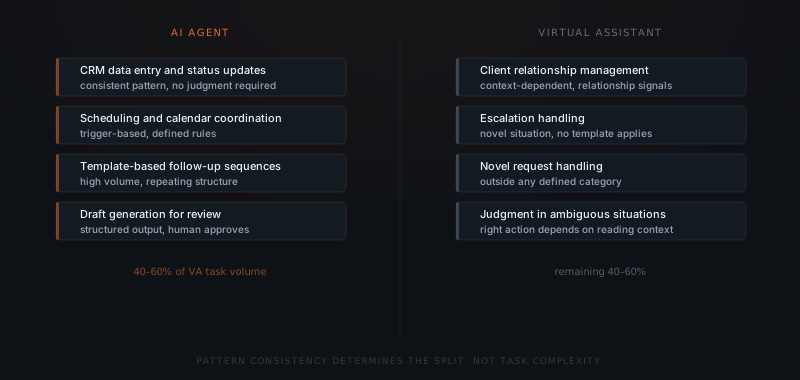
The practical split looks like this:
| Task | Agent | VA |
|---|---|---|
| CRM data entry and status updates | ✓ | |
| Scheduling and calendar coordination | ✓ | |
| Template-based follow-up sequences | ✓ | |
| Draft generation for approval | ✓ | |
| Responding to unusual or escalated requests | ✓ | |
| Client relationship management | ✓ | |
| Novel task handling | ✓ | |
| Judgment calls in ambiguous situations | ✓ |
Most service businesses with a part-time VA find that 40–60% of the VA's current tasks fall in the agent column. The VA's remaining time shifts toward the judgment-dependent work the agent cannot touch — which is often the work the VA was best suited for but had no time to do. For a related framing on when a hire fits better than an agent, see AI agent vs. hire.
Task coverage in detail: input consistency, judgment level, and failure risk
The simple agent/VA split table above identifies who handles what. The table below shows why — the underlying characteristics that determine which tool is right and what breaks if the assignment is wrong.
| Task type | Input consistency | Judgment required | Right tool | Risk if assigned wrong |
|---|---|---|---|---|
| CRM data entry and status updates | High — same fields every time | None — rule-based | Agent | Low — data errors are visible and correctable |
| Template-based follow-up sequences | High — defined triggers | None | Agent | Low |
| Scheduling (standard, single-party) | High | None | Agent | Low — booking errors surface immediately |
| Draft generation (with approval gate) | Medium — varies by client | Low — human reviews output | Agent | Low — approval layer catches contextual errors |
| Scheduling (multi-party, negotiated) | Low — depends on preferences | Medium | VA | Medium — missed preference signals cause friction |
| Client status communications | Medium format, variable tone | Medium-high — tone varies by relationship | VA or agent with approval | High — tone errors damage relationships silently |
| Escalation handling | Low — every case is different | High | VA | Critical — wrong response escalates the problem |
| Client relationship management | Low | Very high | VA | Critical — agent produces technically correct, relationally wrong output |
| Novel task handling | None — one-off situations | High | VA | Critical — agent cannot adapt to inputs outside its brief |
The pattern across all nine rows: when input consistency is high and judgment is low, the agent handles it reliably. When input varies and judgment is required, the VA handles it reliably. The failure cases in the middle — scheduling with preferences, status emails with emotional context — are where most businesses make the wrong assignment.
What is the most common mistake when replacing a VA with an AI agent?
The most common mistake is replacing the wrong task category — assigning judgment-dependent tasks to an agent because they look like structured tasks from the outside.
Client status emails look like templated tasks. They follow a format. They go out on a schedule. An agent can handle them. But client status emails carry relationship signals the agent cannot read. A client who is frustrated will read a templated status update as a signal that nobody is paying attention. The message is technically correct and contextually wrong.
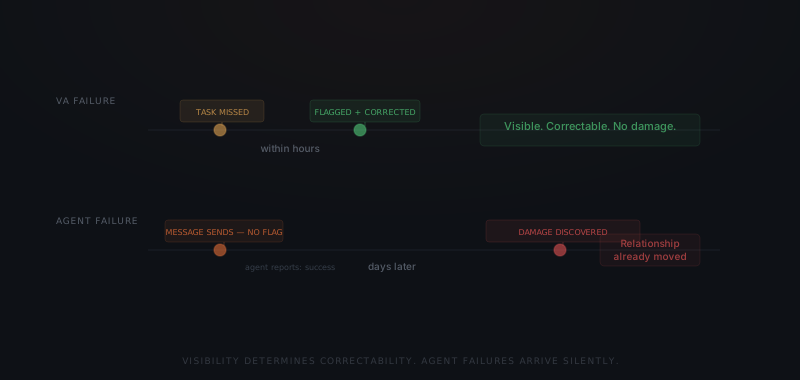
The agent fails silently. The VA fails visibly. That difference determines which tasks you can hand off.
The VA's visible failures — the late reply, the missed scheduling update — are easy to spot and correct. The agent's failures — the tone-deaf follow-up, the check-in sent after a difficult conversation — often go unnoticed until the relationship has already moved. For a framework on assessing which processes are ready to hand to an agent, see how to know if a business process is ready to hand to an AI agent.
Cost comparison: agent vs. VA on the tasks they share
The cost case for running both is straightforward once the task split is defined.
| Cost element | AI agent (structured tasks) | Virtual assistant (judgment tasks) |
|---|---|---|
| Setup cost | $2,000–$5,000 (one-time) | $0 — time to onboard and brief |
| Monthly operating cost | $10–$50 (API usage) | $1,500–$3,000 (part-time, 20 hrs/week) |
| Scales with volume | Minimally — API cost rises slightly | Linearly — more hours required |
| Structured tasks (40–60% of typical VA load) | Handles at any volume | Costs $600–$1,200/month of VA hours |
| Judgment-dependent tasks | Cannot handle reliably | Handles well |
With an agent covering 40–60% of the structured task volume, the business pays $10–$50/month for work that previously consumed $600–$1,200 of the VA's time. The VA's hours consolidate around the judgment work — which is typically the higher-value work the VA was best suited for but had too little time to do.
Year 1 cost for the agent on a standard service business structured workflow: $2,100–$5,300 (setup + first year API). Year 2+: $120–$600/year. The VA cost stays the same or decreases as the structured load moves off their plate.
The total system — agent handling volume, VA handling judgment — typically costs less than a full-time VA handling everything, and produces better output on both sides: the agent is more consistent on structured tasks than a human doing them under time pressure, and the VA is more attentive on judgment tasks when routine volume is no longer competing for their attention.
When to use each — a decision framework
The scenario below replaces the "agent or VA?" question with a structured starting point.
| Scenario | Use first | Reason |
|---|---|---|
| VA spending more than 40% of hours on templated, structured work | Agent | Frees VA hours for the judgment layer they are actually suited for |
| Volume of structured tasks growing faster than VA can absorb | Agent | Agent cost is nearly flat at high volume; VA cost scales linearly |
| No VA, primary need is relationship management and escalations | VA | The judgment layer is more critical than the structured layer at this stage |
| No VA, primary need is data entry and follow-up volume | Agent | Structured work does not require human judgment |
| VA handles retention-critical client accounts | Keep VA, add agent for structured tasks | VA focus on retention; agent covers volume |
| Business scaling quickly and adding clients monthly | Both, sequenced | Agent covers intake volume; VA handles the judgment layer in onboarding |
Running both is the most common outcome. The agent is not a replacement for the VA — it is the layer that removes structured volume from the VA's week. Most service businesses with a VA discover that adding an agent does not reduce the VA's hours but redirects them toward work that is harder to replace and more valuable to retain.
The right starting point is a task audit: list the VA's current weekly activities, classify each by input consistency and judgment requirement, and identify the structured 40–60% the agent can absorb. That list defines the first agent scope — not "build an agent," but "build an agent to handle these twelve tasks."
The same input-consistency test applies when the alternative under consideration is a no-code automation tool rather than a person — see AI agent vs. automation.
Frequently asked questions
What is the difference between an AI agent and a virtual assistant? An AI agent handles structured, high-volume tasks that follow a consistent input pattern — data entry, scheduling, draft generation, triggered responses. A virtual assistant handles variable, judgment-dependent tasks — relationship management, novel requests, escalations, and situations where the right action depends on context the agent cannot read. Both can operate in the same business on different task categories.
Can an AI agent fully replace a virtual assistant? For structured, templated, high-volume tasks — yes. For tasks that require reading context, managing relationships, or handling novel situations — no. Most businesses find that an AI agent replaces 40–60% of the VA's task volume, and the VA's remaining time shifts to judgment work the agent cannot do.
What types of tasks should never go to an AI agent? Tasks where the right action depends on context not captured in the structured input: client relationship management, escalation handling, communication that requires reading emotional tone, and novel requests outside any defined template. These tasks require judgment an agent does not have.
What happens when an AI agent is given tasks it cannot handle? The agent produces output that is technically correct but contextually wrong — a templated follow-up after a difficult conversation, a status update that misses the subtext of a frustrated client. The agent reports success. The problem surfaces later as relationship damage rather than a visible error.
Notes
- McKinsey Global Institute, "The economic potential of generative AI," McKinsey & Company, June 2023. https://www.mckinsey.com/capabilities/mckinsey-digital/our-insights/the-economic-potential-of-generative-ai-the-next-productivity-frontier