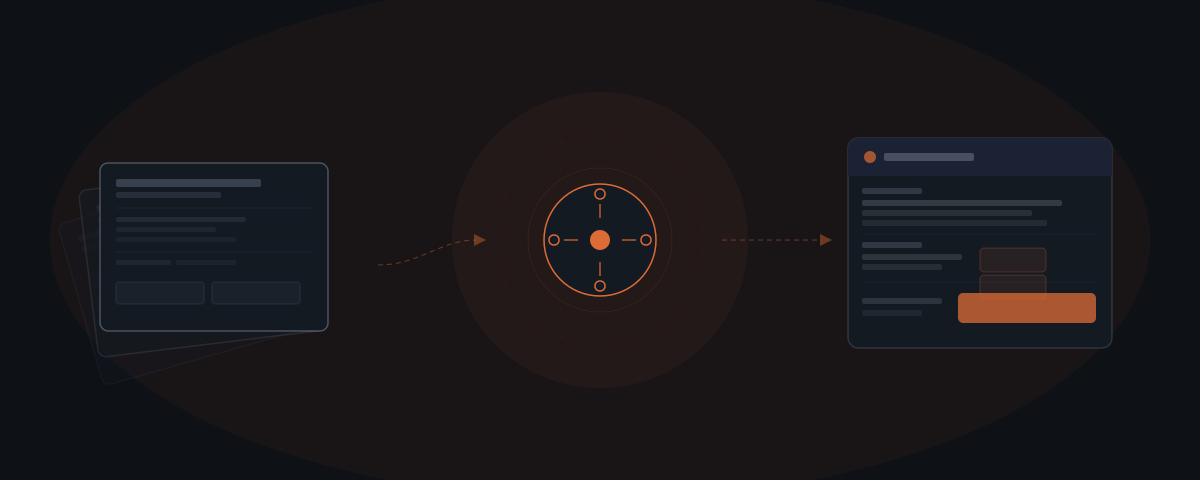
An AI agent for proposals assembles structured drafts from past work, client context, and your service catalogue — cutting hours of blank-page composition down to focused review. Professional services proposals follow the same structure every engagement. The variable layer is thin: client name, specific scope, pricing, and relationship framing. The agent handles the scaffold. Founders handle what changes.
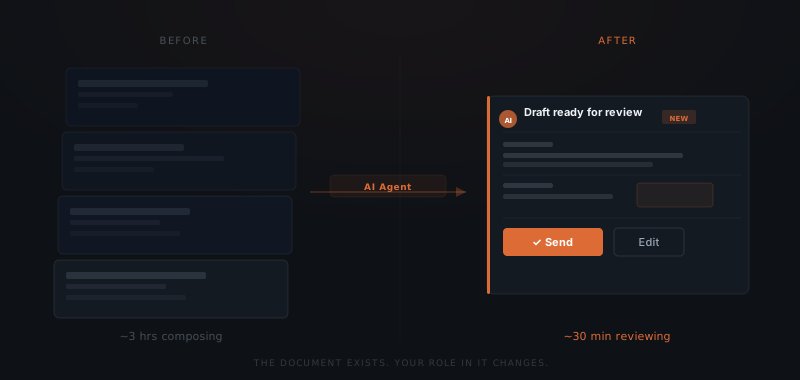
A prospect asks for a proposal after a good call on Wednesday. You block out Thursday afternoon. You open a past proposal, strip the client name, rewrite the scope section, rebuild the pricing table, adjust the timeline, and reformat the deliverables list. Two hours and forty minutes later, the document is ready. That block could have been a client call or a billable afternoon. An AI agent assembles the proposal from your past work and client data and puts a near-complete draft in your review queue. You adjust the pricing, refine the scope, and send.
Most proposals reuse the same components
A six-person agency handling 30–40 pitches per year uses the same proposal skeleton every time: executive summary, scope of work, deliverables, timeline, team overview, pricing, and terms. The structure does not change between clients. The variable inputs are the client name, the specific scope, the pricing tier, and the relationship context.
HubSpot's annual State of Sales research found that sales representatives spend only 34% of their working time on actual selling.[¹] The remaining 66% goes to administrative work, research, and preparation — including proposal creation. For founders handling their own business development, no dedicated sales team means no one to offload the preparation layer.
Loopio's 2023 RFP and Proposal Trends report found that teams spend an average of 23 hours on each major proposal response.[²] A significant portion of that time goes to locating and adapting content from past proposals — identifying which scope language fits this engagement, which deliverable descriptions apply, which pricing structure is closest. An AI agent retrieves and assembles this automatically when a new pitch is initiated.
The problem is not that founders write proposals slowly. The problem is that the assembly work — locating the right content from past work, structuring it for a new client, filling the standard sections — is time-consuming and does not require the judgment that makes a founder valuable.
Proposal types and what the agent handles differently
The assembly complexity varies significantly by proposal type. Retainer and advisory engagements have near-identical structures every time — the agent pulls from past work with minimal adjustment. RFP responses require matching the requester's format exactly, which raises assembly complexity significantly.
| Proposal type | Structure it follows | Key variable inputs | Assembly complexity |
|---|---|---|---|
| Retainer engagement | Scope of work, monthly deliverables, pricing tiers, terms | Scope package selected, monthly rate, client-specific terms | Low — structure nearly identical each time |
| Fixed-scope project | Scope of work, milestones, deliverables, timeline, pricing | Scope specifics, milestone structure, project budget | Medium — milestone structure varies by project type |
| Audit or discovery | Engagement objectives, methodology, deliverables, report format | Audit scope, company context, delivery timeline | Low — methodology section is reused heavily |
| Advisory | Scope summary, meeting cadence, output types, pricing | Frequency, engagement model, advisory scope definition | Low |
| RFP response | Must comply with the RFP's required sections and format | All sections must match the RFP's specific requirements | High — agent can pre-fill but founder must validate compliance |
For retainer and audit proposals — which represent the majority of professional services pitches — the agent handles 80–90% of the assembly with no structural variation. For RFP responses, the agent drafts against the RFP's structure but the founder must confirm compliance before the document goes out. Most firms start the agent on retainer and project proposals and add RFP handling once the base library is structured and tagged reliably.
What an AI agent assembles in a proposal draft
An AI agent in a proposal workflow — for the broader concept, see what an AI agent is — does not write the proposal from a blank page. The agent assembles it from material that already exists in the firm's library.
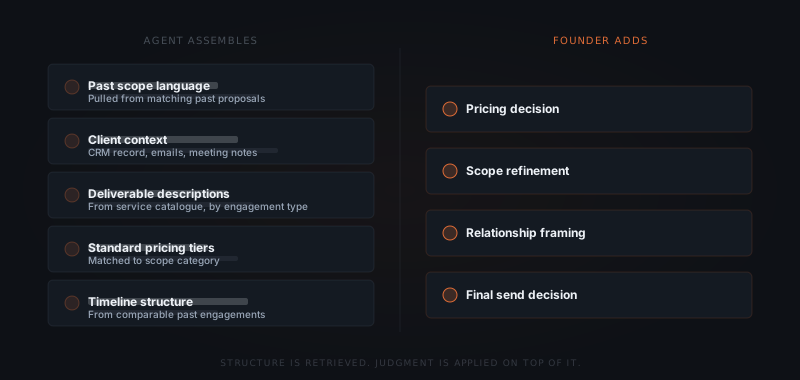
Past proposal content. The agent pulls relevant sections from completed proposals tagged by engagement type. Scope language that matches this category of project, deliverable descriptions the team has used before, timeline structures for projects of similar size. The agent selects the closest match, not a generic template.
Client context. The agent reads the CRM record, recent emails, and meeting notes connected to this prospect. The industry, company size, stated problems, and prior conversation threads inform how the scope language is framed. A professional services firm and a software company read a different version of the same scope section.
Service catalogue inputs. The agent references the firm's current service offerings, standard deliverable definitions, and pricing tiers. The deliverables and pricing sections populate with the closest matching options.
The output is a structured draft: a near-complete proposal with filled sections, appropriate framing, and relevant pricing. Founders receive a document that is 80–90% complete, not a blank page.
Proposify data shows that proposals sent within 24 hours of a sales conversation close at a 35% higher rate than proposals sent after 48 hours.[³] An agent removes the assembly block that makes same-day turnaround impractical for founders managing client work simultaneously.
What the founder still owns: pricing, scope, and the relationship read
The agent assembles the structure from your past work. Pricing decisions, scope adjustments, and relationship framing belong to the founder — the agent never overrides them.
Pricing decisions. An AI agent populates standard pricing tiers from the service catalogue. The agent cannot decide whether to discount for a strategic client, offer a phased engagement to reduce friction, or adjust scope to fit an unspoken budget constraint. These are commercial decisions that require knowing the relationship, the opportunity, and the business context of this specific pitch.
Scope refinement. The scope section in a proposal reflects an ongoing conversation. The agent pulls the closest matching scope language from past work. The founder adjusts it based on what the client said in the last call — what they care about most, what they pushed back on, what is unstated but implied by the context. That adjustment takes ten minutes. Composing it from a blank page takes forty-five.
The relationship read. A proposal sent to a first-time prospect reads differently from one sent to a client renewing for the second year. The agent does not have that context. The founder does, and the tone of the proposal reflects it.
For the broader framework on which workflows are ready to hand to an agent, see how to know if a business process is ready to hand to an AI agent.
The clearest way to frame the boundary is by output type: if the output can be retrieved from existing materials and structured into a known format, the agent handles it. If the output requires knowing something that is not in the data — the unstated budget, the competitive context, the client's actual priority — the founder handles it.
| Task | Agent | Founder |
|---|---|---|
| Retrieve matching scope language from past proposals | ✓ | |
| Pull deliverable descriptions by engagement type | ✓ | |
| Populate standard pricing tiers from service catalogue | ✓ | |
| Structure timeline from similar past projects | ✓ | |
| Adapt framing based on CRM industry and company size | ✓ | |
| Decide whether to discount for a strategic account | ✓ | |
| Adjust scope based on unstated client priorities | ✓ | |
| Protect against scope items that created problems previously | ✓ | |
| Calibrate tone for a cold prospect vs. a returning client | ✓ | |
| Make the final send decision | ✓ |
Five things the agent cannot do regardless of how it is configured, and why each requires the founder: decide whether a discount is warranted for this specific client; read unstated priorities from the last call; know which past scope items caused delivery problems; determine whether the proposal should lead with price, experience, or process based on the competitive situation; and judge whether the relationship context changes what needs to be said in the opening paragraph. All five require knowing something about this specific engagement that does not exist in any structured data source.
How to configure a proposal workflow for an agent
Setting up a proposal agent starts with the content it will pull from, not the tools it runs on.
Audit and tag past proposals
Collect completed proposals and label each by engagement type: retainer, project, audit, advisory. The agent retrieves by type. Proposals without labels cannot be matched reliably.
Define the variable inputs
List what changes per proposal: client name and company, scope category, pricing tier, and relationship context. Everything not on this list is structural and can be assembled by the agent.
Connect the data sources
The agent needs access to the proposal library, the CRM record for the prospect, and the service catalogue. Email threads from the prospect conversation improve framing accuracy. Most firms have all three — they are not yet structured for retrieval.
Set the assembly trigger
Define what initiates the draft: a stage change in the CRM, an email containing a proposal request, or a manual trigger from the founder. The agent assembles on trigger and routes the draft to the review queue.
Proposals feel bespoke. The structure never is.
Integrations a proposal agent connects to
The agent needs read access to three data sources — past proposals, CRM records, and the service catalogue — and write access to wherever the draft lands for review.
| Platform | Role in the workflow | Access required |
|---|---|---|
| Google Drive / Notion | Past proposal library — source material for scope, deliverables, and timeline sections | Read — agent retrieves tagged documents by engagement type |
| HubSpot / Salesforce / Pipedrive | Prospect CRM record — industry, company size, conversation history for framing context | Read — agent pulls context fields, does not write to CRM |
| Gmail / Outlook | Recent email thread — latest conversation for framing accuracy and scope context | Read — agent reads prospect threads; does not have access to full inbox |
| Proposify / PandaDoc | Proposal output — renders the assembled draft for review and tracking | Write — agent creates draft in the proposal tool |
| Airtable / Google Sheets | Service catalogue — current deliverable definitions and standard pricing tiers | Read — agent pulls offering definitions and pricing structures |
| DocuSign / HelloSign | Signature and send workflow once the proposal is approved | Connected post-approval — not part of the assembly step |
| Slack | Review queue notification — founder alerted when draft is ready for review | Webhook — notification only |
The minimum viable integration is proposal library + CRM + service catalogue. Together they provide the content (past proposals), the context (CRM record), and the current offering definitions (catalogue). Email integration improves framing accuracy but is optional in the first implementation. Proposify or PandaDoc integration makes the review experience cleaner and provides open/read tracking after the proposal is sent — useful for knowing when to initiate the follow-up conversation.
For the sequencing framework — which workflows to automate first — see which workflows to automate first. For how an agent handles the scheduling coordination that precedes a proposal call, see AI agents for scheduling.
Frequently asked questions
What does an AI agent do in proposal writing? An AI agent for proposal writing assembles structured drafts from past proposals, CRM data, and a firm's service catalogue. When a new pitch is requested, the agent pulls relevant scope language, deliverable descriptions, and pricing tiers, and generates a near-complete draft for founder review. Pricing strategy, scope decisions, and relationship framing remain with the founder.
How long does proposal writing take with an AI agent? With an agent handling the assembly layer, founder time per proposal drops from 3–5 hours of composing to 30–45 minutes of reviewing and adjusting. The agent does not eliminate proposal work — it eliminates the blank-page drafting and content retrieval that precedes the judgment layer.
What does the agent need to generate a proposal draft? The agent needs access to past proposals tagged by engagement type, the CRM record for the prospect, and the firm's current service catalogue. Integration with the email thread for that prospect improves framing accuracy. Most professional services firms have all three — the missing piece is structure and tagging, not data.
Can an AI agent handle proposal pricing? An AI agent populates standard pricing tiers from the service catalogue. The agent cannot make pricing decisions — whether to discount, offer a phased structure, or adjust scope to match a budget constraint. Pricing in a proposal is a commercial judgment that requires knowing the opportunity, the relationship, and the business context of the specific pitch.