OpenClaw and Hermes are both AI agent tools for founder-led service businesses — but they solve different problems. OpenClaw holds every outbound message in an approval queue until a named person releases it. Hermes coordinates multi-step workflows autonomously across 20+ platforms. Most businesses need one before the other, and the choice depends on which workflow failure is costing the most right now.

A proposal that needed to go out Thursday sits unsent on Monday. A candidate confirmed an interview slot, but nobody created the calendar invite. Both are agent problems — but they require different agents. Picking the wrong starting point, or starting both at once, is how implementations stall in month one before producing anything. OpenClaw and Hermes solve different problems on different timelines, and the right sequence starts with your most expensive workflow failure.

OpenClaw vs. Hermes: side-by-side

The two tools sit at different points in an agent system. Neither replaces the other.

OpenClawHermes
What it controlsOutbound communicationMulti-step internal workflows
Approval modelEvery outbound action gatedAutonomous — human notified at completion
Platform coverage23 messaging platforms20+ platforms
Self-hostingYesYes
Skill buildingNoYes — improves from experience
Best forClient-facing communication oversightSequential cross-platform coordination
Setup time1–2 weeks2–4 weeks
Year 1 cost$2,400–9,000$4,000–11,000
MaintenanceLow — prompt + integration driftMedium — skill refinement + integration drift

The cost difference reflects setup complexity. OpenClaw's first workflow is narrower to scope — one communication channel, one approval model. Hermes requires mapping a multi-step workflow across several connected platforms before the first deployment.

What is the difference between OpenClaw and Hermes?

OpenClaw is a messaging gateway with a human approval layer built in. Hermes is an autonomous agent coordinator built by Nous Research. Both are tools for implementing AI agent systems in founder-led businesses — but they solve different problems at different points in an implementation.

OpenClaw sits in front of outbound communication. Every email, follow-up, and client-facing report the agent drafts goes into a review queue before it sends. A named person approves or dismisses each item. Nothing reaches a client without that sign-off. OpenClaw handles drafting volume while the founder keeps control of what actually goes out.

Hermes coordinates what happens across systems. A recruiting intake form arrives — Hermes parses it, creates a candidate record in Notion, schedules a screening call in Google Calendar, drafts a confirmation email, and logs the status in Slack, without a human initiating each step. Hermes builds skills from completed tasks and applies them to future similar tasks, improving accuracy the longer it operates.

The distinction is not about which tool is more capable. It is about what kind of control problem each one solves.

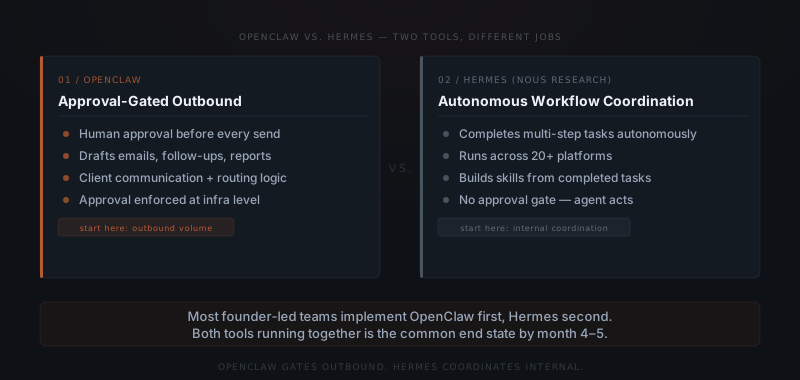
Side-by-side comparison of OpenClaw and Hermes: OpenClaw shown as approval-gated outbound with human approval before every send, Hermes shown as autonomous multi-step workflow coordination across 20+ platforms
OpenClaw and Hermes are not competing tools — they operate at different points in the same implementation.

What does OpenClaw handle that Hermes doesn't?

OpenClaw handles outbound communication with an enforced approval layer. The agent drafts — OpenClaw holds. Every message, report, or client-facing document waits in a review queue until a named person releases it. That approval is enforced at the infrastructure level, not a setting the agent can override.

For client-facing businesses — agencies, consultancies, and recruiting firms — this matters. A six-person agency sending status updates, proposals, and follow-ups across eight clients generates dozens of outbound messages a week. The drafting time is real. The error risk — wrong information sent to the wrong client — is higher than in internal workflows. OpenClaw takes over the drafting without removing the human who catches errors before they send.

OpenClaw also handles routing logic: when a lead emails, OpenClaw categorises the inquiry by type, routes it to the right queue, and flags anything outside the defined parameters. For businesses managing high outbound volume across multiple clients, OpenClaw is the right first workflow to automate.

What OpenClaw does not do: coordinate sequential steps across systems. If a workflow requires parsing a form, creating records, scheduling a call, and sending a confirmation in a defined order — that is Hermes work.

What does Hermes handle that OpenClaw doesn't?

Hermes is an autonomous agent built by Nous Research. Hermes coordinates multi-step workflows across Slack, Notion, Google Calendar, HubSpot, and 20+ other platforms without requiring human input at each step. Hermes creates skills from completed tasks and applies them to future similar tasks, so accuracy improves as the agent accumulates experience in a business's specific workflows.

A consultant running a standardised client onboarding process — intake form received, contract sent, onboarding questionnaire triggered, kickoff call scheduled — is describing a Hermes workflow. Each step depends on the last. Data moves across platforms. Hermes handles the full sequence end-to-end.

What Hermes does not do: enforce an approval gate before outbound communication. Hermes acts. For workflows where the agent's output is internal — creating records, updating systems, scheduling — that is the right model. For workflows where the output reaches a client or external contact, the absence of an approval layer is a risk that OpenClaw is built to address.

Which tool does a founder-led business need first?

The decision follows one question: what is the most expensive workflow problem right now? Use the table below to locate the answer.

Workflow problemStarting toolWhy
Follow-ups not sent, proposals going out lateOpenClawOutbound communication volume is the bottleneck
Client reports taking 3+ hours to assembleOpenClawHigh-volume drafting with approval layer
Onboarding sequences missing stepsHermesMulti-step coordination across systems
Intake-to-delivery pipeline has missed handoffsHermesSequential cross-platform workflow
Both outbound and internal workflows are failing equallyOpenClaw firstApproval workflows are faster to scope and produce visible results in week one

The default recommendation — OpenClaw first — holds for most founder-led service businesses. The reasoning: client-facing errors are more costly than internal coordination gaps, the approval layer builds operational trust in agent outputs, and the shorter feedback loop (you see every draft) means calibration happens faster.

The exception is a business where internal coordination is genuinely the bigger problem. A 12-person HR consultancy running 40 concurrent client engagements, where onboarding breakdowns cost more than delayed follow-ups, should start with Hermes.

The decision follows one question: what is the most expensive workflow problem right now?

If the answer is outbound communication volume — follow-ups that don't happen, proposals that go out late, reports that take an hour to assemble — OpenClaw is the right starting point. OpenClaw takes over the drafting load while the founder keeps sign-off on what sends. The benefit appears in week one and the risk is contained by the approval layer.

If the answer is multi-step internal workflow coordination — onboarding sequences, intake-to-delivery pipelines, cross-platform data routing — Hermes is the right starting point. The workflow runs end-to-end. The founder is notified at completion, not involved at each step.

Most founder-led service businesses start with OpenClaw. Client communication is the highest-volume, highest-risk workflow. Getting that right first builds the operational trust needed before running autonomous internal workflows.

OpenClaw controls what goes out. Hermes controls what gets done.

Both tools can run in the same business. Most founder-led teams reach that configuration by month four or five — OpenClaw managing client communication, Hermes coordinating onboarding and internal reporting. For a realistic picture of what implementation looks like in practice, see what a real AI agent implementation involves.

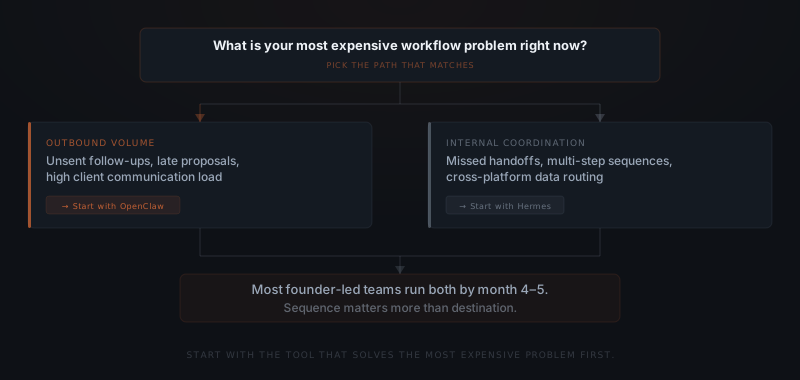
Decision flow diagram: starting question asks about most expensive workflow problem, left path leads to OpenClaw for outbound volume, right path leads to Hermes for internal coordination, both paths converge at running both tools by month 4-5
The starting point depends on the workflow — not the tool. Most teams end up with both.

Can OpenClaw and Hermes run in the same business?

Both tools can run simultaneously in the same business — but starting both at once is the most common way to stall an implementation before it produces results. The right sequence depends on which workflow problem is costing the most right now.

OpenClaw and Hermes complement each other. OpenClaw gates outbound communication. Hermes coordinates internal workflow sequences. A business running both operates at a level of throughput that neither tool delivers alone.

The path that works: implement one first, run it for four to six weeks, review outputs, calibrate the instructions, then add the second. Attempting both at once splits the owner's attention across two sets of instructions, two output review queues, and two calibration cycles — and neither tool gets the oversight it needs in the first month.

For a step-by-step picture of how the implementation sequencing works from kickoff to month six, see the AI agent implementation timeline.

Frequently asked questions

What is the main difference between OpenClaw and Hermes? OpenClaw is a messaging gateway that holds every outbound message until a human approves it. Hermes is an autonomous workflow coordinator that completes multi-step tasks across platforms without human input at each step. OpenClaw controls what an agent sends. Hermes controls what an agent does.

Can a small business use both OpenClaw and Hermes? Yes — and most businesses using both arrive there by month four or five, starting with one and adding the second after the first is calibrated and stable. Running both from day one splits the implementation owner's attention and delays results from either tool.

Which tool is easier to implement first? OpenClaw is the easier first implementation to scope because the workflow is well-defined: outbound communication with an approval layer. The output is visible, the feedback loop is fast, and the risk of sending something wrong is eliminated by the approval queue. Hermes requires a clearly mapped multi-step workflow before implementation begins.

What kind of business should start with Hermes instead of OpenClaw? A business where the most expensive workflow problem is internal coordination rather than outbound communication. If onboarding a new client requires five coordinated steps across three platforms and the failure point is a missed handoff — not an unsent email — Hermes addresses the root problem. For a guide to identifying which workflow to automate first, see which workflows to automate first.

What the first 90 days look like with each tool

Understanding the ramp period helps set realistic expectations before committing to a starting point.

With OpenClaw: Week one — configure the first messaging channel and run the approval queue. The agent drafts, you approve or reject. The feedback loop is immediate. By week three, the agent's draft quality on common message types is high enough to approve with minimal edits. By week six, the time saving per week is measurable. Drafting and approving 30 outbound messages takes 40 minutes instead of 3 hours.

With Hermes: Week one — map the multi-step workflow and connect integrations. The agent runs supervised on real inputs. Week three — prompt refinements from the first real-world inputs. Skill objects start forming. By week six, the agent handles common inputs end-to-end. By week ten, the skill library covers 70–80% of inputs in the workflow without manual refinement. The improvement curve is longer but the ceiling is higher — Hermes continues improving past the point where OpenClaw is static.

Running both after month four: The workload is manageable once the first tool is stable. OpenClaw's approval queue is an established habit. Hermes's first workflow runs autonomously. Adding the second tool does not restart the learning curve — it extends it into a second workflow type.

For how the full implementation timeline sequences from kickoff to month six, see AI agent implementation timeline.

Adding the second tool: what carries over and what needs to be rebuilt

The decision to add the second tool is not a calendar milestone. The signals that the first tool is ready are operational: the agent's draft quality on common scenarios is high enough to approve with minimal edits, the same correction does not appear twice in the same week, and the approval queue or output log runs without the owner checking it more than once a day. A business that reaches those signals at week six is ready earlier than one still making daily corrections at month four.

What adding the second tool actually involves is shorter than the first implementation — but not trivial. Founders who assume "half the work" often under-scope the second tool and stall it before it produces consistent output.

The table below covers the most common path: OpenClaw running first, Hermes added second.

ComponentStatus when adding Hermes after OpenClaw
Platform integrations (Slack, Google, Notion, HubSpot)Carry over — reconnect existing credentials, not rebuild connections from scratch
Business context and workflow documentationCarries over — reuse what was mapped during OpenClaw's implementation
Agent instructionsWritten fresh — Hermes's multi-step coordination logic differs from OpenClaw's drafting model
Output review habitsCarry over — the owner already knows how to read and correct agent outputs
Escalation triggersDefined fresh for Hermes's specific failure modes: missed handoffs, incomplete sequences, integration errors
Calibration period3–4 weeks — shorter than the first tool, because the owner already understands the feedback loop

The transition follows a fixed order. Skipping steps two or three is where most transitions stall.

Confirm the first tool is stable

Check for three signals: consistent output quality on common scenarios, no repeat corrections in the same week, and the approval queue or output log running without daily intervention. Do not add the second tool before all three are present — splitting the owner's attention before either tool is calibrated delays results from both.

Map the second tool's workflow scope

Identify the specific workflow Hermes will run: which trigger, which platforms, which output, which failure modes. The mapping should be as specific as the OpenClaw workflow was at kickoff. A vague scope at this stage produces a vague implementation.

Audit existing integrations

List every platform already connected for OpenClaw. Cross-reference with Hermes's required platforms for the mapped workflow. Reconnect what exists. Build only what is new. This step takes 30–60 minutes and avoids rebuilding connections that are already live.

Run supervised for the first two weeks

Apply the same approach as OpenClaw's kickoff: real inputs, owner reviews every output, corrections logged explicitly. Hermes builds skill objects from completed tasks — supervised runs in the first two weeks accelerate the calibration curve significantly.

Set escalation triggers for the second tool's failure modes

OpenClaw's escalation logic handles drafting errors and out-of-scope requests. Hermes's failure modes are different: missed handoff, incomplete multi-step sequence, integration timeout. Define the escalation trigger for each before the workflow runs unsupervised.

The most common mistake in the transition is adding the second tool before the first one has stabilised. An owner still correcting the same drafting error in week five of OpenClaw does not have the attention bandwidth to calibrate a Hermes workflow simultaneously. The second tool waits.

Notes

  1. Nous Research, Hermes — Autonomous AI Agent, Nous Research. https://nousresearch.com